Showing posts with label books. Show all posts

Saturday, January 3, 2026

Favorite Books: Shaping a Life with Agency


At the end of each year, I weigh which books stood out for me. I am often surprised by themes that connect them. 


A theme that occurred in much of what I’ve read is about women having agency over their own life, and the ability to live it without threat of sexual or physical violence. Several books explored this theme through a lens on the past when women had far less agency. Even then, some succeeded in exerting control over their own life either because they had a supportive spouse, or they functioned in a critical and respected role in the world of women. A community of women can be a powerful counterbalance to the lack of control that women often experienced in the wider world.


I am drawn to literature, which follows a woman throughout her life, revealing the evolution of the person. This has become a topic of interest to me as I am at that point in my life where I am able to look back and see my own evolution. I am interested in the shaping of a life through time.


Yet another theme which appears in many of the books that I read is the act of documenting one’s own life with words. As someone who has often done that, I am especially intrigued with that written record of one’s own history. It is not lost on me that I have sixteen years of blogs publicly documenting my own life path. On a more personal level, I found myself reviewing my own past letters and journals when I recently moved, valuing them for their view into my thoughts at a much earlier time, a bit of personal time travel.


I have written of how liminality, that place in between where transformation happens, and bringing what is hidden to the forefront, are subjects often reflected in my artwork. It occurs to me that these are also themes in the construction of a story.  Liminality is a core theme in many books as it captures the journey of a character through life challenges, often shaped by personal secrets. That is similarly true of many of the books that I recommend.


The Frozen River by Ariel Lawhon


The Frozen River, while fictionalized, is based on a true story of a midwife, Martha Ballard, who lived in the late 1700s in Maine along the Kennebec River. The river is a character within this story, presenting a theme of the river’s buried secrets revealed only upon its thawing.  The story presents a view of the community of that time and the rich interrelationships between its residents.


It was a time when women had little control of their life and lived in a world of physical and sexual threat. In this tale, our protagonist has a respected career as a midwife which afforded her a level of agency, even as she moved within a world where many women lacked that and were easy prey for unscrupulous men. 


She also was a keeper of secrets, aware of the often-hidden stories of the women in the community. We know her tale because she recorded it in a daily diary which became key evidence in a rape trial, a critical part of the story. That diary and its analysis can be found in yet another book, a non-fiction one, that served as source material for Lawhon. A Midwife’s Tale: The Life of Martha Ballard, Based on Her Diary 1785-1812 by Laurel Thatcher Ulrich, was a winner of the Pulitzer Prize. Excerpts of the diary are woven into The Frozen River.


The Correspondent by Virginia Evans 


The Correspondent has elements of each of the mentioned themes. I picked it up because the author Ann Patchett recommended it. It is a book written in letters directed to a variety of people. I wasn’t sure at first how that was going to work. Was it going to engage me? How does one fully develop a character through letters? I was surprised to realize that I had a through line to the essence of the letter writer; a view of her through the eyes of her many correspondents and her self reflections shared with those to whom she was close. Within the letters, I saw her personal evolution and honesty in coming to terms with the challenges she had struggled with in the course of her life.


Sybil Van Antwerp, our correspondent, was a woman who by all standards had agency over her life. She had a successful career as an attorney, married and divorced, had children and grandchildren. Most importantly she had a curiosity about the world and people. She preferred the handwritten word to the electronic and wrote each week to family and friends and especially authors of books she enjoyed, including of course Ann Patchett.  She also reached across generations, writing to a young boy, who ultimately came to live with her in his time of crisis. And she was feisty. She had an ongoing correspondence with a woman at the university who would no longer let her audit classes. She didn’t give up without a fight, ultimately winning what she sought and winning a friend in the bargain with her understanding of the person. But a life is more than an outline. Within it lies the painful disruptions of what we imagined our life to be, and our response to that reshaped future. It is within this story arc, that we begin to learn the fullness of a life as one responds and reshapes one’s understanding through time.


I've been told that an audio book for this story adds an additional dimension in capturing each character effectively through their voice.


Circes by Madelyn Miller


When I was a child I loved mythology. I think the idea of a god defined by a theme intrigued me and moments where they stepped into the world of humans were fraught with drama. The novel Circes is based on the story of a lesser goddess, some would say a witch, for she turned men into pigs when necessary. The story humanizes her, bringing us into her world where she doesn't quite fit in goddess circles. Exiled to an island where at first she is reliant on visitors to relieve her solitude, she soon discovers visitors can also pose a threat - hence the pigs. Witchcraft is her protection in a world where even goddesses are subject to threat. Along the way she offers her guidance to Odysseus and bears him a son, learns to weave with a loom gifted from Daedalus and chooses to be human rather than immortal. She hits my theme of agency and has a life path of many centuries through which to decide her course.


Night Watch by Jayne Anne Phillips

Night Watch, a Pulitzer Prize winning book, is a story of the aftermath of war, of both soldiers and the women and children they left behind, each trying to reshape their life after loss and disruption. It is a story of a mother and her child as a stranger  violently inserts himself into their lives as the head of their household. It is the mother's silence that ultimately frees her of his control as he tires of them, leaving them at a lunatic asylum which surprisingly proves to be a place of respite. Far ahead of its time, the asylum gives them an opportunity to regain control of their lives.


The Dictionary of Lost Words. By Pip Williams 

The Dictionary of Lost Words takes us to the creation of the Oxford English Dictionary as a team of scholars determines which words warrant inclusion. Through the eyes of a child playing under the table to the thoughtful woman she grows into, it explores the underlying idea that the language of women can be different from the language of men and easily dismissed if not recorded in writing. Hence Esme, the protagonist of this book, creates the Dictionary of Lost Words to preserve a world otherwise hidden from view.


Other recommendations: 

The River We Remember by William Kent Krueger - Another river theme! It too holds secrets. Prejudices and the threat to women underlie the story.

The Mighty Red by Louise Erdrich - a coming of age story, but also a story where the river plays a significant role related to secrets.

Show, Don't Tell by Curtis Sittenfeld, a collection of short stories that have an authenticity that resonated with me.

Saturday, January 25, 2025

Favorite Books: History and Human Experience


This blog post has become a bit of a tradition for me. This is the fifteenth year that I have written about the books that I especially enjoyed in the prior year of reading. I frequently go back to fondly remember the details of a particular book or when I read it. When I describe my reading, I usually look for the common themes and often they are quite clear. I am drawn to historical themes and several of these fall within that category, but perhaps the overriding theme is that of the human experience.  How do individuals respond to the challenges that life presents? What actions do they take, both in outward action, but also on an emotional level? Here are some of my favorites from the past year.


When Time Stopped by Ariana Neuman


Have you ever been to the Pinkas synagogue in Prague? There you will find the names of Holocaust victims written on the walls. When the author of this book first visited the synagogue, she was shocked to discover her father’s name. Where normally there would have been a death date, she saw only a question mark. This sets the stage for what is a book of discovery of what exactly that question mark embodied. Raised in a privileged family as a child in Venezuela, Ariana was the daughter of a man who had become a wealthy industrialist. And yet he harbored secrets. As a child, Ariana formed a detective club and was drawn to secrets, stumbling across clues about her father that everything was not as it appeared.  


It was only upon her father’s death that she was gifted a pile of clues from him from which she reconstructs the amazing story of his life during the Holocaust, living in the heart of Berlin under a forged identity. She learns of the Jewish grandparents she never knew and conjures them to life through her discoveries of their life in Prague and later in their letters exchanged with family while they were held in Terezin. A talented author and a dogged researcher, she has created a rich memoir and brings us along on the journey of her search. 


James by Percival Everett 


James is a retelling of Huckleberry Finn from the perspective of the runaway slave Jim, referred to as James in this telling, who is often a father figure to Huck.  Together, they travel down the Mississippi in flight. James because he learned he was to be sold away from his wife and child, while Huck is fleeing his drunk and abusive father. If there is a theme to this book, it is that things are not what they appear to be. Our first hint of the differences arises with an example of code switching that James teaches the children, or what he refers to as “correct, incorrect grammar.” It is the vernacular of “black-speak” designed to play to stereotypes, to hide in plain sight and preserve one’s safety.  He switches into perfect English when among other slaves. The few times he lets a white hear him speak in that manner, it strikes fear in the listener, shattering the world as they knew it. Appearance too does not always reveal race, a black man appears white and in one story James joins a band of white musicians and performs in a minstrel show in black face, made up to appear as if he is white. A thought-provoking book with an unusual framing.


Master Slave Husband Wife by Ilyon Woo


This is a story of both slavery and escape, a true story based on the lives of Ellen and William Craft. Each experienced separation from loved family members as the cruelty of slavery divided families with no consideration of family ties. It was from this experience that they resolved to escape, to remain together and create a family that could not be sundered. Ellen, the daughter of her mother’s master, appeared to be white and they cleverly played upon this by assigning her the role of a young master suffering from illness while her husband assumed the role of her personal slave and attendant. They had some unique obstacles. Ellen had never learned how to write her name, so they bandaged her hand to avoid situations where she would need to sign travel documents. As Ellen had served as a slave to her half-sister, she had opportunity to observe how young men of wealth carried themselves, useful information as she crossed both racial and gender lines. Upon their successful arrival in the North, they joined the antislavery lecture circuit. They soon had to contend with the Fugitive Slave Law of 1850 which could have resulted in them being sent back but evaded it and ultimately moved to Great Britain where William continued with the lecture circuit, and they raised a family. This is a dramatic story of escape and the people who became an important part of the anti-slavery efforts.


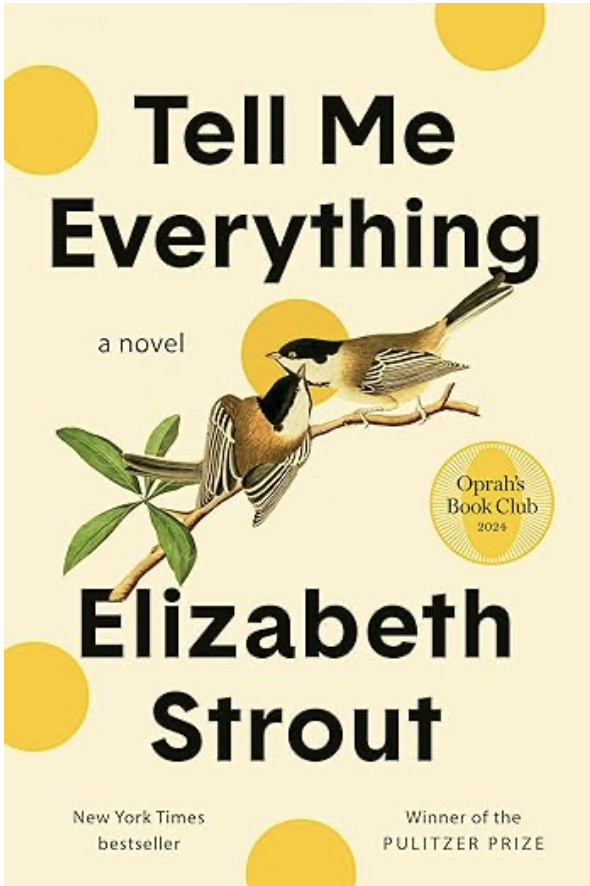
Tell Me Everything by Elizabeth Strout


This book brings together many of the characters from Strout’s earlier books, Olive Kitteridge, the Burgess Boys and Lucy Barton. Bob Burgess is falling in love with Lucy, drawn in by the intimacy of being truly known on their regular walks. Meanwhile he navigates his marriage to Margaret where he often feels unknown. Olive and Lucy share small stories of people they encounter, those with unrecorded lives as they reflect on the meaning of the story or if there is any meaning at all. A murder mystery introduces some new characters and builds bonds between Bob and the young man who he defends, offering a fatherly presence to someone deeply in need of it. The book is a character study filled with well-developed characters living out life’s conundrums with each other, often bringing to them a level of unexpected kindness and insight.


The Secret Life of Sunflowers by Marta Molnar


This book is historical fiction, but also based on history. Told as many such novels, it alternates between two braided stories, one modern day fictional story, the other based on history.  What is unusual about this is its subject and her role in art history, the sister-in-law of Vincent Van Gogh, credited with introducing him to the world after his death and that of his brother.  Upon the death of her husband, Theo Van Gogh, Johanna Bonger was left with a young son and hundreds of Vincent's paintings. Her deep commitment to her late husband and her growing appreciation of Vincent's work, led her to move into a role that was quite unusual for a woman of that day as she gradually introduced the world to Van Gogh's work. The modern day story revolves around a young woman whose grandmother has just died and left her with a mystery and a diary. She too is finding her way as a young woman asserting herself in the world. She learns that the diary she received was written by Johanna Bonger. In crafting her story the author drew on the contents of the actual diary, that exists at the Van Gogh Museum in Amsterdam and in digital form as well, having first been released in 2020. While I enjoyed the present day story, I found myself intrigued by this woman who had the drive to carve out such an unexpected life and life's work. 


Doorman Wanted by Glen Miller 


On a lighter note, this book tells the story of the son of a wealthy man who suddenly inherits a fortune upon his father’s death.  Wealth is a world that he has long rejected and as he struggles with this new position in the world, he is sent to a building owned by his late father to sign some documents. Arriving at the building he notes a sign seeking to hire a doorman and in a brief moment of mistaken identity coupled with his hesitance to assume the mantle of wealth, he accepts a job as that doorman. The story develops around his role and relationships as the doorman, a role in which he thrives. His struggle is with how he will be perceived as a wealthy man and treated in a manner that prevents true relationships. This is a first book debut by Glen Miller who crafts a story with wit and heart.

Sunday, January 7, 2024

The Ones That Stayed With Me

Each year I write a summary of some of the books that spoke to me throughout the year. By the end of the year I have a long list, but I am often hard-pressed to resurrect the threads of the books that I rated highly after reading. Instead, it is the ones that had sufficient force to stay with me that remain. This year there are several that met that test. 

Tom Lake by Ann Patchett


I have always been a fan of Ann Patchett and her latest book Tom Lake did not disappoint. Central to the story is the play Our Town and a theater company in which Lara, in her youth, performed the part of Emily as she became involved with Duke, the actor who played her father. After their relationship ended, Duke goes on to become a famous actor while Lara, after a brief stint in acting, ultimately chooses a less glamorous, but satisfying life. The story moves between time periods with flashbacks to that earlier time— then a young woman, still forming and vulnerable, versus the mature woman relating the story to her daughters, as she chooses how much to impart. It made me think of the encounters of youth with all their foolhardy elements. Who we are in maturity contains all the layers of our past as we form the boundaries of our adult self.


The Postcard by Anne Berest


When people come through my studio and view my artwork on cultural themes, they often recommend books to me. I am always intrigued that they think they know me so well as to know what I’d like. Even more so when I find they are correct. The Postcard came from such a recommendation. It begins with a mysterious unsigned postcard that arrives with only the names of family members who died in the Shoah. An unsolved puzzle then, fifteen years later, a chance barb at the author’s inconsistent engagement with being Jewish, launches her into a search for that lost family. And quite a search it is, with dead ends and serendipitous discoveries deep into the French experience of the Holocaust and the personal history of the author’s family. It is a search laden with self-discovery as she discovers a deeply personal connection to her ancestry.


The Heaven and Earth Grocery Store-James McBride


Many years ago, I read the Color of Water by James McBride. I recalled that his mother was a white Jewish woman who married her black husband in the 1940s. When I first heard of The Heaven and Earth Grocery Store which connects the black and Jewish communities, I thought it likely drew upon the threads of his own personal experience. My involvement with the Jewish historical community had also made me aware of the early beginnings of my local Jewish community which also existed as an immigrant community side by side with the black community. For a firsthand flavor of these joined communities, McBride is the perfect storyteller, bringing a warmth and tenderness to the relationships that connected the two communities. While sometimes separated by ethnic and racial differences, the two communities also interact and support each other. Each character is finely developed and an integral part of the larger community that surrounds it.


Foster by Claire Keegan


This novella packs a lot in. Foster is a quiet story, amplified by the quiet as it forces the reader to focus on each gem of expression and thought. Even the one word title implies both a foster child and  what it is to foster. A young girl is sent to spend the summer with a foster family as her family awaits another child. In this new home the child is nurtured and flourishes in a way we learn was not likely in her home of birth. The foster home has its own griefs, the loss of a son, a sadness that allows its hosts to open their hearts to this girl child in need. This quiet story was made into a quiet movie, quite true to the novella. On a flight back from London, I had the good fortune to watch the aptly named The Quiet Girl. I was left to wonder what happens to this glimpse of sunshine in a child’s life upon her return to a family that lacks the nourishment under which she thrived. Does she keep that spark alive within her?


So why these books? Each spoke to me in a unique way, touching aspects in my own experience. From the inward and vulnerable child, to the experimental period of youth, to the understanding of family history that connects each of us to our own roots and culture. Each topic of interest was explored by an author who is a master of their craft, capable of touching those common experiences in a manner that echoes our own personal experience.

Sunday, January 8, 2023

Of Islands and Remarkable Women

So here's round two of favorite reading from 2022. Some seemed to pair conceptually even though quite different in content. One story explored the relationship between an island and the people who populate it, another the Covid virus and the lives of the people within a restricted island of safety. One offered a view of the often-untold story of remarkable women in Victorian times, another an all too relevant view of the China-Taiwan history through the experience of two remarkable women. One, of course, was also trapped on an island. I found all of these books remarkable and hope you do too.


Existing on an Island


The Unseen (2020) by Roy Jacobsen is a book I was unlikely to find on my own. Too quiet I would have said about this Norwegian writer recommended by a bookclub friend. And yet, I found this book quite enchanting. It is about an island and the people who live there. Life is not easy there and their character is not etched with words, but with their actions in this challenging environment. And yet they are deeply formed and people of clearly defined character. The island is a character as much as its stoic inhabitants, the weather and the sea are as well. They all exist in relationship to each other; the islanders engage with their surroundings to carve out their existence and find meaning in that effort. The novel itself is composed of carefully chosen words that construct a world that would be foreign to many of us.


I loved Lucy by the Sea (2022) by Elizabeth Strout and read it in one day. It had a simplicity to it that made you feel as if you were having a conversation with a friend. From an island of safety in Maine, Lucy shares a home with her ex-husband as they watch Covid emerge and send its tentacles throughout NY, touching friends and family as its grip tightened. Another theme that played out through the book were former partners maintaining close friendships, forgiving and accepting each other for who they are and continuing to grow in their relationship as they age. And yet a third theme of the relationship between adult children and their parents as it unfolds against the backdrop of Covid. Life is not simple for anyone, but the growing and deepening relationships keep them connected despite the turmoil that surrounds them.


 Remarkable Women


The True History of the First Mrs Meredith and Other Lesser Lives (2020) by Diane Johnson is a reframing of the past through present-day eyes. It was originally written in 1972 and was reissued in 2020 with an introduction by Vivian Gornick.  It looks at those famous male authors who we can find in Wikipedia, one the father of Mary Ellen Peacock and the other the husband. And then it takes a step to the side and dives into the “lesser” life of Mary Ellen, a woman of the Victorian era who was raised to think and express herself freely. Her life had a challenging trajectory, her mother went mad, and Mary Ellen left her well-known husband for an artist, then died young. In the meantime, she left much documentation of her life and her thoughts, all captured in pithy footnotes. It creates a captivating portrait of a thoughtful, engaging and for her time, unconventional woman. 


In Daughters of the Flower Fragrant Garden (2022), Zhuqing Li tells the true story of a family where two sisters found themselves separated between Mao’s China and Nationalist Taiwan during China’s civil war. When what was to be a short visit to a friend resulted in Jun being trapped on an island held by the Nationalist Army, a separation of over thirty years ensued.  The sisters came from a family of wealth, long lineage and Nationalistic ties, a background particularly troubling for those trapped in Mao’s China, who were punished and “re-educated," sent to primitive villages and forced from successful careers. Juan’s sister Hong, a doctor deeply committed to women’s health, met such a fate, ultimately recovering her career, but assiduously avoiding any political connection, even cutting all ties with her sister in Taiwan. The book explores how they each navigated this schism and the environment in which they found themselves.

Wednesday, December 28, 2022

Readings: Bridging the Space Between


Since 2010, I have compiled my favorite books that I read each year. It allows me to trace the topics that have intrigued me over time. I often find recurring themes and this year was no exception. Many had two threads to the story, past and present which ultimately weave together, bridging time and deepening understanding of past to present. Others invoke that liminal space between life and death, often bridged through the suggestion of ghostlike presences. And one addresses a different kind of liminal space, that between sleep and wakefulness.  

Past and Present


One of my favorite authors is Geraldine Brooks. Her books are a rich exploration. Her newest book Horse (2022) is a story of a racehorse and of race. The racehorse is Lexington, one of the most famous racehorses of all time. Coupled with his story is a story of Jarrett, his black groom who raised him from a foal and accompanied him throughout his 25-year lifetime. While a highly recognized and rewarded slave because of his special skills, Jarrett still functioned within the boundaries of slavery. When he sought to buy his freedom, his owner reminded him that as his slave he couldn’t own anything so the money he offered should revert to his owner. A magnanimous owner, he did not impose that requirement, but reminded Jarrett that it was his choice, not Jarrett’s. Paintings were desired of these celebrity horses and were valuable in the horse business of racing and trading. A practitioner of equine art is introduced into the plot and his work reaches into a modern-day story tied to the horse in question. Even the horse’s skeleton becomes an element within the modern-day story. I found myself searching for the outlines of history and it was never far away. Set at the time of the Civil War it was told with accuracy. Jarrett is an imagined composite character as are the two modern-day protagonists, but everything else was clearly documented in history as the reader is given a front row seat. 


Once on a visit to Chicago, I stopped by the Holocaust Museum in Skokie. There I discovered a show composed of letters written by newly freed African Americans post-Civil War seeking their families from whom they had been separated. It was both touching and heart-rending. I was struck by how I had never contemplated the separation of families and the efforts to rejoin them after the Civil War, although I was certainly aware of the similar search of Holocaust survivors for remaining family after WWII. The Book of Lost Friends (2020) by Lisa Wingate takes this period and explores it through one of those past and present books with two layered story threads, one in 1875 Louisiana and the other over a century later in the same location. As a family historian, I often focus on the connection of past to present, a connection that allows us to make sense of today's world resting on the bones of the past. 


Sunjeev Sahota’s, China Room (2021), is another novel with two threads, past and present. Despite its perhaps misleading name, it is set in India and its reference to China is the crockery variety. The first and most compelling story dates to 1929 during a time of arranged marriages. Three Indian women are married to three Indian brothers. The conceit around which all revolves is that none can identify which is their husband in daylight -opaque marriage veils and only nighttime assignations create this circumstance. Mehar, a fifteen-year-old from a poor family, believes she has identified her husband only to be in error, leading her into a love affair with another brother. Seventy years later her great-grandson arrives from England and discovers the traces of her life and the story behind it.


Life and Death


The Sentence (2021)by Louis Erdrich was an especially intriguing book to me as it is set in the community in which I live during the time of Covid and the unrest after the George Floyd murder. To make matters even more interesting, it incorporates a ghost story with a permeable veil between this world and the world beyond. A former customer continues to haunt the bookstore and Tookie, our protagonist, must contend with her presence. Erdrich writes of what she knows, setting this story in a bookstore, no doubt modeled after Birchbark Books, the store she runs in real life. Through the guise of Tookie, we are also offered a variety of additional book recommendations. 


Ghosts seem to be a feature in Erdrich’s writing as the line between the living and the dead seems often quite permeable. In The Night Watchman(2020) a fictionalized story is based on Erdrich’s grandfather and the important role he played in fighting termination. Termination efforts began in 1953 and were designed to eliminate the role of the Federal government in controlling reservations, instead passing costs to the states and pushing Native Americans off the reservation and into the cities. The result often meant the loss of their reservation lands and the government support which was in fact to be compensation. This is one of several plot lines as the Native Americans organize to challenge this strategy. While the character who represents her grandfather drives this storyline, the broader community is interwoven with a cast of strong characters that we come to care about, both living and those who have passed on. Strong women rooted in Native American culture show the way to a future navigating two worlds successfully.


I loved Maggie O’Farrell’s Hamnet so was eager to read her new book The Marriage Portrait. But first I heard her do a reading where she was asked about her memoir, I Am, I Am, I Am (2018). Before I moved to her latest novel, I took a detour and read this most unusual memoir which explores the close calls with death or danger that she somehow evaded. Each chapter focuses on the physical point of vulnerability in her body. It culminates in the life-threatening situation which grips her most deeply as she watches her daughter’s life precariously perched on that thin line that separates life from death. I took away from that book a new appreciation of the opportunity to live each day of our life and the vulnerability which always hovers nearby.


I then moved to The Marriage Portrait (2022), based on an actual marriage in 1558 which similarly sits atop a deep sense of vulnerability between life and death. A young girl of 16 enters a marriage with a ruler who fluctuates between a heightened sensitivity and understanding of his bride and a cloud of threat which makes her fear for her life. It is underscored by the sense of vulnerability women of that time faced in a marriage should they not produce an heir while subject to the control and whims of a spouse. I thought back to Hamnet which also focuses on the thin line between life and death. This seems to be the theme that intrigues O’Farrell through these books, a thread in her own life which informs her choice of material.


Sleep and Wakefulness


Colson Whitehead’s latest novel Harlem Shuffle (2021) is quite different than his earlier books The Underground Railroad and Nickel Boys. It is a character study of both the people and the place, New York Harlem in 1959. I found myself especially intrigued with a concept that it frequently referenced dorvay, a derivation of Ray Carney, our protagonist, from the word dorveille. The word is formed from the French words, dormir and and veiller, to sleep and to be awake. It came from a time before electric lights when people split their sleep in two, waking in the middle to perform those tasks that somehow eluded them in daytime hours. Carney thought of himself as coming from a crooked beginning with a father who was, well, a crook. He however was just slightly bent and dorvay was when the straight world slept and the slightly bent got to work. Carney bridged the world between the straight and the crooked, living a life perched on a tightrope between the two. How he resolves this contradiction is the story.


Stay tuned for a few more topics on islands and remarkable women!