Sunday, September 20, 2015

Always a Novice


I’ve written of the memory jar, filled with memories, that I gave my mother years ago.  It was a ceramic jar with the title "Memories" inscribed on its side. Among the keepsakes that I got from my parents' home after their passing were the gifts I had given them over the years.  Fortunately I gave them things that I rather liked.  Now they are imbued with the essence of my parents.

One of the things I came back with was another ceramic jar, a gift I had given my father.  It is titled "Brilliant Ideas".  My father was rather known for brilliant ideas so it seemed an appropriate and complementary gift.  I now eye it thinking about what brilliant ideas I will fill it with.

Years ago in my first job I used to keep an idea file.  At the time I was starting a nonprofit that was a new concept.  It actually became a model program because novice that I was, I didn’t know my own limitations yet.  There is something rather freeing about not knowing what you can’t do.   In those days when I had an idea I would write it down.  Then I would write what resources I needed to make it happen and the people I needed to engage.  When I had fleshed it out as best I could, I put it in the file.  I seldom opened the file and when I did I was always amazed at how I had forgotten about the ideas I had dropped within it.  Many of them I had implemented.  There was something rather magical about thinking it though and filing it away that somehow translated into action.

I think perhaps I should use the jar much like I used that early file, to give ideas life.  I have found that I am good at coming up with ideas and reasonably good at implementing them, yet I still hit impasses that I founder upon. They are not for lack of ideas. I have no shortage of those.   Rather they occur because I now know my limitations and need to learn how to move past them.  Usually they are a lack of knowledge about a new pursuit or uncertainty about how to begin in a new direction.  Sometimes they require me to reach beyond myself, to connect with new people and propose my idea to them.  I need to be persuasive about something that exists only as an idea.  To be persuasive we need to believe in our idea enough to be convincing that not only is it a good idea, but we can execute it successfully.  The more successes I have, the better I get at that, but there is always that novice within me who hesitantly drags her feet like a recalcitrant child.  She whines about her uncertainty and secretly wishes someone would take her by the hand and show her how to do it.  I suspect I’m not alone in that. Most of us keep that novice pretty well hidden leaving others to think that they are alone in their feelings of ineptitude.

I gave a talk this week about the Identity and Legacy Project, a rather involved interview and art creation project that I embarked on despite my inner novice.  I convinced sponsors, got grants, did interviews, learned video editing - all sorts of new endeavors of which I knew little.  When I spoke about it I shared my sense of being overwhelmed and intimidated as I took them through my process. I realized it took a certain confidence to share that.  Of course by now I had figured out a path through those uncertainties.  I let my novice speak and found that people responded with interest because we all can identify with those feelings.  So often we talk of our successes, but seldom the struggles.  Often those struggles are within ourselves as we embark on a new path without the expertise we imagine it requires, expertise that we assume others possess along with that poise and confidence we so envy.

If we live our lives with curiosity we are novices over and over again, always learning new things. It is only people who do the same old, same old that don’t experience both the fear and adrenaline rush that comes from facing something new. And if we succeed we are left with a deep sense of accomplishment and mastery.   

Friday, September 11, 2015

The Traces We Leave Behind

 I come from a well documented family and one that keeps things.  As I sort through my parents' papers, I find that  I am on the other side of keeping, evaluating what to discard, what to pass on and what to hold close. As a family historian I bring a unique sensibility to this endeavor. My dad was a bit like me in this regard as he kept material dating back to high school and his early career his entire life.   It had historic value to him, reminding him of the path he wove through life.  I am sure he hoped it would have historic value to his children.

When I ran across my dad's high school transcript, I thought about how thrilled I would be to discover that in a genealogical search. Then there are those things that hint at the person within. Let me give you a flavor... I've found his original letter from 1956 to the university where he subsequently worked for over 30 years. In it he laid out his vision of what he hoped to accomplish in starting a new department. He was 30 years old at the time with a touch of arrogance, at least so it may have appeared then as one considered this yet unproven young man.   In his letter he laid out his philosophy and noted that he’d like to attempt to implement it at a school not inhibited by traditional lethargy. He hastened to add that he did not wish to imply that hair-brained ideas and actions were his specialty, always a little tempering with humor. The school wisely saw past the rhetoric of this rather cocky young man and hired him to accomplish great things which indeed he did, quite beyond what they may have imagined.

Much of his paper trail relates to his career. Like many men of that era, his work was his focus and he found his engaging and rewarding. My dad started a public television station in Central Illinois, but before he got to that stage he introduced educational television. I read through a report in 1964 to the board proposing the development of a professional quality educational television studio. Now to put this in perspective, TV first was introduced in that community just about ten years earlier. I remember watching Captain Kangaroo in black and white on an old mahogany Magnovox with doors that clicked into place. In this proposal my father was recommending the purchase of a broadcast quality VCR, then around $35,000.

I laughed out loud when I read this. My father loved technology, but had a special fondness for video equipment. He recorded everything he considered worthwhile and one of our biggest projects in disposing of the contents of the house are video tapes, about 2500 of them. We also disposed of 20 VCRs. Old habits die hard. I’m sure he thought they were a deal after that quite costly initial investment.

As I go through my mother’s material I find different things that speak to me. Our connection was often through books so I felt as if I hit the mother lode when I discovered a file titled Notes on Books Read. The sheer variety of what she read and responded to was amazing. In addition to literature, there were notes on finance, history, medicine and the Talmud.  My mother was a curious person with wide ranging interests.  It is in this territory that we converged, finding our common ground. Many of the quotes she recorded related to dealing with fear, finding meaning in life and ultimately confronting death.  She took her lessons from books and she learned well, recognizing and valuing insights.  Her path through life was paved with books.   I consider how fortunate I was to have her as my guide in life.

The other thing my parents considered worth keeping were my words. I think they kept every email I ever sent them, emails for which I no longer have an electronic copy. A large file titled "Susan's Emails on Family Ancestry" held the first email I sent them asking for information as I began my journey into family history. Hmm, I think I'll read that at a genealogy talk I give this month. A good illustration of where to start.  We so often forget our baby steps once launched.  It is fitting that I should be reminded of mine by my parents.

It is a strange exercise going through this material. I feel as if it is an honoring of my parents. I turn the pages with their familiar handwriting, my mother’s perfectly formed first grade teacher letters, my father’s minute script. I would recognize their writing anywhere and feel their presence in it.  As I turn those pages I am taking pleasure in who they were at their core, their lives as thoughtful, contemplative beings. And I am grateful.

Sunday, August 30, 2015

Always an Artist


I recently spent a week beginning the disposition of the belongings of my late parents. It is an odd project to dispose of a lifetime of things, things that conjure the two people who were central figures in my world for much of my life. What to discard, what to keep? One thing I don't plan to discard is my mother's creative work.

I've written of my mother's collaging, or as that former first grade teacher termed it, "cutting and pasting". She began this activity in the fall of 2013 and concluded it a few weeks before her death in 2015. With roughly one a month she left 20 albums, a "legacy" she termed it. She began this project when Alzheimers robbed her of the ability to pursue her favorite activity of reading. Each morning she eagerly awaited her newspaper so she could begin to cut it up and paste it in her notebook. At the time we were just glad she had found something that seemed to engage her, but as I carefully perused her albums I was struck by how her style evolved. I could see her mind working and felt her presence surround me.


1
Carefully I went through each one, page by page. I put them in date order so I could better see their evolution and took photos of those that struck me the most. My plan is to frame some of them and perhaps show them along with my painting of her cutting and pasting. They clearly underscore the fact that creativity can be sustained, perhaps even enhanced, as memory fades. With this perusal, I found myself analyzing her composition, her juxtapositions and repetition of forms. Often I felt as if she was perched on my shoulder, especially as I read her little notes jotted amidst her collages.

I was touched and intrigued and thought I'd share some of her efforts with you.


2
Her albums began in October 2013 with a few pages recapping her life, her children, her teaching career, my father and how long she had lived in her home. Then she began with her first effort. Her early work was very simple, she took images that appealed to her and pasted them on a page with white space surrounding them. You can tell from the content that it was fall and she was already beginning to paste leaves in as well (1).

Soon that morphed into a more overlapping style and this is where I began to notice some interesting things. She clearly had a fascination for faces and repetition of forms. Notice the upside down burger mimicking the pumpkin face (2) ? You can see how she was using grapes to create a sense of flow in the image, drawing your eye along with it. Now her work was beginning to overlap creating a denser image.

At the end of that first book was a note that she had sung Happy Birthday to my sister and my sister told her that it made her day. I felt a surge of satisfaction. I talked to my mother each morning and my sister spoke to her in the evening. She was no longer able to remember birthdays, but I had reminded her of my sister's birthday. She had said, "But I don't have anything for her!" I had suggested she sing to my sister and the suggestion had stayed with her all day, a long time in Alzheimer time.


3
She often included newspaper articles, sometimes about sports; she was an avid basketball fan. She told me she included anything she saw about Obama who she firmly supported. A newspaper article might find itself enhanced by visuals, often with repetition of form, notice the hands of the M&M guy and the basketball players (3).
4

Mom was drawn to images of families and it appears that she had a fondness for William and Kate. Here they are adorned with a gingerbread house and Tinkerbell, filling out their world with sweetness (4).

While she had begun to overlap images, she hadn't firmly shifted from individual images yet. She was often conscious of the relationship between opposing pages and might divide images to get some repetition (5). She often used her pages as a notebook, noting important things like her breakfast or the fact that her paper hadn't come yet. This was the high point of her day and if it hadn't arrived by our morning phone call, I immediately called the paper to urge them onward.


5
Her work often had a bit of whimsy in how she separated images. Notice the child reaching for a tidbit just out of reach (6).


6


About six months into this activity she began to overlap imagery in earnest and make use of full page spreads (7, 8).
8


7
Now she was hitting her stride turning out imagery which merged black and white and color (9) and using swatches of color like mosaics (10).
11
10
9
13
12
I've been teaching classes in family history collage and on one visit I brought in printouts of family pictures and decorative papers. She did a collage while I was there, but then I left her with a bunch of family images out of which she did my favorite creations - the crowns of strawberries for her mother and my sister. It made me regret leaving images of me out of the batch I provided her.
14
She continued her work for another ten months and while not everything worked, the ones that did made me take a second look. She always had an artist's eye and I admire not only her sense of purpose, but the creations that came out of it. Here is a sampling from the remaining months of some of my favorites.
15

16


Sunday, August 23, 2015

Fun and Games

We just took our grandson on a college visit. Campuses always remind me of all the interesting directions we can go with our lives. And that doesn't stop in our teens and twenties, not even in our sixties. If I were to embark on a new career, I think I'd explore the study of game theory. I love games that present a puzzle and especially those that make use of words. But it is not just the challenge of games that intrigues me, it is the lessons that live within them. They reveal our fundamental nature and offer us clues on how we can begin to improve on it. They also give us insight into other people and how we interact with them.


My husband and I got to know each other over a Scrabble game. I noted several important things about him. He had a good vocabulary and was strategic and competitive. Anything less and there would not have been a second date. Those were fundamental requirements. 

Over time I began to observe a difference in our styles. I knew all the two letter words and could wedge them into tight spots. I played a game that hugged the board. He on the other hand loved the grand gesture, laying out a seven letter word with a flourish. For a while we stayed in our separate spheres, tight spots versus expansive gestures. One day it dawned on me that the best way to beat him was to master his game while retaining my own. I began to look at words differently, identifying beginnings and endings and building on them. Most importantly I began with the premise that a seven letter word could be hiding in those letters. I stopped treating it like a lucky rarity and assumed it was there. Suddenly I began to spot them. I decided that I could be someone who put down seven letter words much as I decided at age 30 that I could be someone who traveled. Part of altering our life is embedded in that decision about who we will be and how we perceive our possibilities and limitations.

There are a few lessons here...

1) Allow for the possibilities in the world and in your own capacity to grasp them. You won't find them if you assume they don't exist and especially if you don't believe in your own ability to find them.

2) Look for components and how they connect. Even in the grand gesture, you can build in segments. I've always described myself as an incrementalist, one who builds things step by step.  There are moments when an entire word or idea or even a painting bursts forth fully formed, but more often we need to assemble the pieces in a gradual process.

3) Learn an unfamiliar approach to expand on your existing approach.

I've moved on from Scrabble to Words With Friends and Word Streak and along the way gathered a few more lessons. One rather jarring one is...

4) There is always someone better than me. Or you.

I've written of that time I had a career upset and my father said, "it was about time you landed on your ass, you were getting entirely too smug." Games keep me humble and there are times that is a good thing. Ask those who know me. I win a lot of games, but just when I start feeling rather smug, someone creams me.

Now at first I lick my wounds and then I realize there is an opportunity to learn, just as I did from my husband. So lesson # 5, the corollary to #4 is that you can always get better. One of the best ways?

5) Learn from your opponent.

I start analyzing their game. What words do they get that I don't? How do they maximize endings? Do they win on speed or vocabulary or both? How strategically do they make use of bonus points? I figure out what they are doing successfully and then try my hand at it. I believe they call that "beating them at their own game".  

The strategy you use against one person may not be the strategy for the next.  Each of us is different and acknowledging the differences allows you to study that person rather than simply projecting from yourself.  Seeing clearly without getting in your own way, is an important part of engaging with another person.  And what are games, but an engagement with another person.


Games reveal a lot about us and our opponent, but they also show us how to take on the world in a different way and embrace its possibilities as our own.

Monday, August 10, 2015

A Well-Fitting Suit


It has been slightly over a month since my mom passed away and it doesn't feel as if she's gone. I've written about the concept of "ambiguous loss", first introduced by Dr Pauline Boss. It is that kind of loss one experiences when someone is gone, but not gone or conversely here, but not here. An example of the former might include someone who disappears on a plane over the ocean, the latter could be someone with Alzheimer's. It is a loss unaccompanied by societal support of grieving. 

So now I'm on the other side of this equation, unambiguous loss. I was with my mother as she took her last breath. I spoke about her at the funeral and have been the recipient of others' support. I must confess that it still feels quite ambiguous. Death is such an inconceivable concept to wrap our brains around, perhaps it just won't seem real until time has passed. I may need to go through a Thanksgiving without Mom at the table for reality to set in or perhaps that week that looms on my calendar, scheduled for disposing of my parents' belongings, the detritus of long lives. In the middle lives their negative space, the outline of their presence like the chalk figure at a crime scene. I've written of my mother's daily collaging, her cutting and pasting. It sits on her kitchen table undisturbed, cut out images waiting to be secured to the page in an unfinished collage. Neither my sister nor I can yet bring ourselves to dispose of it lest we lose the fragile sense of her presence that lives in that space. 

With both parents gone, I've been thinking a lot about parent-child relationships, what we know of each other, or think we do. When my father passed, I was struck by how little I knew the man that the outside world knew. I wished I had known him in that way. I was also suddenly aware of our similarities. Much of my understanding came from the paper trail that he left. His meticulous nature, echoed my own or rather I suppose mine echoed his. There were many flashes of recognition. I was also struck by his understanding of me. I was surprised to see that he had named me as his executor when I was in my 20s, newly out of college with a social work degree. I had always assumed it was based on my later career in finance. He knew his children and their potential better than I realized.

It was different with my mother. We always understood each other. There was a similarity in our wiring when I was a child. An introspective nature, a love of books, a curiosity that was fed by a love of learning. We also shared a certain unease with the world, a shyness that friends now often fail to see in me. My mother saw it and recognized it as her own. She worked hard to not let it imprison me and to do that she had to work to not let her own nature imprison her. I was a child who was hard for her to raise because she had to try so hard to give me the courage she struggled with herself. Oddly my ace in the hole was my father's nature. He just plowed ahead and did what he wanted to do. I grew up witnessing that foreign quality and over time began to own it in myself. I am a mix of them both and that is a good thing. They tempered each other and now they temper me. I don't need to look far to see my parents. I wear them like a well-fitting suit.

There are differences as well. Some qualities I would do well to emulate. My mother was a much kinder person than I will ever be. I have my moments, but for her it was a fundamental part of her gentle nature. In yoga when we set an intention, I used to send her love and energy. Now I decide I will try to honor her with kindness. To find those opportunities in everyday life to reach out to another.

My parents live on in the temporary space of things, in the temporary space of me. It is what I do with their presence that matters now.

Thursday, July 16, 2015

Of Blessed Memory


After my mother passed, I stepped into the whirlwind of activity that accompanies a death. Having done this with my father I knew what to expect this time and with two weeks of waiting we actually had done many of the necessary things.

I had dreaded the funeral, thinking of it as something I just had to get through. Somehow I managed to deliver my remarks on my mother without dissolving into tears. I was touched by the people who shared memories of my mother. Their experience with her in the public world was the same as mine in the private world of family. So many people present a different face to the public. My mother had a consistent presence and was so often described by her kindness. She was an easy person to love and admire. I still have trouble describing her in the past tense.

Our drive back to Minnesota felt like a separation from the hard reality in which I had been a participant. I could almost tell myself that my Mom was still back there living her life. I don't think the reality has fully hit me yet. The finality of it all. It was fascinating and mysterious, but oh so final. I've heard from readers of this blog who experienced some of the mystery that I too observed. It has changed my understanding of death and left me more hopeful that our energy continues in some form. I guess I'll find out some day, but as I used to say to my mom when she talked of death, "No hurry".

What I had not expected was this wave of fatigue. For almost two weeks I had camped out in my mother's room in hospice, waking every two hours as nurses checked on her. Now I cannot sleep more than two hours at a time. The hospice social worker calls. They continue to reach out to family to offer support. Very solicitous, but my stoic self can't imagine how I'd draw on what they offer.

In the midst of this my computer gets a virus, sending errant emails to my email list. I want to wail,"Leave me alone! Don't you know my mother just died. Go pick on someone else."

I throw my energy into my to do list, filled with post-death financial responsibilities. I check off my list diligently, taking comfort in these tasks I know how to do. My solace is always in action and there is no shortage of things to do.


Once again I pick up the threads of my life that had been abandoned as I waited in that hospice room in Illinois. Tonight I have an opening and have spent the day assembling the pieces around my paintings. The work is focused on memory. Once my focus was loss of memory as I watched my mother lose pieces of her memory, yet retain her identity. Now the theme of memory revolves around my memories of her.

I have written in these pages of a memory jar that I once gave my mother, filled with all my precious memories of our time together. It felt symbolic to retrieve it from her home and bring it back to mine. I am indeed the keeper of our memories.

The Jewish Artists' Lab show that opens this evening is on the theme of water which I of course tied back to memory.  Because I couldn't stop at just one painting it turned into a diptych inspired by a quote by Toni Morrison.


"You know they straightened out the Mississippi River in places... Occasionally the river floods these places. "Floods" is the word they use, but in fact it is not flooding; it is remembering. Remembering where it used to be. All water has a perfect memory and is forever trying to get back to where it was."

Water is often used as a metaphor for memory. We speak of waves and floods of memory. Of memories submerged or bubbling up.

In the beginning God's breath hovered over the water. Then God divides the water into sky and sea, then land from water. The creation of the world has to do with differentiation. A flood signifies a returning of water to land, a remembering of its origin. The sky offers its rains that roil the waters and overtake the land, joining firmament, ocean and land into its original whole.

My artwork examines the parallels between memory and flooding, identity and creation. My work on memory explores the persistence of identity that also develops out of differentiation, an echo of the creation story. We are this, not that. Even as memory flees, we continue to seek the familiar boundaries of our one-time identity just as does the river when it floods.

In front of my painting is a memory jar. I am asking people to contribute a memory they once shared with a loved one who may have lost memory. I will develop a series of paintings of memories that are shared. The series will honor those who are kept alive in memory by those who love them. I will call it "Of Blessed Memory", what more fitting conclusion to my recent tumultuous weeks bidding goodbye to my mother.


Sunday, July 12, 2015

Waiting 5


 My mother passed away on July 4th, 2015 at the age of 88. I spent the last two and a half weeks of her life with her, much of it in hospice waiting for her to pass. It was the first time I had been that close to the dying process and I am grateful I had that time with her. It was a very strange experience, often fascinating, sometimes surreal. (5 of 5 posts)
 
 
It has been ten days since that first phone call. We have taken over the room with roll away beds and easy chairs. As we've become fixtures around here the staff have been very accommodating. We fall asleep to the sound of my mom's breathing and the oxygen pump. It is part dormitory with a touch of slumber party, this vigil. My mother is very hard of hearing, but we are told that hearing becomes acute at this stage. "What are you giggling about?" my mother asked a few days ago, back when she was still speaking. Normally she would only hear us if we spoke loudly facing her. I think she likes the sound of her girls giggling. And yes there are moments of giggles amidst the sadness. One of the many incongruities of this strange time.


We think we are near. The signs that they told us about are appearing. Maybe today. No more talk, just sleep. Her breathing is jagged. Part of me is fascinated by the process of dying, how defined it is, at least the outward manifestations. What we don't know is the inner experience.


My sister sings songs to her that they used to sing when my Mom took her to kindergarten. I talk to her about our travels together. I reminisce about a trip we shared in France. I had gotten aboard our train and then reached my hand down to her. Just then the train jolted and pulled forward. I stood in shock as she grew smaller on the platform. Finally I threw my bag down and jumped. After that we clung to each other when we boarded a train. We are going to go separate paths for awhile, I tell her. 
It will be OK.


I wonder how I'll react afterwards. I've been focused on the mom with Alzheimer's and haven't allowed myself to think of the amazing person she was before. I didn't want to spend time bemoaning that change. I wanted to appreciate the person in front of me. Even in a diminished state she has been a kind, loving person, her essence intact. I've been mourning gradual łosses all along. Soon I can allow myself to miss the whole person, the person I've known over a lifetime. It would have been harder without the Alzheimers. Perhaps it was a gift. To let go of the person she was with all her faculties would have been wrenching. This is hard enough.


Nurse LaRosa tells us that if Mom passes tonight, one of our CNAs asked her to call her. She wanted to come in and wash Mom, an act of love for her Rose. There are rich connections that have been formed with the staff here. The loving care they have given our mother is special. They had two weeks of her in her normal state with which to bond. What amazes me is how many of them did. They saw the person within and I am grateful.


..............


It is now eleven days since I learned there were signs of impending death, nine days in hospice. It feels as if she is no longer there, but her body is hanging on. This is the hard part. When she was still conscious the time was precious, we could still feel a connection and communicate. Now we just wait for her body to tire of the fight.


My husband is still 500 miles away. I will call him when Mom passes and he will drive eight hours. It is hard for him too, living his life on hold, not knowing. I at least have the certainty of each moment, of each breath that she takes. He tells me he wants to be there to support me, but doesn't want to be in the way. I know he went through this with his mother and I watched his grief. It is comforting to know he understands on a very visceral level.


Cutting & Pasting with Mom's collages below
I think about support. What does that mean? What do I need? I've been mostly with my sister and niece who feel as deeply for my mom as I do. That is a form of support, to be with people who understand the importance of that person. We get support from many of the staff here. They recognize and treasure my funny, warm, loving mother. Hugs are given freely. I feel especially supported by my friend Dora, a second mom to me. Her voice on the phone brings comfort. Many of my friends have lost parents. They reach out with kind words. Normally I am not very good with accepting support. There is a bit of a stoic strain in me and right now this is something to get through. I think perhaps the need for support will come later, when grief can fully surface. I remember my husband had a large photo of his mother on our refrigerator for months after she died. Every time he put food in his mouth, he thought about her.

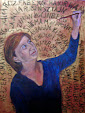
I have a painting I did recently of my mother, now hanging in my studio. She is cutting and pasting, her equivalent of collage. She used the language of her old career as a first grade teacher. I look at her last book of collage images. She last cut and pasted on June 15th. I find the Mother's Day card I sent her collaged in. My husband had the forethought to put the painting in the car. He remembered us having one I had done of his mother there at her visitation. Her painting was of our weekly Scrabble game, commemorating when she put down a seven letter word. It conjured up her presence doing something she loved. I would like this to do the same for my mother.

We are going into a holiday weekend. Tomorrow is the Fourth of July. It seems a fitting day for my mother to pass. She loves the American flag. When we drive by one she always notices it. Flags stand in her planters and at my father's grave. When I see flags they make me think of my mother. She has always said she is so happy that she was born in America where she got an education. Her mother came from the Ukraine. Boys were educated, but not the girls.

My sister strokes one of my mother's arms, I stroke the other. I'm not sure who came up with the idea of telling a loved one it is OK to let go or how valid that is. We decide to try again. I remind my mom of our travels in Europe, how she dreaded the next city on our itinerary, not wanting to leave the familiar. Then she would grow to love the new city and not want to venture to the next. Change was always hard for her and this is the biggest one she will ever face.
I talk of how fulfilling her life has been, how she's loved each part of her life. Of the people she's touched. I once told her that my philosophy of life is to take my little piece of the world and make it shine. That resonated with her and she adopted it, writing it out and posting it over her desk, next to a flag of course. We told her that her piece of the world was shining.
.......

It is the Fourth of July in the middle of the night. The nurse has come in several times tonight. Each time she checks my mother's heart and says it is weakening. We sit on either side of my mother's bed. "It's OK Mom", we say as we stroke her arms. "You can let go".

It is a time that seems to call for a blessing. Not a normal practice in our lives, but this is not a normal time. My voice choked with tears, I recite the one she has always loved. 

"May the Lord bless you and keep you, may the Lord make His face to shine upon you and be gracious unto you. May the Lord lift up his countenance upon you and grant you peace."


 A few minutes later she passes from this world.


                   ~~~~~~~~~~~~~~~~~~~~~~~~~~~~~~~~~~~~~~~~~~~~~~

A special thanks to the staff of Lutheran Hillside Village in Peoria, Illinois who cared for my mother in her final days and treated us all with great kindness and compassion.