Sunday, August 27, 2023

Roadmap to My Evolution


As I approach a milestone birthday, I realize that one of the advantages of getting older is that you have a roadmap to your own evolution. You have enough history to understand who you are and the confluence of events that has led to the you of today. Often you find there are major themes that consistently drove your decisions, be it in careers, partners, or interests.  You may have had a glimmer of that earlier in your life, but hindsight has a way of underlining it with a head slapping Duh! I think this is what they mean when they say older and wiser. 

As I revisit my history, I recognize my parents within me and how fundamental their influence was. I also am surprised by my younger self. How did she know that I wonder as I view my former self at arm’s length. I’m a bit awed at this somewhat foreign creature I see in the rear-view mirror. I think more and more that we start out with a package of skills that we hone over time, but it is all there earlier than we realize. We really don't change much; we just get more comfortable in our own skin.

Usually, we are relying on memory as we assess our past. Of course, memory can polish up many a failing, but sometimes we have the benefit of documented memory.  Recently I had the opportunity to revisit former self at less than half my age. It came about in a rather unexpected way.
A local history museum recently promoted their Memory Lab. The lab allows you to digitize media that is now obsolete, such as VHS tapes. I knew I had a drawer full of videos that had been languishing for many years and there was one that I had always wanted to digitize. This tape was of my mother with my aunts. It was at a time, when my parents used to travel down to Florida to visit my mother's sisters. I had prepared a list of questions about family history and asked my mother to pose those questions to her siblings. My father was enlisted to video the discussion. My mother diligently posed her questions as the conversation rapidly spun out of control. She fruitlessly tried to coax her unruly sisters back to their assignment.

I took the VHS tape into the lab and was surprised to see that the date on it was 1992, ten years before I really did a deep dive into family history. It was a time when I was doing oral histories, which sparked my interest in this effort. I also realized that 1992 was ten years past the maximum period (10-20 years) before a tape starts to degrade. While not in perfect condition, it was usable, and there was my mother a few years younger than I am today. I felt a yearning to leap into that video and ask her thoughts on getting older, a topic that I often discuss with contemporaries, one of which she suddenly appeared to be.
 
I was delighted to have that tape and began to gather other tapes to digitize. Next on my list was a tape that dated back to the 1980s when I had made a career change from running nonprofits to banking. I had finished an MBA in finance, and by then had spent a few years as a lender at a large bank. The bank was known for a controversial contemporary art collection that was unusual in the corporate world of that time. I had been interviewed in 1987 about my perception of that project and its impact on employees, but also my view of the workplace and my place within it. I set the tape aside with the intention to digitize it when time allowed. 
 
The Universe soon kicked into gear in a surprising way, one that makes you wonder who’s pulling the strings. Two weeks after I located that tape, I received an email from the co-founder of a nonprofit working with exhibitions of contemporary public art in Los Angeles. His email harkened back to the visual arts program at the bank where I had worked so long ago. He had received a grant from the Andy Warhol Foundation to explore that project and learned that I had been interviewed by a videographer as part of a series of interviews. He expressed interest in my recollections of the program and that video project from thirty-six years earlier. That old video had been elevated to archival status. Should I agree to share it, it would be the first one to which he had access. 
 
“You’re a good researcher to track me down,” I replied. I went on to explain the unusual fact that I had that tape, newly unearthed, sitting on my table to digitize. I agreed to consider sharing it after I viewed it.
 
It was a shock to see my younger self, complete with those 1980's shoulder pads, emerge from that video. My first thought was that I hoped I didn't embarrass myself saying anything stupid now that I had an interested audience. I was relieved to find that former self passed my scrutiny. I liked that she considered each question carefully and pushed back on conclusions with which she didn't agree. I regarded her with almost a maternal eye, as if she were a unique being with a connection to me, and yet, not me. 
 
On the tape I spoke of my decision to go into finance a few years prior, when I had been approaching the much earlier milestone birthday of thirty. After a degree in social work and experience running nonprofit organizations, I had been weighing my next step. I explained that I had chosen finance because I had encountered a financial person who I felt was skewing the facts, manipulating the numbers to their benefit. Ultimately, I went into finance to protect myself, to be able to challenge with knowledge and authority. And I wanted credibility in the world, that for women often comes with degrees in “hard” subjects–– all uniquely female motivations. 
 
Both my choice of finance and my later choice of banking were driven by the same desire for options, both were broad areas that would offer a range of future paths. Control and choice, big themes that repeat in my decisions. Once I arrived in banking, I found I was rather ambivalent about being a banker. It was a very different world than what I had done previously and the culture that surrounded me seemed quite foreign to me. I spoke to the interviewer of a duality in me, what I would today call my analytic and creative sides, both well developed and sometimes competing for my time and attention. My friendships and interests outside of banking fed my more creative side. I knew clearly even then that I would never fit well into a narrow track.
 
I went on to explain the bargain that I felt I had struck with the bank. “It’s like I don't buy wall to wall carpeting in my home, I have rugs, I'm coming to the bank, I give the bank certain things, certain skills that I have to offer. And I hope that when I leave the bank, I can roll up the rugs and take them with me. I'm developing certain skills that I will carry away with me. But I'm not setting up residency here.”
 
Thirty-six years later I look back at a time when I didn't know what would come next but was carefully charting my path. Something that resonated with me was a comment I made about banking being a job which didn't absorb all my energies. I went on to reflect on an early job running a nonprofit which I had created that did absorb all my energies. I noted that I liked that in many ways. . . And missed that. . . And I wouldn't mind being in that again, I added, but I wasn’t sure about the stress that accompanied it.  Today I seem to have come full circle, working with several organizations and projects that do absorb my energies, embracing the stress and finding the engagement of that effort satisfying once again. 

Of course, former self knew that long ago.


And by request, here is a brief excerpt from the interview.


Sunday, July 23, 2023

An Accidental Collection

As a genealogist, I am a keeper of stuff. I would hazard a guess that most genealogists are pack rats, as they know that gems are hidden in the materials that others with a less historical bent would blithely discard. 

With this orientation at my core, it is not surprising that I have recently become enamored by the Cairo Genizah. In a few days I head off to an international conference on Jewish genealogy in London. They will be showing the film From Cairo to the Cloud and Dr. Ben Outhwaite, the head of the Genizah research at Cambridge will be at the conference. I’ll have an opportunity to visit with him over dinner so decided it was time to learn more about this topic.


So, what is a genizah? The word comes from the Hebrew word ganaz which means treasure house or hiding place. In Jewish tradition, holy writings are held within a genizah when they have been retired from use. Holy was often taken to mean containing the word "God." As was the custom at that time every document contained the words "with the help of God," hence many secular documents found their way into the genizah as well, painting a picture of bygone centuries.  


I love how the actual discovery of the Cairo Genizah unfolds. The surfacing of the genizah was due to two Scottish twin sisters, who were respected scholars. They purchased manuscripts in the Cairo marketplace in 1896 that they identified as possibly significant. They in turn shared them with their friend, the scholar Solomon Schechter, who identified them as writings of Ben Sira, better known in the Christian world as Ecclesiasticus. This was no small thing, the Hebrew text of this had not been seen since the 10th or 11th century. 


As I read newspaper accounts of this discovery from 1898, I stumbled across a rather delightful interview with one of the sisters, Mrs. Lewis, who reports, “The author of Ecclesiasticus was a woman-hater. The names of Deborah, Ruth and Judith do not occur in his list of national heroes, and one of his aphorisms runs, ‘Better is the wickedness of a man than the goodness of a woman.’ It seems therefore a just judgment upon him that the Hebrew text of his book, the text that he actually wrote, should have practically disappeared for fifteen centuries and should have been brought under the eyes of a European scholar, I might say a scholar of his own nation, by two women.” (Cambridge Independent Press 12/2/1898)


Solomon Schechter studying the Genizah documents


Schechter believed these papers likely came from the genizah at the Ben Ezra Synagogue in Old Cairo and promptly paid it a visit where he charmed the community and was invited to take what and as much as he liked. He reported that he “liked it all,” boxed it up and brought it to Cambridge. Today, the collection consists of 193,000 fragments that have been mined for over a century. Historian, Simon Schama, termed it “the single most complete archive of a society anywhere in the whole medieval world.” 


This was no orderly library he walked into. In a colorful description Schechter talks of "a battlefield of books... Some of the belligerents have perished outright, and are literally ground to dust in the terrible struggle for space, whilst others, as if overtaken by a general crush, are squeezed into big, unshapely lumps." He described the resulting odorous grit of this centuries-old deterioration as genizahschmutz.


It is not just the mass and deterioration which catches his attention, but the juxtapositions and contradictory nature of its contents. He reports that "In their present condition these lumps sometimes afford curiously suggestive combinations; as, for instance, when you find a piece of some rationalistic work, in which the very existence of either angels or devils is denied, clinging for its very life to an amulet in which these same beings (mostly the latter) are bound over to be on their good behaviour and not interfere with Miss Jair’s love for somebody."


A letter signed by Abraham, the son of Maimonides

What I find fascinating is that it is a collection by accident, not carefully curated and created with a specific point of view filtered through the eyes of the historian. It is a jumble of direct source documents, both secular and religious that capture a cross-section of society for 1000 years of Middle Eastern history. Precisely because it doesn't have a specific focus, there have been scholars through time who have made this collection their life's work, plumbing its depths from their own unique vantage point. For some, the emergence of a new form of Hebrew poetry drew them in. Others focused upon the evolution of Judaism that is revealed within documents ranging from 4th-5th century CE to the end of the 19th century. I think perhaps my favorite was the holistic approach taken by the scholar Shelomo Dov Goitein. Rather than focusing on one aspect, he attempted to join the disparate pieces to recreate the community between 950-1250. To this end he identified 35,000 individuals, including 350 prominent individuals and the interactions with each other. Archives of entire families found their way to the genizah. He looked at professions, goods and trade to paint a picture of a community where Jews worked side by side with their Arab neighbors. It was a bit of a golden age for tolerance.


Within the collection are documents in the handwriting of Maimonides (who lived in Cairo and attended the synagogue) as well as marriage contracts, leases, shopping lists and even young children practicing their letters. Since paper didn’t emerge until around the 10th century, early documents were on parchment and as writing surfaces were precious, they would often scrape away prior writing to replace it with something new. While much of it is written in Hebrew, Arabic and Aramaic, other languages literally emerge from beneath the surface text, a palimpsest echo of the old providing yet another work of interest. Beneath an 11th century Hebrew text, hides a 5th-6th century Greek translation of the Book of Kings. Often palimpsests were Christian writings originally purchased for their writing surface and resulting in documents of importance for Christian scholars as well. The genizah is also credited with being a treasury of Arabic literature.There is something for everyone.


The Friedberg Genizah Project is now digitizing the manuscripts making them available to scholars around the world –– A little crowd sourcing is likely to open up new pathways and understandings.


To learn more about the Genizah, I highly recommend the book Sacred Trash: The Lost and Found World of the Cairo Genizah by Adina Hoffman and Peter Cole.


There are also several YouTube videos on this topic. Here's one to get you started:  https://youtu.be/3VkiYSVl48c

Tuesday, May 23, 2023

The Pieces That Surprise

Each year, Northeast Minneapolis hosts Art-a-Whirl, the largest open studio event in the country. Thousands of people come through  studios over a three-day weekend. For the artists, that means 18 hours, sitting in our studios and interacting with our visitors. This year was the first year that began to feel more normal after Covid. Many of us have begun to unmask as we welcomed visitors.


As an introvert who has interacted through a Zoom screen for several years, it felt both exhilarating and exhausting. So much of creating artwork is a solitary pursuit and suddenly there are people, so many people! It was fascinating to watch them respond to my work, and to engage with them about my work and about life, for the human experience is often a theme within my work. For three days I get to channel my inner extrovert. I turn into a performer and a storyteller. And I have new insights into my work and my process, as I answer my visitors’ questions.


"What is the piece that feels most important to you?" one woman asked. I tell her that the pieces that surprise me are most dear to me. Sometimes I start out thinking I’m going in a particular direction but if I listen carefully, I end up somewhere entirely unexpected. It feels rather magical. The separation between me, and the universe, feels quite permeable in those moments as our energies align. 


I came out of a career where I was very good at getting results, driving to a conclusion. That doesn’t serve me very well in creating artwork. It is all about letting go of the process and letting it guide me, learning to unlearn. The work that I do revolves around story, often difficult ones. I paint about family history, which takes me into the Holocaust. I’ve painted about both loss of memory and of cherished memories. Through an Artist Lab, I have painted on themes of change and transformation, brokenness and wholeness, often using nature as a metaphor. 


Stepping into the Chrysalis


The story I tell most often is of a triptych I painted called "Stepping into the Chrysalis" which tells the story of transformation and change. Oddly enough it evolved in a similar manner to its subject matter. I tell of its evolution, then dramatically open the doors as I talk about how we too often go through change with trepidation, eating ourselves alive with worry, much as a caterpillar dissolves into caterpillar soup within that chrysalis. They laugh ruefully, acknowledging this shared experience. 


People often bring friends to my studio after hearing me tell a story that they then want me to tell their friends. Sometimes I watch them retell the story themselves, tickled that it touched them and that they remember the details. One young woman told me that this story of transformation had stayed with her and she often thought about it.


I painted about my mother’s loss of memory in her later years and I post stories as well as the related artwork. I’ve had people respond with tears about subjects that resonated in their own life. Many have loved someone who lost memory and my work touches those raw places. 


Those with Jewish heritage, and many without, respond to artwork based on interviews with Jewish elders or my story of traveling to Poland with a friend who is a survivor to show my artwork about the one-time Jewish community from which both my grandfather and my friend came. 


Gedenken

And many respond to a tall painting of the forest of Ponar with Yiddish text beneath the trees. It is from an old series, but too difficult to store in my loft so stakes its claim to wall space. Ponar is where the Jews of Vilnius were murdered during the Holocaust by their Lithuanian neighbors. The painting has a certain beauty that attracts people to it and when they ask me about it, I always hesitate for a minute, unsure about bringing them into the dark story that underlies it. I tell them about the Polish journalist who lived near the forest and saw the Jews brought to the forest, who afterwards heard the stories of their murder- the woman who hid her child in a pile of clothing, the chase through the forest after someone who fled. Each day he wrote about what he saw and heard, burying his words in jars in the forest, as if the forest could speak. In time it does, those pages surface in archives, then a book, painstakingly pierced together. He reports, “It was a beautiful day,” then writes of the horrors of that day. It is the juxtaposition between beauty and horror, that is the coda to the story.

Ghost Trees


Sometimes I have a story to tell that reads in an entirely different way to a different viewer. A painting titled “Ghost Trees,” that I did shortly after reading The Overstory, has trees separated from their stumps, a reflection of the way in which trees exist in community and the impact of deforestation. It drew an excited response from a young woman who exclaimed “It’s a Minecraft tree!” I soon learned that floating trees are a feature in Minecraft. And here I thought I had been channeling Magritte. 


When story is your creative engine, it makes for interesting conversations,  ones that touch on shared experiences that have deep emotional roots.  I may never know someone’s name, but I often learn their story as well as sharing mine. Sensing a kindred spirit they often suggest books and movies they think I would enjoy. 


To share stories with those who were once strangers is powerful. It builds an awareness of how we are all connected and reminds me of why I do what I do, in precisely the way that I do it. I ended my weekend with that mixture of exhilaration and exhaustion, with gratitude for the opportunity to share stories and artwork and to make those very real connections with others.


Monday, May 15, 2023

The Shape and Contour of a Life

Every Mother's Day, I reflect on the many mothers who have influenced my life. My own mother has been gone now for almost eight years and yet she still feels close to me, embedded in my wiring. We often say, "may her memory be a blessing" and her memory has indeed become one.

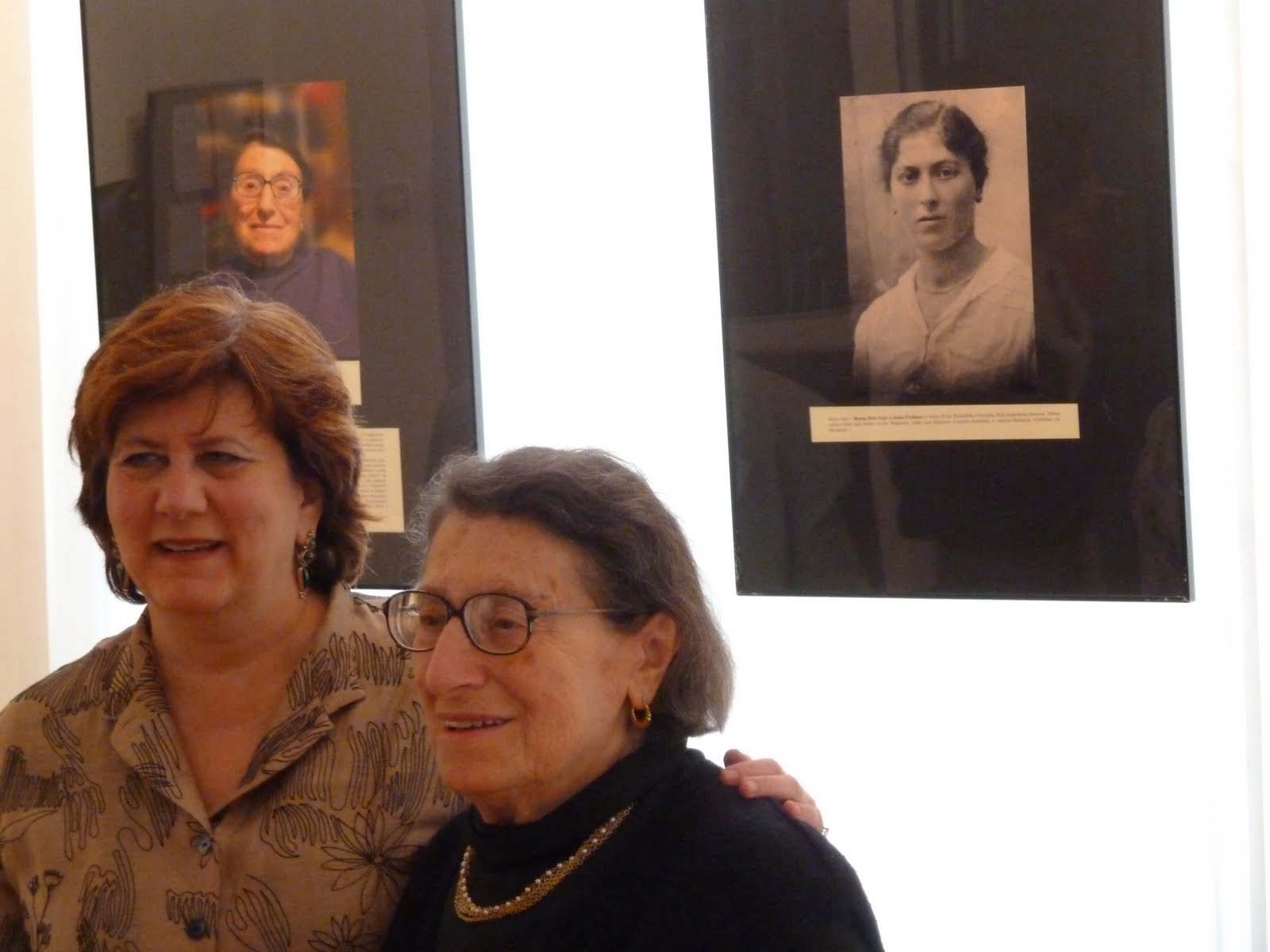
I have always had strong friendships with women of my mother’s generation, something that becomes more difficult with time as so few of them are left. This year my friend Dora invited me to join her family for her Mother’s Day brunch. Dora is 99 and was born within two years of my mother. We have gotten together weekly since we met almost thirteen years ago. It was a connection of bashert (Yiddish for fate). We were introduced by two separate friends, one in Israel and one in my community. I was creating a website on the former Jewish community of the Polish town from which my grandfather came. Dora was born in that town. She survived Auschwitz and Bergen Belsen and later came to Minnesota after the war. 


Susan and Dora at  our show in Poland

We have traveled back together to our shared ancestral town. I showed artwork there together with photographs of Dora’s pre-war and ghetto life, photos that survived hidden in her family members’ shoes. On a weekly visit in 2020, just prior to Covid shutting the world down, Dora told me she had a little project for me. Now I should have been suspicious when she said “little.” There is no such thing as a little project, for me or for Dora. They always expand. She wanted to document her relationship with seven generations of women dating from her great-grandmother to her great-granddaughters. She sat between those two poles and reached out her hands to touch them all, from great-grandmother to great-granddaughter, she was the point of connection.

The following week the world shut down. After such steady contact with Dora for ten years, I wasn’t quite sure how we would stay connected, but that “little” project proved to be central to our evolving relationship. It also proved important in giving her a purpose and a connection in a time of great isolation. We set up a weekly phone call and, on that call, I interviewed her. She would talk and I would type. By this time, I knew much of her story. She had told parts of it on video when we were in Poland. Later she told me stories that I painted. Sometimes she used the paintings in her classroom talks as a Holocaust educator. I would interview her and show the image of the painting. She would tell the story. 


But this was somehow different. It was a continuous thread, from childhood through the Holocaust, the loss of family members, the chanciness of survival. She told me of life after the war in a displaced person’s camp and attending university in Germany, going to school with former German soldiers. When asked where she was from, she replied, “The east.” It was only when spring came and she wore short sleeves that they noticed the number tattooed on her arm. In 1950 she and her husband immigrated to America. There she found her way in a new culture, returning to school for a graduate degree, starting a family and a career, then telling her story as a Holocaust educator. It gave me the shape and contour of a life, one which was lived in a purposeful way, with intention. 


After we could get together again, we began to meet at her home. Rather than going out to lunch, I now bring lunch to her. Afterwards we pick up the thread of her story. We are often faced with the limits imposed by aging. Her sight is impaired, so we were reliant on hearing. As her hearing worsened, I improvised with technology so she could hear what I had typed to review and edit. I set up a speaker and used the speak option in Word in a male voice which was easier for her to hear. I would jot her changes and then add them to the version I had uploaded to the Cloud. Her grandson, a journalist, was our editor. He would read through it and make changes, move passages around and leave questions for me if something was unclear. I would pose his questions to her and send him a note back with her replies.


Dora in Warsaw at memorial to deportees

We are nearing the end of the story, writing a conclusion. There was a symmetry in recent events which speaks to the cross-generational theme of this project. Recently, I was at her home when she and her daughter were on Zoom to a class at the university where Dora talked of her experience during the Holocaust. A few days later she testified at the state Capitol in support of Holocaust education. She had been nervous going there. She had spoken to many large groups and never seemed to be ill at ease, but this time she felt the weight of what she was doing. There was a consequence that was important. She had to get it right, to make a difference. I got several emails that day from members of the press trying to locate pictures of her as a young woman. Her daughter, who was with her, didn’t have easy access to the photos and had referred the press to me. I sent the photos off and later watched her and the photos on the evening news. She was the star of the show, an articulate spokesperson seeking to make a difference for subsequent generations, for those great-grandchildren for whom she had written her story. 


Sunday, January 8, 2023

Of Islands and Remarkable Women

So here's round two of favorite reading from 2022. Some seemed to pair conceptually even though quite different in content. One story explored the relationship between an island and the people who populate it, another the Covid virus and the lives of the people within a restricted island of safety. One offered a view of the often-untold story of remarkable women in Victorian times, another an all too relevant view of the China-Taiwan history through the experience of two remarkable women. One, of course, was also trapped on an island. I found all of these books remarkable and hope you do too.


Existing on an Island


The Unseen (2020) by Roy Jacobsen is a book I was unlikely to find on my own. Too quiet I would have said about this Norwegian writer recommended by a bookclub friend. And yet, I found this book quite enchanting. It is about an island and the people who live there. Life is not easy there and their character is not etched with words, but with their actions in this challenging environment. And yet they are deeply formed and people of clearly defined character. The island is a character as much as its stoic inhabitants, the weather and the sea are as well. They all exist in relationship to each other; the islanders engage with their surroundings to carve out their existence and find meaning in that effort. The novel itself is composed of carefully chosen words that construct a world that would be foreign to many of us.


I loved Lucy by the Sea (2022) by Elizabeth Strout and read it in one day. It had a simplicity to it that made you feel as if you were having a conversation with a friend. From an island of safety in Maine, Lucy shares a home with her ex-husband as they watch Covid emerge and send its tentacles throughout NY, touching friends and family as its grip tightened. Another theme that played out through the book were former partners maintaining close friendships, forgiving and accepting each other for who they are and continuing to grow in their relationship as they age. And yet a third theme of the relationship between adult children and their parents as it unfolds against the backdrop of Covid. Life is not simple for anyone, but the growing and deepening relationships keep them connected despite the turmoil that surrounds them.


 Remarkable Women


The True History of the First Mrs Meredith and Other Lesser Lives (2020) by Diane Johnson is a reframing of the past through present-day eyes. It was originally written in 1972 and was reissued in 2020 with an introduction by Vivian Gornick.  It looks at those famous male authors who we can find in Wikipedia, one the father of Mary Ellen Peacock and the other the husband. And then it takes a step to the side and dives into the “lesser” life of Mary Ellen, a woman of the Victorian era who was raised to think and express herself freely. Her life had a challenging trajectory, her mother went mad, and Mary Ellen left her well-known husband for an artist, then died young. In the meantime, she left much documentation of her life and her thoughts, all captured in pithy footnotes. It creates a captivating portrait of a thoughtful, engaging and for her time, unconventional woman. 


In Daughters of the Flower Fragrant Garden (2022), Zhuqing Li tells the true story of a family where two sisters found themselves separated between Mao’s China and Nationalist Taiwan during China’s civil war. When what was to be a short visit to a friend resulted in Jun being trapped on an island held by the Nationalist Army, a separation of over thirty years ensued.  The sisters came from a family of wealth, long lineage and Nationalistic ties, a background particularly troubling for those trapped in Mao’s China, who were punished and “re-educated," sent to primitive villages and forced from successful careers. Juan’s sister Hong, a doctor deeply committed to women’s health, met such a fate, ultimately recovering her career, but assiduously avoiding any political connection, even cutting all ties with her sister in Taiwan. The book explores how they each navigated this schism and the environment in which they found themselves.

Wednesday, December 28, 2022

Readings: Bridging the Space Between


Since 2010, I have compiled my favorite books that I read each year. It allows me to trace the topics that have intrigued me over time. I often find recurring themes and this year was no exception. Many had two threads to the story, past and present which ultimately weave together, bridging time and deepening understanding of past to present. Others invoke that liminal space between life and death, often bridged through the suggestion of ghostlike presences. And one addresses a different kind of liminal space, that between sleep and wakefulness.  

Past and Present


One of my favorite authors is Geraldine Brooks. Her books are a rich exploration. Her newest book Horse (2022) is a story of a racehorse and of race. The racehorse is Lexington, one of the most famous racehorses of all time. Coupled with his story is a story of Jarrett, his black groom who raised him from a foal and accompanied him throughout his 25-year lifetime. While a highly recognized and rewarded slave because of his special skills, Jarrett still functioned within the boundaries of slavery. When he sought to buy his freedom, his owner reminded him that as his slave he couldn’t own anything so the money he offered should revert to his owner. A magnanimous owner, he did not impose that requirement, but reminded Jarrett that it was his choice, not Jarrett’s. Paintings were desired of these celebrity horses and were valuable in the horse business of racing and trading. A practitioner of equine art is introduced into the plot and his work reaches into a modern-day story tied to the horse in question. Even the horse’s skeleton becomes an element within the modern-day story. I found myself searching for the outlines of history and it was never far away. Set at the time of the Civil War it was told with accuracy. Jarrett is an imagined composite character as are the two modern-day protagonists, but everything else was clearly documented in history as the reader is given a front row seat. 


Once on a visit to Chicago, I stopped by the Holocaust Museum in Skokie. There I discovered a show composed of letters written by newly freed African Americans post-Civil War seeking their families from whom they had been separated. It was both touching and heart-rending. I was struck by how I had never contemplated the separation of families and the efforts to rejoin them after the Civil War, although I was certainly aware of the similar search of Holocaust survivors for remaining family after WWII. The Book of Lost Friends (2020) by Lisa Wingate takes this period and explores it through one of those past and present books with two layered story threads, one in 1875 Louisiana and the other over a century later in the same location. As a family historian, I often focus on the connection of past to present, a connection that allows us to make sense of today's world resting on the bones of the past. 


Sunjeev Sahota’s, China Room (2021), is another novel with two threads, past and present. Despite its perhaps misleading name, it is set in India and its reference to China is the crockery variety. The first and most compelling story dates to 1929 during a time of arranged marriages. Three Indian women are married to three Indian brothers. The conceit around which all revolves is that none can identify which is their husband in daylight -opaque marriage veils and only nighttime assignations create this circumstance. Mehar, a fifteen-year-old from a poor family, believes she has identified her husband only to be in error, leading her into a love affair with another brother. Seventy years later her great-grandson arrives from England and discovers the traces of her life and the story behind it.


Life and Death


The Sentence (2021)by Louis Erdrich was an especially intriguing book to me as it is set in the community in which I live during the time of Covid and the unrest after the George Floyd murder. To make matters even more interesting, it incorporates a ghost story with a permeable veil between this world and the world beyond. A former customer continues to haunt the bookstore and Tookie, our protagonist, must contend with her presence. Erdrich writes of what she knows, setting this story in a bookstore, no doubt modeled after Birchbark Books, the store she runs in real life. Through the guise of Tookie, we are also offered a variety of additional book recommendations. 


Ghosts seem to be a feature in Erdrich’s writing as the line between the living and the dead seems often quite permeable. In The Night Watchman, (2020) a fictionalized story is based on Erdrich’s grandfather and the important role he played in fighting termination. Termination efforts began in 1953 and were designed to eliminate the role of the Federal government in controlling reservations, instead passing costs to the states and pushing Native Americans off the reservation and into the cities. The result often meant the loss of their reservation lands and the government support which was in fact to be compensation. This is one of several plot lines as the Native Americans organize to challenge this strategy. While the character who represents her grandfather drives this storyline, the broader community is interwoven with a cast of strong characters that we come to care about, both living and those who have passed on. Strong women rooted in Native American culture show the way to a future navigating two worlds successfully.


I loved Maggie O’Farrell’s Hamnet so was eager to read her new book The Marriage Portrait. But first I heard her do a reading where she was asked about her memoir, I Am, I Am, I Am (2018). Before I moved to her latest novel, I took a detour and read this most unusual memoir which explores the close calls with death or danger that she somehow evaded. Each chapter focuses on the physical point of vulnerability in her body. It culminates in the life-threatening situation which grips her most deeply as she watches her daughter’s life precariously perched on that thin line that separates life from death. I took away from that book a new appreciation of the opportunity to live each day of our life and the vulnerability which always hovers nearby.


I then moved to The Marriage Portrait (2022), based on an actual marriage in 1558 which similarly sits atop a deep sense of vulnerability between life and death. A young girl of 16 enters a marriage with a ruler who fluctuates between a heightened sensitivity and understanding of his bride and a cloud of threat which makes her fear for her life. It is underscored by the sense of vulnerability women of that time faced in a marriage should they not produce an heir while subject to the control and whims of a spouse. I thought back to Hamnet which also focuses on the thin line between life and death. This seems to be the theme that intrigues O’Farrell through these books, a thread in her own life which informs her choice of material.


Sleep and Wakefulness


Colson Whitehead’s latest novel Harlem Shuffle (2021) is quite different than his earlier books The Underground Railroad and Nickel Boys. It is a character study of both the people and the place, New York Harlem in 1959. I found myself especially intrigued with a concept that it frequently referenced dorvay, a derivation of Ray Carney, our protagonist, from the word dorveille. The word is formed from the French words, dormir and and veiller, to sleep and to be awake. It came from a time before electric lights when people split their sleep in two, waking in the middle to perform those tasks that somehow eluded them in daytime hours. Carney thought of himself as coming from a crooked beginning with a father who was, well, a crook. He however was just slightly bent and dorvay was when the straight world slept and the slightly bent got to work. Carney bridged the world between the straight and the crooked, living a life perched on a tightrope between the two. How he resolves this contradiction is the story.


Stay tuned for a few more topics on islands and remarkable women!

Wednesday, October 12, 2022

Layers of Time

When my mother was in her final years, I often traveled to spend time with her. She lived in Peoria, the town where I grew up, still in my childhood home. It was an eight-hour drive and a week-long visit.  I explored the city with her, rediscovering it myself as we visited museums and gardens. We shared special moments, but it was also challenging as her memory fled. I needed a periodic escape to be fully present for her and began reconnecting with old friends from college and post-college days. One evening at dinner, a friend noted that when my mother was gone, my visits would cease. Of course, he was right, but it had never occurred to me, acknowledging my mother’s future absence was not something I could easily conceive of – emotion clouding the logical inevitability.


His prediction came to pass in 2015 when my mother passed away.  I came down again in 2016 for the unveiling of her tombstone and the sale of my childhood home. After that, there was no reason to make that lengthy trek–– until I received the invite to my 50th high school reunion, one year delayed because of Covid. I had never gone to a high school reunion. High school was not my happy place, but rather something I needed to get through to get on with my life. I began to poll my friends on whether they had ever attended a reunion. There were two schools of thought, those who encouraged me to go and those who insisted they would never ever go to a reunion. The former tended to have an air of conviviality that would serve one well at a reunion. I am much closer in temperament to those in the latter group. 


I hold no sentimentality for high school or any of the schools I’ve attended. I’m not much good with the rah-rah stuff, hated pep rallies, don’t follow college sports and have no interest in graduation ceremonies. I skipped two of mine. I love learning, it’s the sentimentality and ceremonial parts that felt foreign to me. And then there is the question of ownership. There are those who owned high school. They were the stars of that show, attended the reunions and basked in the sentimentality of those years.  I understand the concept of owning one’s space better now as I do that in my spheres of interest. It is a good feeling, being recognized for what you do well, a feeling of belonging.  I am grateful to feel that in my life. Still, high school wasn’t my space, and to enter a place and time that didn’t really belong to me, I needed reinforcements. I started a message group with a couple of high school friends who I’d connected with on Facebook. They too were debating attending and shared similar sentiments. Slowly we converged on a decision to attend.


These were the thoughts that occupied me as my husband and I set forth on that long drive. Our route took us through the Driftless area, a region that covers portions of Wisconsin, Minnesota, Illinois and Iowa. This region wasn’t covered with ice during the Ice Age so lacks deposits of drift, hence driftless, but by no means unfocused. It has steep hills, bluffs, dense forests and deep river valleys. The Mississippi River cuts through the region creating amazing vistas and overlooks. Add to that fall colors and my usual napping in the car was held in abeyance as I absorbed the extraordinary beauty of our drive. It felt like a prelude that demanded something equally worthy.


In my purse were several colorful stones I was bringing to place on my parents’ gravestone. My parents’ presence still pervaded my sense of the city. I remembered when my father took us on what we jokingly termed the Phil Weinberg memorial tour. First to the studio of an artist to see a portrait he had just completed of my father, then to their burial plots. Some years later, we gathered in front of his portrait for a family photo after his funeral. Perhaps this was a memorial tour of my own, saying goodbye to a city I was unlikely to return to anytime soon, a city vested with a rich layer of memory. I suppose it is only fitting to have it begin with high school friends, some dating back to grade school.

We stopped for dinner at the Landmark Cafe in Galesburg, a nearby city.  I noted the stamped tin ceiling, brick walls, and a curious window, not sure if it was a decorative feature or an actual window. My husband stopped at the car to pick something up and on his return announced there was a courtyard that the window overlooked. I looked around me again with dawning awareness, picturing the room, its window and door from the opposite side. I logged into my pictures, pulling up a photo of my mother sitting in that courtyard eight years earlier smiling happily at me. It was the beginning of something I experienced throughout my visit, an odd sense of layered time. Past and present co-existing with an accompanying sense of dislocation.


Once in town everything seemed different, yet oddly familiar. My husband asked if I wanted to drive, quickly regretting that proposal as we both remembered the reason he usually drives. He is a horrible passenger. But I needed to drive to get my bearings in this strange mix of the familiar turned on its head. I drove by that old pink house in which I grew up, well more like a watered-down burgundy, now painted white. There was my mom’s old car in the driveway. We had sold it along with the house. I stealthily took a picture out the car window.  


We went to lunch in an area I remembered for interesting shops and restaurants only to learn the familiar places were gone.  Finally, we settled on Cayenne, a place painted with a Day of the Dead theme, grinning skulls on its walls. Once again, I had this déjà vu moment realizing that this was formerly a more sedate restaurant named Salt. We had gone there after my mother’s funeral. I reimagined our table of family amidst the skeletal grins.


Later we went to the cemetery. I said the Kaddish, the prayer for the dead, and placed my stones atop my parents’ pink marble tombstone, their new pink home. I had started a new ritual on my last visit. Three months before my father died, my parents had called my answering machine and sang Happy Birthday. I kept the recording and played it on each birthday since. My last visit to their graves was around my birthday so I had conjured them up with a rousing Happy Birthday song from cyberspace. Now as my birthday loomed, I again summoned their spirits, letting their voices waft through the graveyard.


That evening we joined old college friends for a Friday night art crawl and dinner. We had a satisfying visit, filled with deep conversations that I had missed. At the reunion the following evening, I enjoyed connecting with childhood friends. Many people were no longer recognizable as the teen in my memory. No one escapes aging. We were the fortunate ones as the list of those no longer with us grows. Since then, life had layered its own disruptions and challenges on everyone in that room, the great leveler. We all live layered lives, juxtaposing times both past and present.


We drove back through the Driftless area, stopping at a vista near which locals had set up a table selling homemade jams. My husband recalled our return from a visit to my parents many years ago. We had stopped there to enjoy the view and had of course purchased jams, likely from the same merchants who confirmed they had been selling there for almost twenty years.