Sunday, January 26, 2014

A Matter of Vision

As I wrote in the prior post, I have been thinking about how to express the topic of vision in the sketchbook project. I am to fill 3 or 4 pages and then consider some repeating feature that is carried throughout to create a sense of flow. Then I send it off to other artists to add their creativity to the remaining pages. I must confess to being too intimidated to mark directly in the accordion fold moleskine. Instead I decided I should at least start sketching outside of it and see if I come up with anything I can use and glue it in later. It is beginning to take shape and I thought it was far enough along to share with you here.

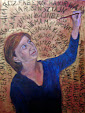
As you may recall my theme is vision and I am basing my material on the experience of my friend who has macular degeneration and has learned how to manage within its constraints quite competently. On my last visit she showed me how she reads her mail and I took some pictures as source material. Now I began to sketch an image of her as she read, one round magnifier on her glasses lens, pressed up against another on the page she was reading. In this fashion she is able to read brief information.

I have been thinking about my conversation with her when we last went out to eat and I was startled at her perception of me picking up chopsticks. "You can use those?" she questioned to which I had replied, "You can see them?" Often movement or contrast gains her attention and I have to remind myself that legally blind isn't totally blind.

Since this sketchbook is mine, I thought I'd put my own image at the beginning. I had my husband take a picture of me holding chopsticks with the quizzical appraising glance I had turned towards my friend when she asked her question. I am picturing a pattern of chopsticks falling from the sky in the blank space in front of me. I'd like to include some text that tells a little of her story and the exchange which prompted the portrait.

I had printed out the image of my eye from my eye doctor, quite otherworldly in orange with the inner eye in yellow, a sun around which all orbits. I cut out the image of my friend and of me and began to arrange them on the page as I imagined them, although the page is actually four folds that unfold into one or can stand alone. I wanted her against the background of the eye with the yellow sun out in space as if she were an astronomer examining the universe. I also wanted some space at the bottom to include text. I decided to continue the background of the eye behind my figure to unite the pages. In front of me I cut out chopstick forms from the print of the eye and placed them in the open space. I will write out our exchange in a delicate ink pen and perhaps continue with text next to her figure.

I am also thinking that the form of chopsticks cut out of the same color as the eye, scattered throughout the sketchbook will provide a unifying theme that others can incorporate into their own artwork.

With it laid out I can begin to weigh other decisions. I may add some paper to round out my figure so it isn't cut off by what was the edge of the paper and create more of a sense of flow between the two figures. I also am considering whether to add ink to my figure as I have used it in the other. Every artistic creation is filled with many such small decisions and it is often surprising how one seemingly minute decision can pull it all together.

Monday, January 13, 2014

The Inner Eye

I haven't written recently of the Jewish Artists' Lab because I've been writing a separate blog for the group. It is a little different in style, more focused on sharing specific content, a bit less my own ruminations. Meanwhile I've been thinking about what I hope to work on for the Artists' Lab exhibition on the theme of Light later this year. 

I may try on more than one idea between now and then and will have an opportunity to explore some ideas through a sketchbook exchange. The project will involve trading a sketchbook between artists at labs in Minneapolis, Madison and Milwaukee. I am thinking the sketchbook project will allow me to test out ideas in perhaps a less finished form or at least on a smaller scale. I have to decide on a theme for the one I initiate and will respond to themes of four other artists. All themes will relate to light in some fashion.

Now what I am contemplating is vision. My friend has macular degeneration and is legally blind. I hang out with her a lot and we've talked a lot of her "handicap" as she puts it. I am also awestruck with the way she moves forward despite it. She has become my role model for how you deal with the challenges that ultimately befall each of us. As her friend I've had an opportunity to consider vision through her eyes. When I went to Poland with her she knew the city streets on which she grew up even though she couldn't see them. She talked of seeing in her mind's eye. So that's a kind of vision.
When she lost her vision, for a time she also lost her vision of her life as she had known it. She told me that life became worth living again when she discovered the Library of Congress had books on tape. Suddenly she could read again. My scope expands to loss of vision, both literally and a vision of how one imagined one's life, then regaining a vision of a renewed and different life.

I also think about magnified vision, how she translated her father's memoir from Yiddish with the help of a magnifying machine, one letter at a time. Again there are two kinds of vision, the vision she held of this book published and the act of using her limited vision to translate it.

I am always trying to gauge the extent of my friend's vision. Recently I took her to lunch and as I manipulated chopsticks, she said, "You can use those things?" To which I replied, "You can see those things?" She seems to notice movement or contrast, but can't see my face. I kneeled down and looked up."Now can you see me?," I asked wondering if I became non-central vision if it might help. "Not clearly", she replied. When I recently had my eyes examined they took a picture of the eye, an orange globe with blood vessels like tree limbs, actually quite beautiful. In the middle there is a yellow light. While I am sure there is some technical term that strips away the mystery, I like to think of it as the inner eye. I looked up macular degeneration and there was the image of how it looks in a diseased eye, still quite beautiful, but now with the result that central vision is destroyed and peripheral vision remains. I can see a painting with the central portion blurred out.

It dawned on me that the place where I had my eye exam might have a photo of my eye that they could share with me and sure enough they did. Now I need to contemplate if it might work as a background for other imagery on this theme. How I depict it in a cohesive and pleasing way remains to be seen, but my starting point is always a many layered idea.

Monday, January 6, 2014

The Collective You

I am always intrigued by which of my blog entries get the most readership and response. I write on the subjects that interest me and presumably some of them interest you as well. By classifying my blogs by topics and looking at hits and likes I get a sense of who you are. I often find myself having a conversation with the collective you as I write what has become in many respects an on-line journal. Now an on-line journal has some rules that a private one may not such as don't say something that you don't want a family member, friend or future employer to read. Even with that caveat, people know some things about me and that is a bit eerie for a one-time private person. I was once introduced at a talk and was surprised at how much the introducer knew about me. Midway through his introduction it dawned on me that he had read this blog. Kudos for research, but I must admit it threw me. Fortunately I try to calibrate what I put out there to my personal level of comfort with exposure.

GenealogyOver the past year it looks like one of the heavy hitters was a blog entry I wrote on a session at the International Jewish Genealogy Conference titled Making Sense of Genealogical Clutter, Another session on Informing Your Search Through Literature also received many hits. Genealogy blogger Emily Garber reported on bloggers at the conference making it easy for those with interest to follow up.

Personal ReflectionI wrote a number of blogs that I would put in the category of personal reflection that also received a substantial number of hits. One was on My Intergenerational Self, a theme that supports my quest to explore the stories of elders. In short it claims that knowing your history strengthens your ability to deal with the world. I first learned of this concept in a New York Times article by Bruce Feiler and that spurred my ruminations. Another one within the category of reflection was titled A Declaration of Being about the act of saying, "I am an artist or a writer" or whatever identity you may be reaching towards.

I also periodically write about family, especially my mother, now in her late 80s and dealing with the challenges of aging. While these get a middling number of hits, they get a lot of likes. I suspect many readers have dealt with similar experiences and find them easy to relate to. Some of those are Shared Memories, Blowing Kisses and Unveiling.

TravelStories, Observations and a Few Odd Facts, a synopsis of exactly that from my time traveling in Israel, received many hits.

I frequently write about discoveries when I travel and while in Boston this year I discovered amazing artwork both in and out of typical venues and wrote about it in Unexpected Finds.

HolocaustI attended a workshop on the Holocaust this summer and wrote about it in Creating Collective Memory. In the workshop we explored how memory is created and preserved and the different stages the world went through in fully acknowledging what had occurred. Also on this topic, I wrote of the book Sky Tinged Red, the memoir by Isaiah Eiger. My friend translated her father's memoir from Yiddish and it was published with the aid of her grandsons. The book explores Eiger's two and a half years in Auschwitz. The story of its discovery is also compelling.

Art RelatedLast year I wrote about the Artists' Lab in which I am participating and the blog on Endings received considerable readership. This year I am writing about those in a separate blog, but will periodically report on it here as well. I wrote a blog entry quite recently in my Artists' Lab blog that surpassed all of these in hits.You never know when you are going to strike a chord. This blog, Look to the Skies, touched on topics relevant to this year's Artists' Lab theme of light and explored sundogs, reflections in the sky from ice crystals, as they have been addressed in the Bible and art.

Sometimes a blog seems to speak to a more targeted readership, but they respond strongly with likes. I am always happy to see that happen with ones on my artwork as it helps me gauge how successfully I reach my audience. Beneath the Stairs was one such blog, telling one of my friend's Holocaust stories.

All of these topics seem to have their fans. How do I decide what to write about? I write about my life and the things that I come in contact with. That means genealogy, artwork, travel, classes, books and the Artists' Lab. Sometimes a blog is spurred by an outside stimulus, a public radio story, a lecture or a news article. I'm a reflective person so you also get my thoughts woven in. The reflection blogs are actually the easiest to write. They tend to spill out of me, but they are the hardest ones when it comes to pressing "publish". "Have I shared too much?" "Is it too self-absorbed?" "Will anyone care?" All questions I wrestle with before hitting "publish". So please let me know if you like something and share your comments. It makes blogging so much more satisfying.


Thursday, January 2, 2014

In its Own Time

I have for the most part ceased to make New Year's resolutions, save for the annual resolution to work out more, never quite satisfactorily achieved. I find that my inner need to be productive will cause me to achieve new things anyway and there will be surprises that I cannot conceive of from today's vantage point. When I look back on my past year, I feel a sense of movement. New opportunities arose and I was ready for them. Sometimes I gave them a nudge as well. I am heartened and encouraged that perhaps the same will be true of the new year.

And yet, 2014 feels a bit different, a transitional year of sorts. Seven years ago I left my job and embarked on an adventure into the unknown. It has taken me wonderful places that I could never have anticipated, into artwork, story and the opportunity to share it with others. Seven years often represents a cycle and I am feeling as if I am about to embark on another adventure to yet another unknown destination. I must confess that gives me a bit of unease as I like to know where I am heading. And I'm not quite sure.

I remind myself that it is not always about producing. Sometimes we need a quiescent period, a time of stillness during which we nourish ourself, before we have more within with which to create. 2014 may be such a year for me. Looking back, I realize that 2007 was also such a year, a year of laying the groundwork on which I began to build.

In 2007, my first year post-job, I began things that didn't take shape until the following year. I planted seeds. I began a series of paintings on family history. I submitted a proposal for my first solo show. I spent a month in China. Those baby steps resulted in three solo shows and two bodies of work in the following year. Not everything matures in the space of a year despite our tendency to define time in that manner. Many of the things I do in my work today had their seeds in that early period.

Each year I go through my annual number counting exercise. How many books did I read? How many blogs did I write? Websites design? Exhibitions hang? Paintings complete? Talks give? I realize numbers don't tell the tale fully, but they capture a certain momentum and focus. I also look for firsts. What did I do this year that was new? What caused me to stretch, for it is in the stretching that I begin to create new directions. Much to my surprise I realize that with the sole exception of reading and painting, the things I now count all were a first for me during the past seven years. My first public non-work speech, my first website, my first solo show, my first blog, my first video. I stretch into the challenge and discomfort of something new. Then I reinforce it by doing it again and again, each year adding a few new firsts. I feel a bit like a juggler, continually adding new plates to my routine until I move faster and faster to keep them all in the air.

Now 2014 may not be the year when I let all the plates clatter to the floor, but it may be the year when I slow my pace down, take a class in a new artistic medium or a writing workshop. Put less emphasis on immediate results. Hone my craft. Experiment with some new approaches. Too much activity can get in the way of hearing myself, so this year may be one of listening. Often when we state an intention publicly it moves us in a direction. Rather than my normal intentions to take action, this intention is the reverse. I hereby give myself permission to not take action, to explore in a testing and meandering way, feeling my way with no clear outcome in mind. Perhaps I'll trip over the next step when I let it happen in its own time.


Wednesday, January 1, 2014

Recommended Books: Jewish Content

Recommended Books: Jewish Content

  • A Day of Small Beginnings by Lisa Pearl Rosenbaum
  • A Hole in the Heart of the World: Being Jewish in Eastern Europe by Jonathan Kaufman
  • An Uncommon Journey by Deborah Strobin and Ilie Waks
  • Behind Enemy Lines by Marte Cohn
  • Crossing the Borders of Time by Leslie Maitland
  • Enemies of the People by Kati Marton
  • Ester and Ruzya: How My Grandmothers Survived Hitler's War and Stalin's Peace by Masha Gessen
  • Everything is Illuminated by Jonathan Foer
  • Fire in the Blood by Irene Nemirovsky
  • Frauen: German Women Recall the Third Reich by Alison Owings
  • From That Time and Place: A Memoir 1938-1947 by Lucy Davidowicz
  • Guide for the Perplexed by Dara Horn
  • In the Garden of Beasts: Love, Terror and An American Family in Hitler's Berlin by Erik Larsen
  • Jewish Luck by Leslie Adler and Meryll Page
  • Man in the White Sharkskin Suit by Lucette Lagnado
  • My Father's Paradise A Son's Search for His Jewish Past in Kurdish Iraq by Ariel Sabar
  • Not Me by Michael Lavigne
  • Outwitting History by Aaron Lansky
  • People of the Book by Geraldine Brooks
  • Ponary Diary 1941-1943: A Bystander's Account of a Mass Murder by Kazimierz Sakowicz
  • Prague Winter by Madeline Albright
  • Rashi's Daughters, Book I, II and III by Maggie Anton (3 separate books)
  • Sarah's Key by Tatiana de Rosnay
  • Septembers of Shiraz by Dalia Sofer
  • Shtetl: Life and Death of a Small Town and the World of Polish Jewry by Eva Hoffman
  • Sky Tinged Red by Isaiah Eiger
  • Smuggled by Christina Shea
  • Songs for the Butcher's Daughter by Peter Manseau
  • Stranger in My Own Country by Yascha Mounk
  • Suite Francaise by Irene Nemirovsky
  • The Baker's Daughter by Sarah McCoy
  • The Dove Fancier by Bernard Gotfryd
  • The Forgetting River by Doreen Carvajal
  • The Girl From Foreign by Sadia Shepard
  • The Girl With the Gallery by Lindsay Pollock
  • The Golem and the Jinni by Helene Wecker
  • The Great Escape by Kati Marton
  • The Great Jewish Cities of Central and Eastern Europe by Eli Valley
  • The Hare with the Amber Eyes by Eduard de Waal
  • The Heavens Are Empty by Avrom Bendavid
  • The Invisible Bridge by Julie Orringer
  • The Jew Store by Stella Suberman
  • The Lady in Gold by Ann-Marie O'Connor
  • The List by Martin Fletcher
  • The Little Russian by Susan Sherman
  • The Lost by Daniel Mendelsohn
  • The Pages in Between by Erin Einhorn
  • The Watchmaker's Daughter by Sonia Taitz
  • The World to Come by Dara Horn
  • The Zookeeper's Wife: A War Story by Diane Ackerman
  • Those Who Save Us by Jenna Blum
  • Too Jewish by Patty Friedmann
  • Virtually Jewish: Reinventing Jewish Culture in Europe by Ruth Ellen Gruber
  • We Are Here by Ellen Cassedy
  • Where She Came From: A Daughter's Search for her Mother's History by Helen Epstein

Thursday, December 26, 2013

The Clutter Within

I've been thinking lately about identity. Now one of the reasons I've been thinking about this is because I am preparing to dispose of belongings that no longer relate to the me of today. As a historian of sorts, I find it very difficult to let go of my history and its physical remnants. It occurs to me that perhaps I need to understand these attachments before I can let go. My history forms my identity and when I pitch its physical proofs I am releasing part of who I was. Hopefully it also opens me to new possibilities of who I will be.

So what is this stuff that defines us? Some of it is the everyday stuff of living and those things tell a story of who we are. Our things are intricately interwoven with our identity. I went to my car the other day and chuckled at what one can tell about me from the clutter within. In my 2005 Prius I have two yoga mats and reusable bags from Trader Joes and Whole Foods. There are frequently programs from theater events and nonprofit boards on which I serve. The detritus of my everyday life tells you something about me without me even being present.

The category of stuff that I find most challenging is that of papers and books. I come from a family that is inordinately fond of information. An old friend used to joke that if you plotted information density there would be a huge vibrating black dot over my parents' home. For years my father videotaped everything that interested him as if the act of videotaping acquired all of the knowledge contained within. I am afraid that I am also guilty. Information gives me comfort even if I absorb it only by osmosis.

I have books that I know full well I will never pick up again, but they represent my history of reading. While electronic reading and a list now satisfy my sense of ownership, there is still that history reflected in very tangible books from my past. And then there are the books that populate my shelves that I never read and think I might someday, I remember one time I picked up a Jack Finney book from my shelves and was captivated by time travel. Now I contemplate what other treasures might be lurking. Kind of like shopping your closet.

I once asked a friend how she kept her home so tidy, cleansed of that paper that finds its way to the level surfaces of my home. She motioned to a cluster of woven baskets which she filled up with papers before guests arrived. Upon my return, I went out to Bed, Bath and Beyond and purchased several large baskets which worked perfectly until they were full. I had forgotten to ask her about the next step. How do you empty them? Or do you? Perhaps you just buy more.

Over time I cobbled together an approach. Periodically I go through them and throw out information on events that have passed, but there is a perma layer which always remains. So what is in that layer? A Jewish children's book that I got in the mail. I don't have kids and my step-daughters' kids aren't Jewish. So why do I hold onto this? Well first of all, it's a book, but does it perhaps reflect some sense of the road not taken? I have articles on places I've visited and places I'd like to. Ironically two are about a place my husband and I are planning to visit soon, but I made the reservations totally unaware that I had these articles. There is a sketch of Tai Chi poses an old friend recorded for me almost 20 years ago. Every time I pull them from the perma layer, I think, "Perhaps some day I'll try them" and with that thought, back they go. These scraps seem to represent an identity as well, often the one not assumed, but that coyly beckons.

I was listening to MPR recently and heard a show from This American Life on Andy Warhol's time capsules, 610 boxes of detritus that he began to assemble when moving to a new studio. Someone suggested that he box his stuff and call it art and he went with it. Three women are charged with cataloging his stuff and have a sense of knowing him from his belongings. They talk about which relationships he was happiest in and which of his partners they prefer. From such ephemeral items as a note from Bianca Jagger signed with a lipstick kiss to dirty underwear, they catalog it all. I totally understand the impulse behind such a project though doubt I'll have the luxury of catalogers. Perhaps I should just buy more baskets.

Thursday, December 12, 2013

A Mystery to Unravel

One of the things that I most enjoy about genealogy are the global connections that emerge. From one town in Poland, I have developed connections around the world. Currently I am doing research for a woman in Australia whose husband came from Radom, the same town in which my grandfather was born. Yesterday I spoke with two Brits on Skype who are interested in visiting Radom and I shared what I knew from my visits there. And as I translate Russian records for my Australian friend, I am drawing on a gentleman in the UK for assistance. Meanwhile in my own town, I've developed a close friendship with a survivor from Radom. I love the idea that the connections from that town radiate around the world and I am part of that web, often in the middle of it as I do the website for those researching their roots.

As I do research for others, I often stumble across new mysteries and am working to untangle one currently. I recently received records that I had ordered from the archives in Radom for my Australian contact. Among those records were the marriage of her husband's great-grandparents, the birth of their children and the death of his great-grandmother. But something was unusual. The children were born in the late 1800s and the marriage occurred in 1903. In 1904 the great-grandmother died. What does that mean?

One gentleman who helped me with the translation said that perhaps it was a marriage allegata which I believe is attesting to the fact that a marriage occurred. Now my guess is that the great-grandmother was ill at that time and they thought it best to make sure there was a clear trail in the event of death. Our original theory was that there had been a religious marriage, but not a civil one, but we soon learned that was not the case. Interestingly two of the children had the same record date for their births. Now I learned from my own family that meant not that they were twins, but that they had delayed in reporting one of the births until the second one occurred.

The plot thickened when a second translator advised me that one of the birth records noted that it was the father's fault that it was late because he had "annulled" the marriage. The word for annulled was not clearly written so we are continuing to translate other records looking for further clues. We then translated the marriage record which clearly stated that this was a religious marriage and they cited their children's names and birthdates. In addition they included the following language: "With this marriage act (the bride and groom) recognise (the children) as their own, andon the basis of the article 291 of Civil Code of the Polish Kingdom guarantee them the status and the rights of lawful children."

Documents tell a story, but we need to connect the dots. Perhaps this is one for which we will never fully know the underlying story.