I feel a bit like a negligent letter writer when I decide to write a blog post, as if I should apologize for my long absence. Ideas need downtime to percolate and as is oft the case, I have filled my life to excess with little time for contemplation.
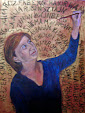
So, what brings me back to the keyboard? It is a practical task that I soon discover has many layers. I have been trying to update my art/genealogy card, a card that has a self-portrait titled Piercing the Veil, from a series of artwork that I did on family history in 2008. And yes, that was a few years ago and the image no longer is the me of today, although the concept of a genealogist uncovering the unknown is still quite apt.
I was surprised to discover that this seemingly simple task is a far more introspective act than I anticipated. I find myself contemplating imagery, the deeper meaning of a name, and the common threads between my artwork and genealogy.
My artwork has changed over time. My early work was largely figurative, paintings of people dominated. I loved the process of discovering a person by painting them, studying them and finding the essence of what makes them who they are. Often just the right line would magically bring their image to life.
During the Covid years, I began walking around my neighborhood. My direct contact with people diminished and I started noticing trees, noticing them in a way I hadn’t previously. They too were figural, often with distinct personalities, and often bearing scars and injuries that drew me to them. I was in an Artists’ Lab and trees became a fluid metaphor for the wide variety of topics we explored.
To my surprise, I also noticed themes in my work beyond that arboreal content. I found that many of my paintings dealt with liminal space, that space in between as we go through change. Liminal space is often a place of transformation. This theme is perhaps best illustrated by my painting Stepping Into the Chrysalis.I recently wrote of the liminal space between sleeping and waking, life and death in my blog post I Thought I Dreamt You. It is often a scary place because we don’t know yet what awaits us or how we will navigate it. In addition to liminal space, I also seem to often take what is hidden and make it visible. In the case of trees, you can see that in Tree Time, a painting of a 4,700-year-old tree where I brought the tree rings into visibility. I did a similar thing with the Burly Tree as I reflected on burls as a metaphor for brokenness and wholeness.
I suppose I should not be surprised that the theme of liminality is also reflected in my genealogy work. Many of my genealogy talks relate to topics of names and immigration. An immigrant is the ultimate liminal being, occupying that space between old country and new, old names and new, as they try on new identities. And what is genealogy but taking the hidden and making it visible. That early self-portrait clearly illustrated that as it spoke to the unveiling of family names arrayed behind me.
I didn’t consciously realize how much of my interest focused on the hidden and the in-between until I studied the
In deciding what to change on my card, I realized that I needed to include a new email as my old email address had stopped forwarding correctly. I needed a new email name, and I knew that “liminal” would be part of it. I soon discovered that others had that same inspiration. After trying several versions of the word, only to find someone had beat me to it, I decided to combine two words, liminal and ruach, creating a new word “Liminachal.” I’ve had a couple people ask me about the origin. I don’t have an elevator speech on what it means so I usually stammer something about it relating to my approach to artwork and genealogy. So let me practice on you with a little more cogent definition.


 Posts
Posts