Showing posts with label liminal. Show all posts

Sunday, September 21, 2025

The Hidden and the In-between

I feel a bit like a negligent letter writer when I decide to write a blog post, as if I should apologize for my long absence. Ideas need downtime to percolate and as is oft the case, I have filled my life to excess with little time for contemplation.

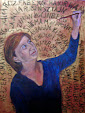
So, what brings me back to the keyboard? It is a practical task that I soon discover has many layers. I have been trying to update my art/genealogy card, a card that has a self-portrait titled Piercing the Veil, from a series of artwork that I did on family history in 2008.  And yes, that was a few years ago and the image no longer is the me of today, although the concept of a genealogist uncovering the unknown is still quite apt.

I was surprised to discover that this seemingly simple task is a far more introspective act than I anticipated. I find myself contemplating imagery, the deeper meaning of a name, and the common threads between my artwork and genealogy.  

My artwork has changed over time. My early work was largely figurative, paintings of people dominated. I loved the process of discovering a person by painting them, studying them and finding the essence of what makes them who they are. Often just the right line would magically bring their image to life.

During the Covid years, I began walking around my neighborhood. My direct contact with people diminished and I started noticing trees, noticing them in a way I hadn’t previously. They too were figural, often with distinct personalities, and often bearing scars and injuries that drew me to them. I was in an Artists’ Lab and trees became a fluid metaphor for the wide variety of topics we explored. 

To my surprise, I also noticed themes in my work beyond that arboreal content. I found that many of my paintings dealt with liminal space, that space in between as we go through change. Liminal space is often a place of transformation. This theme is perhaps best illustrated by my painting Stepping Into the Chrysalis.I  recently wrote of the liminal space between sleeping and waking, life and death in my blog post I Thought I Dreamt You. It is often a scary place because we don’t know yet what awaits us or how we will navigate it. 

In addition to liminal space, I also seem to often take what is hidden and make it visible. In the case of trees, you can see that in Tree Time, a painting of a 4,700-year-old tree where I brought the tree rings into visibility. I did a similar thing with the Burly Tree as I reflected on burls as a metaphor for brokenness and wholeness.

I suppose I should not be surprised that the theme of liminality is also reflected in my genealogy work. Many of my genealogy talks relate to topics of names and immigration. An immigrant is the ultimate liminal being, occupying that space between old country and new, old names and new, as they try on new identities. And what is genealogy but taking the hidden and making it visible. That early self-portrait clearly illustrated that as it spoke to the unveiling of family names arrayed behind me.

I didn’t consciously realize how much of my interest focused on the hidden and the in-between until I studied the patterns in the paintings arrayed on my studio walls. Perhaps we all have themes that we explore in the course of our life. It is only when the patterns shout out to us that they move into our awareness.

In deciding what to change on my card, I realized that I needed to include a new email as my old email address had stopped forwarding correctly. I needed a new email name, and I knew that “liminal” would be part of it. I soon discovered that others had that same inspiration. After trying several versions of the word, only to find someone had beat me to it, I decided to combine two words, liminal and ruach, creating a new word “Liminachal.” I’ve had a couple people ask me about the origin. I don’t have an elevator speech on what it means so I usually stammer something about it relating to my approach to artwork and genealogy. So let me practice on you with a little more cogent definition.        


Ruach
, the word that I partnered with Liminal, is first introduced in Genesis in the creation story. Its meaning is God’s breath. In fact, the line that follows it is “Let there be light.” It is the act of breathing life into something, an act of creation. Creating artwork, when it works, takes me to a liminal space, a transformational one. It requires me to learn to live with not knowing exactly where I am going, but to trust the process.  Hence the uncertainty that accompanies it. Surprisingly, when I enter a genealogy search, I have much the same experience. Amidst that uncertainty, I am hoping for that spark that breathes life into my exploration. I have had to learn in both spheres in my life to not force a conclusion, but rather to let things unfold. To go bravely into those liminal spaces with curiosity and openness to the surprises that await.
So what did I arrive at for my card? I decided to keep an excerpt of my early self-portrait on one side, but introduce my painting of Tree Time on the other side. Since my two passions of art and genealogy are joined in this card, a tree felt appropriate, especially a tree that is 4700 years old and goes by the name of Methuselah.


Saturday, July 1, 2017

Finding Our Wings

This week we had the opening of the Jewish Artists’ Lab show.  It is the fifth annual lab show and I’ve created work in each of them.  My work has changed and evolved with each one, but the one constant is that I always try to eke out more wall space and air time. I am used to working in a series and if I find a compelling idea it often begs to burst the bounds of just one artwork.

We each get a limited amount of wall space, but we also have a presentation opportunity.  There is a performance and those who write stories or poetry can do a reading.  I started the lab, not fully defining myself as a writer or a poet, but have gradually stepped into that space, in both performing and doing a blog for the lab as its Resident Writer.

For many of the shows, I have combined painting and poetry. By the third I couldn’t restrict myself to one painting any longer so I deemed my two complementary paintings a diptych and set up a memory jar for attendees as part of an interactive exercise. This year I went all out and did a triptych with five paintings, a central one, two panels on the front that open with paintings on the back as well. It is a layered piece in both concept and execution. I’ve shared a bit on the work's development in this blog previously. Since then my husband built an amazing frame for it, so I could assemble all those pieces. Of course, I wrote poetry, still greedy for more.

My work is called Stepping into the Chrysalis and is about the idea of liminal space, about how we re-invent ourselves, stepping into new space and redefining ourselves as we cross internal boundaries to become someone new. That first time that we say, I am an artist, or I am a writer, we feel as if we are masquerading. We’ve left our familiar world behind and taken that first step into the chrysalis, a place of transformation. As I read about the transformation from caterpillar to butterfly, I learned that caterpillars actually digest themselves and turn into a kind of caterpillar soup. I thought of how we struggle with change, "eating ourselves alive with worry". Within the chrysalis are cells called imaginal discs that house the wings and antenna and legs of the butterfly. If you open the chrysalis of my painting, and enter the ark-like form, you find imaginal discs that house the wings we carry within us, even in our caterpillar stage. I loved the metaphoric possibilities and began to address them in poetry.

Inside the Chrysalis


Did you know,

That caterpillars digest themselves?

Dissolving their very being

In this torturous act of growth.

Seeking change,

Shedding skin.

A caterpillar soup

Of which Creation comes,

But first, Destruction,

We boil ourselves down to essence,
 
A stew of anxiety and worry

Of what comes next,

Accompanies us 
into our chrysalis,

Our private dressing chamber

Where we shed our skin,

open our being,

Tiny wings tucked within,

you would never know by looking,

Legs and wings,

Antennae yet to form,

Spun from discs of imagination,

Gold spots glimmer

On our new home,

A tiny mezuzah


A Flash of Orange


I crawl out on my liminal limb,

Testing its sturdiness

For support,

Testing my new wet wings,

Gently wobbling in the breeze,

More used to crawling than flight.

I cling to my branch tightly

With six new feet.

I used to have sixteen 

To keep me firmly grounded,

The world feels more tenuous,

Less anchored,

Still wet behind the wings,

I flap them once,

Again,

away 
in a flash of vibrant orange.

I spoke about that first time we venture into something new, still feeling like an imposter. What was interesting was the response of the audience. I had many people who I didn’t know, come up to me afterwards and tell me how it spoke to them, often echoing their experience. That helped to confirm that I was speaking to a shared experience and making the connection that I sought, always a satisfying aspect of being an artist. An acquaintance who I used to work with in the financial world, who has also since left it, was at the show.  She spoke of observing me in what I think of as my past life, we live many within one. She was curious about me, in part because of my Jewish name which was uncommon in the firm, something I had never thought of, having grown up in a town with a small Jewish community. She then watched me as I went through this transformation, exploring artwork and writing along with identity. It was interesting to see it through someone else’s eyes, to think of someone else trying to puzzle out who I was even as I was finding my way.

I think the female experience with entering a new space and identity is different than that of men.  We tend to feel we have to get credentials first before we can legitimately acknowledge our desired change. We live in a world where women are not always taken seriously without those outward trappings. Perhaps I am only projecting from myself, but I think that women often aren’t as good at the bravado and pretense that often accompanies that liminal stage. It is a stage where you leave the familiar, but haven’t yet arrived at a comfort level with the newly defined you and it can be quite uncomfortable.  I used to look disdainfully at the bravado that men seem to slip into so easily, but have come to appreciate the role it plays in helping us venture into new and foreign territory.  Sometimes we must live as if we are what we want to be, until we grow into it.

Monday, May 1, 2017

Stepping Into The Chrysalis

In my last post, I wrote about the concept of liminality, a period of transformation arising from disruption.  I had decided I was going to do a painting on that theme, but where to begin? 


Starting is always challenging, especially when you don't know quite where you are going. I've learned over time that the destination usually emerges once I begin. People often ask me how long a painting takes, a productivity perspective that has little to do with creating anything that doesn't come with a set of instructions.  Painting is itself a liminal process, a series of thresholds to cross and transformations that are often difficult to predict or to time. So, let me take you through the process to illustrate that statement.

 I had picked up three canvases that I thought might be interesting to work with, each was one foot wide and three feet high. In thinking of liminality, I thought I might do a three part piece with the central piece representing liminality.  To kick myself into gear, I did an abstract image on two of the panels using my favorite colors. It looked like a landscape except that the blue along the inside of each canvas resembled a figure which I then pulled out a bit giving it volume. Hmm, looks a bit like someone burning at the stake. While that may relate to our theme of otherness, it wasn't where I wanted to go.

Instead I moved on to another  image it evoked, that of a cocoon. It was through this path that I began to explore one of the ultimate liminal beings, a metaphor unfolding before our eyes, the butterfly.  Its transformation is not an easy road. First that caterpillar must shed his skin, destroying his being to begin anew. It is through imagination, actually a scientific word imaginal discs, that he reshapes himself, forming wings that were always hidden deep within. 


A figure overlaid
Chrysalis gestating
My figure turned into a chrysalis on two of the canvases. I was  still contemplating a middle section that would represent the in-between of liminal space. In the final stage of a chrysalis you can actually see the wings through the chrysalis. There are gold spots on a chrysalis that add a decorative touch which is also believed to be functional in its development. It makes a chrysalis seem both mysterious and precious. In fact, the word chrysalis comes from the Greek word for gold. I never could quite decide what to put on that middle panel, but I kind of liked that chrysalis so I set it aside to gestate against the wall of my studio.


One day I painted a figure across the panels converting into a winged form (above right). Then decided it would look too divided across two canvases and pulled it back to one. The figure looked like it was opening a door in the middle so I created a door to the chrysalis, feeling a bit like a cartoon character who paints a door and then steps through it. In keeping with the caterpillar to butterfly progression, I dressed the woman in a long caterpillar dress, her feet bracing against the canvas edge as if she were climbing up the chrysalis.


I opened the two panels as if they were doors, contemplating what might lie behind them. I was no longer thinking about an exposed middle section, but rather a hidden section behind the doors. I was intrigued by the words imaginal discs. These house the beginning of wings, antennae, legs. They are the building blocks of a butterfly.  I looked up images of them and decided to fill the panel behind the doors with an abstract of imaginal discs, a caterpillar soup out of which butterflies grow.  


I painted them on a  36"x24" canvas that would be covered by the two canvases of the cocoon. Then I realized I needed a back for the two front panels if I was to make a triptych and allow it to open.  I painted an extension of imaginal discs on masonite that would slide behind the original two paintings.  It is a triptych covered by a diptych, but I anticipate showing it with the doors slightly open. An unanticipated synchronicity, it resembles an ark that would house a Torah, something that also addresses passages to transformation. 

Now my husband has the task of framing this odd structure.  Fortunately for me, he seems to like these challenges. We anticipate framing it with a gold frame with a very thin edging dividing the two central panels.

I like the idea of something hidden, gestating, preparing for transformation. This piece is about stepping into the chrysalis, that cauldron of change, where we strip ourselves down to become someone new, drawing on qualities hidden deep within us.

Wednesday, April 26, 2017

Creative Liminality

Each year the Jewish Artists' Lab selects a topic that we study throughout the year. We begin in October and conclude in June. We then have an exhibition and an opportunity to perform in some fashion. I usually do a painting and read poetry or a short story at the performance. It is one painting, but it takes a lot of thought. Of course, each year I hope to come up with something thought-provoking, both for me and for my audience.
Threshold to my ancestors' home in Poland

The theme this year is one that I had proposed, Inside-Outside: Boundaries and Otherness. It is a topic that intrigues me. Most Jews grow up with a sense of otherness, especially those of us who grew up in small Jewish communities where our small numbers helped to underscore our difference from our neighbors. I helped my friends decorate Xmas trees and color Easter eggs, but I was always clear that I was an outsider dabbling in someone else's culture. Part of me has always liked the idea of being an outsider, embracing my differences. I've come to think of otherness as a creative engine. It allows us to see the world through fresh eyes, outsider eyes. 

When I proposed this topic, I didn't imagine it would become quite so...well, topical. In these political times, it has taken on added relevance. It is the year of the Other, the year of boundary walls. Those of us who grew up with otherness feel a deep sense of empathy for those our country seeks to exclude. We were once them. 

It is a broad topic with many parts, in, out and in-between. It is the in-between that interests me.  Maybe it has something to do with being a middle child, my psychology shaped by my indeterminate status, neither here nor there. I don't like the kind of in-between that is being stuck, in limbo, but the in-between of transition leading to transformation speaks to me. In the lab we  have the opportunity to teach a session to our fellow artists. I began to explore an idea for my session and stumbled across the concept of liminality. It was then that my idea for both class and artwork began to come together. 

As we discussed boundaries, those lines that divide us from each other, I found myself thinking of our own internal boundaries. They are the lines we must traverse in order to experience the many changes we undergo in the course of a lifetime. That in turn led me into the concept of liminal space. Liminal means threshold. It is the space between boundaries where the old rules no longer apply, the new yet to be mastered. It is an anthropological term marking rites of passage. Liminal space is often a place of change and transformation, a place of challenge as we face the unknown. While the word resembles "limbo" which derives from a word meaning "border," its focus on passage and transformation is the important distinction. In limbo we are just stuck.

There are stages to liminality. First we must let go of the familiar, deciding what we can take into this new environment and what we must leave behind. Then that difficult stage of transformation, neither here nor there. Finally we learn how to adapt to our new environment. Disruption is often a trigger.  Our lives may be touched by change when someone close to us dies or we divorce. Perhaps we move to a new environment or lose our job.  All the elements that turn our life upside down are also triggers for what may prove to be transformative. I have a friend whose husband died unexpectedly, still a relatively young man. She spent a difficult year adjusting to this new reality and when we met after a time she told me that even though she missed her husband, she was learning to like this new life. She had moved through liminality to transformation.

Liminality can happen to a broader society as well.  War and natural disasters are often disruptions on a much broader scale. I would argue that our recent election was also an exercise in liminality, disrupting the things we believe about our country and our neighbors, the form of transformation, yet to be fully revealed.

Marking our crossing of boundaries with rituals is a concept found in our everyday life. When a guest enters our home we might offer them a drink.  A school bell and perhaps the pledge of allegiance marks the beginning of a school day. We have markers, rituals, that highlight the fact that we are entering a new environment. 

Religion uses rituals to honor such passages. In Judaism a mezuzah might be found at the door entry. It actually means "lintel" and marks our entry into a home. A bar or bat mitzvah marks our entrance to adulthood. The Havdallah ritual marks the end of Shabbat. 

While ritual marks the entrance or exit, Jewish holidays recognize the passage. What could be more liminal than the 40 years in the desert that we celebrate at Passover? In Judaism we celebrate the journey, the preparation to receive the law, a period of transformation.  Purim has as its heroine, Esther. As a Jew masquerading as a non-Jew she has a foot in both worlds. As I analyzed each holiday I found they had a liminal state at their center, with the period of transformation central to the story. In fact as any writer knows, the period of transformation is the story.

People can be liminal as well. Immigrants and refugees have a foot in two worlds. So do those who are transgender. Many of those who are viewed as "the other" don't fit into the tidy boxes in which many like to see the world.  Ah, but no one can escape liminality if they have a teenager, caught between childhood and adulthood, the ultimate liminal being.

I think many artists and writers are liminal. Living in our world, but seeing the world with outsider eyes. It is what enables us to do what we do.  Part of creativity is often about connecting two seemingly disparate ideas into a new whole.  As artists we need to work through that transformative stage every time we create, leaving the familiar to enter something new. So with that teaser, stay tuned for what I plan to show at the Artist Lab show in June.