Recently I received a request from our granddaughter. She was given an assignment to interview someone who had written a book and to focus on what they had learned out of that experience. It was a thought-provoking list of questions framed as a focus on achievement and a personal journey. I had published the book, We Spoke Jewish, some years back and it has a bit of a backstory.
The book was based on an interview project with Jewish elders at Sholom Home, an elder facility. Its beginning was quite accidental. I had been talking to the staff at the facility about exhibiting artwork I had done on family history. As I spoke with them, it occurred to me this was a place filled with story. Impulsively I blurted out “Wouldn’t it be interesting if I could interview people here and do artwork on their stories?”
They liked the idea. It got legs when they suggested that I could write grants through them to fund it. At that juncture I went to our local Jewish historical society (JHSUM.org) for whom I had been doing talks on genealogy. I asked if they would partner with me and advise me on interviewing. And then I asked, “Where do you get your grants?

I wrote a grant and got my first interviews with elders funded. Then I taught myself how to do video editing and provided them with a carefully created CD with excerpts of my interviews. And I got a second grant for interviews with elders and family members. A third grant funded publishing a book through JHSUM. I had decided to turn my material into a book when my interviewees began to pass away, and I felt it important to preserve their stories. The book was ultimately fueled by 17 interviews and accompanying paintings. It included stories of people who grew up in early 1900's immigrant communities, survivors who came over mid-century and immigrants from the former Soviet Union who came in the late 1900s. I marketed the book with talks and pop-up art exhibitions until Covid drove me online. There I gave genealogy talks on immigration, sharing audio clips of my interviews.
It was not a small undertaking, because I’m not very good at doing small –– projects have a way of expanding, and building.
My granddaughter asked how I came up with the idea, why it mattered to me.
While I had indeed fallen into the interviews rather accidentally, I had begun interviewing family and even family of friends when I first began doing genealogy. Over the years I interviewed two great-grandmothers of our grandchildren. I’m the go to person on school projects on family history. I’ve interviewed the mothers of several old boyfriends, including my husband’s mother. It is a sure-fire way to establish a close relationship.
I had learned the power of an interview, how it builds a sense of connection. Frequently, the other person needs to tell their story, to be heard. And as for my part, I learned history that I knew nothing about. I learned how a person was shaped by their time, the issues they struggled with and survived to tell. I came to appreciate the arc of a life.
My granddaughter asked about my writing process and how I collected the stories in the book. Because the book combined both artwork and story, she asked about how I decided what to paint.
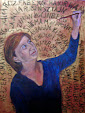
That was something I struggled with. I had thought the paintings would be easier than the interviews. I knew how to paint, but I didn’t know how to do this kind of painting. When you paint story, you need to edit. You can’t include everything. I used to reread the interview, then do yoga or go grocery shopping. I’d see what bubbled up and then develop it. Often I wrote prose poetry, stepping into the shoes of my interviewee. As I told the story in their voice, imagery emerged. That process of editing down to the essence for artwork carried over to my writing.
She closed with the question that is one I often ponder – What did I learn throughout the process?
I am at an age where I do look back, often with amazement at things that I’ve accomplished that look quite difficult in hindsight. Whatever possessed the younger me to tackle them? Maybe I didn’t know what I was getting into or perhaps it was easier to take a risk when I had less to lose if it failed. My mother used to ask, “What’s the worst that could happen?” That’s not a bad yardstick for risk taking.
Sometimes looking back gives me courage to take on something new in my world today. I navigated the unknown successfully and it led to new directions, maybe I can do that again. If we live our life in bubble wrap, we miss out on a lot of opportunities. So, I learned to take risks, calculated ones. Taking a step forward is important. It sets things in motion.
I was most struck by how everything builds on everything else. When I left my salaried work I had volunteered for the Jewish historical society. When they learned of my interest in genealogy they asked if I would do a talk. It was my first genealogy talk and I was nervous, not too sure about being in front of people. I’ve done countless talks since then. I grew into it and found my voice. And it opened doors. After that first talk I peered into the gallery next door, my head filled with family history. In that moment I decided to do a series of paintings on my own family history. I returned to my studio and started painting. A year later I did my first solo show in that gallery on family history. That body of work led me to Sholom and into this project. I began this blog in 2009 when I was going to Lithuania to study Yiddish. I wrote about my travels in Lithuania and later wrote about my interviews and the artwork, long before I contemplated a book. I draw a looping line that begins with family history which in turn led to volunteering, public speaking, solo exhibitions, grant writing, interviewing, travel to ancestral towns, and blog writing. The book grew out of all of these elements. Each one was a step forward that led to the next. My interest in family history was the seed that fed each endeavor.
Learn more about this project at We Spoke Jewish.


 Posts
Posts


No comments:
Post a Comment