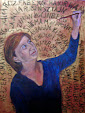
When you paint story, you often encounter historical truths. In two cases I've had the benefit of an actual witness share a detail where I felt I needed to incorporate it, always with some trepidation. I had shared a painting on these pages called Body and Soul of the old Brochin's store and its founder Solomon Brochin. Brochins began in 1906 as a Jewish grocery/deli/community center, an early institution in the Jewish community. Brochin's 98 year old daughter came to my studio during a recent open studio event and I was pleased to hear she felt it looked like him. I had drawn his image

 largely from a faded and grainy photo from 1924 crossed with the image of him as an older man in his obituary photo. I had little certainty as to whether I had captured him. She added one salient fact. Her father always wore a yarmulke in the store. Now I had read this in the archives as well and left the suggestion of darkness at the top of his head, perhaps to be perceived as a yarmulke, perhaps shadow. But the new detail I learned was that it was a square yarmulke that one often sees on Jewish men from Russia. When she told me that I excitedly grabbed a small collage I had done of my great grandfather from the Ukraine. In it he wears the same kind of hat. "Yes, that is it" she confirmed. Now she may be the only person who actually still holds that visual memory, but for some reason I felt compelled to render him accurately.
 The second detail I needed to correct is in the painting They Walked Together. This is the painting I have done for the Artists' Lab which draws on the story of Abraham's proposed sacrifice of Isaac with a more contemporary twist. It tells my friend Dora's story of a death march from Auschwitz which shares many components of the original story. I had decided the painting called for a poem to link the two stories when I displayed it. Dora and I sat together on her sofa as I quizzed her. What was the time of day? How long had you walked? Where did you sleep? What was the weather? All details I wanted to be able to incorporate into a poem that tells the story.
Dora had actually been on two death marches, one to Auschwitz in August 1944 and one from it in January 1945. This story occurred during the later when it was winter and snow was on the ground, not the time I had envisioned nor painted. Now Dora can't critique the painting as I develop it as she is legally blind. When I described the colors to her she felt it important that I show the snow. What to do? The ground has a greenish cast layered with the deep blue shadows of dusk and the richness of the color and its contrast with the iron oxide pleased me. I ended up doing a wash of blue over the green areas and used medium to suggest the snow. Now I need to live with the change for awhile.


 Posts
Posts