Showing posts with label Harold. Show all posts

Saturday, March 16, 2013

A Gentle and Embracing Heart

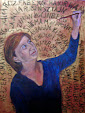
When I began the Jewish Identity and Legacy interview series, I don't think I fully appreciated what I was getting into.  I was interviewing people in their 90s which made it important to capture their story, but it also brought me to them at the final stage of their life.  Two of the 14 have passed away, at least those are the ones of which I am aware.  This week Harold Wittcoff, who I interviewed with his wife Dorothy, died at age 95. I wrote about both of them as citizens of the world because of their extensive travel with stints living abroad and their active engagement in the world.  I have been working on my painting of Harold's story which gave his death an added resonance.

It is a strange thing to spend a few hours with someone learning about their life.  To get a sense of them as a person and presume you know them based on that slight knowledge.  Yet the act of asking someone about their life does spark something, a certain intimacy.  Transcribing the interviews, editing them and then letting details bubble up into a painting to tell their story, builds on that.  I find that I feel a genuine sense of loss with their passing, as if I knew them better than time would support.  Enough so that I decided to stop by the shiva tonight to offer condolences and give his children additional copies of the recorded interview in which he told so many family stories.

The obituary captured his many accomplishments, his engagement in life, his travel and his long marriage.  I certainly learned a bit about those topics in my interview with him, but I also learned a bit more by merely observing.  Before I met them I did some research.  Enough to know of Harold's career and his many accomplishments.  I fully expected him to take center stage and wondered how we would draw out his wife's story, afraid that his would overpower.  I need not have been concerned.  I soon learned that Harold was a very humble man, far more inclined to talk about his wife's accomplishments than his own.  He was proud of her and encouraged her to tell her story.  There was a warmth and affection between them that was palpable.  At one point he reached out to cover her hand with his and I thought this is what it is supposed to be like.  This is what we all hope for.

He recounted their joint decision making process when it came to a move to another country.  It was clear that they both shared a curiosity about the world and a sense of adventure.  He attributed their meeting to "beshert", fate, and perhaps the helping hand of the Jewish community.  They were clearly well matched to share the adventures of life.

Their son and granddaughter also joined us in the interview.  Dorothy's son was born of her first marriage, a marriage that ended when her husband died in WWII.  Harold was a part of her son's life from early on and the same easy affection and humor colored their relationship.  There were strong ties of the heart that connected the family.  A gentle recounting of shared visits with his granddaughter, a teasing humor with his son and a son's pride in all his father had accomplished.  That heart was big enough to fully embrace Dorothy's son as well as a child they took into their family from the DP camps who became a son to them as well.  Together they had one more son to complete their family.

Harold was a storyteller, eager to recount the story of his parents' immigration to America in a manner that brought the listener along with them.   I could imagine him as a very effective teacher.  He understood the importance of story.  So I am grateful that I met him in that final stage of his life and perhaps can help to tell his story.  Not so much the one of accomplishments of which there were many, but the one of a gentle and embracing heart.

Saturday, September 29, 2012

Citizens of the World Part 1

This post continues to share the interviews I have completed in the Jewish Identity and Legacy interview series.*

Some interviewees are difficult to draw out, others are natural storytellers. After 17 interviews in this project, I have learned that each story is an interesting one. Along with that realization, I have also developed a special appreciation for those who know how to tell a story. My interview with Harold and Dorothy offered some complexities. It was the only interview I had done with two primary subjects as well as a child and grandchild. How was I going to assure that I gave each subject sufficient focus? Logistically could I even fit everyone into the video frame?

I was quickly relieved to realize that drawing out the story would not be one of my challenges. Both Harold and Dorothy were storytellers and they had many stories to tell. When they were too modest to share their accomplishments, their son prodded them. And while each was accomplished in their own right, they took pride in their partner's successes and helped to elicit their stories.

Our interview began with them sharing that they had been married for 66 years. Both in their nineties, it soon became evident that they had shared a wonderful partnership that took them all over the world and used their talents fully. Their sense of humor also soon became evident adding a leavening to our interview.

Dorothy came from a well-known family in Minneapolis. Her father started the first kosher grocery store that also sold Jewish books and tallisim. The store served as a community center and Dorothy recalled when Louis Brandeis and Chaim Weitzman came to the Twin Cities, they did a stop at the store.

Dorothy recalled being a small child, but her father told her “You should go and say hello because these are going to be hugely important to the Jewish community.”

Dorothy shared the immigration story of her parents who left Russia because of pogroms. They decided they didn’t want to raise a family only to have them killed by pogroms. They did not tell their parents they were leaving for fear they would try to dissuade them. Once safely ensconced in Minneapolis with friends they let their parents know they were safe.

After settling in Minneapolis they raised a family of seven children. All of the children had Hebrew names which soon got Americanized by their kindergarten teacher. Dvora became Dorothy, Shoshana became Ida, Shear Jashub became Joe and so on. Their son Ralph chuckled in amusement as he imagined Dorothy’s brother being asked “What’s your name little boy?” “My name’s Shear Jashub”, he replied. “Right, you’ll be Joe.”

Harold grew up in Marion, Indiana and as he relates,”Marion, Indiana isn’t the best place for Jews to be born; It’s in what is called the Bible belt. The Ku Klux Klan had an office right next door to my father’s tailor shop. And so, they would have parades on Washington Street in their sheets and headdresses…. So there was a tremendous amount of anti-Semitism. And you found it in places like the schools … some of them (the teachers) were just openly anti-Semitic.”

Harold too absorbed the stories of his parents’ immigration to America. His mother was raised by an older sister who shipped her to America when she discovered she had gotten involved with the Communist party. Having the 100 rubles for passage was just part of the challenge. One also needed an exit visa and those were not readily available to Jews. Instead one had to sneak out at night over the border, the “grenz”. His mother crossed the border into Germany, but an innkeeper, recognizing what was going on said, “For you we have no place”. Undeterred she slipped in behind another wayfarer and slept under a table until she could take the train to Hamburg the next morning.

Arriving in America, she found her way to relatives in Passaic, New Jersey who promptly took her to the Manhattan Shirt factory to find a job. She soon made the rounds to various family members in search of a husband. Her journey led her from New Jersey, to Massachusetts, to Cincinnati, Ohio and finally to St. Louis, Missouri where she met Harold’s father.

His father was one of nine children. Harold related, “When one (a Jew) was inducted into the army he could stay there his whole life and was always given the worst jobs. For the first two or three boys, when it came time for them to go they were able to borrow, beg or get enough money to buy them off. By the time it got to my father, he was the fourth; they couldn’t keep him out of the army so he went into the army. This was 1900 or 1901, the Russo-Japanese war was aflame and he was shipped to the Pacific. If you were caught escaping the penalty was death. But he did, he made his way to Odessa, that’s the southern part of Russia and he apprenticed himself to a tailor and pretty soon he saved up the 100 rubles and got a ticket to the United States.”

I am always intrigued with immigration stories as it often solves some of my personal family puzzles. I have stories of my grandmother being shot at crossing the border and never fully understood the circumstances of her exit. The difficulty Jews encountered in receiving exit visas began to make sense of this saga. Similarly my grandfather fled the Ukraine lest he become fodder for the Russo-Japanese war.

We had yet to learn of what brought Harold to Minneapolis and brought the two together. More to come…

* This project has been made possible in part through the Arts and Cultural Heritage Fund through the vote of Minnesotans on November 4, 2008. Administered by the Minnesota Historical Society.