Showing posts with label Heather Cox Richardson. Show all posts

Saturday, January 1, 2022

Readings: Exploring what It Means to Be Human

Each year I review what I’ve read in the course of the year, some newly published and some just newly discovered by me.  I look for concentrations of work by a particular author, themes that echo across multiple books and that most elusive of measures - books that speak to me. I’ve been doing this since 2010 and as I review past lists I am struck by how much my reading has shaped my understanding of the world.

Some books that I expected to make my list didn’t, even though they were well-written and by authors I’ve enjoyed in the past.  Perhaps their past work set the bar too high. I had loved Amor Towles A Gentleman in Moscow (2016) and found his latest book The Lincoln Highway (2021), mildly entertaining and with an intriguing premise of the hero’s quest, yet somewhere it seemed to meander off the road.  In Apeirogon (2020), Colum McCann attempts an experimental approach filled with snippets of facts, metaphoric in nature. It offers a lot to analyze, and yet the profusion of details deterred me from quickly engaging with the story at its crux– an Israeli and a Palestinian who each lose a daughter to the conflict and form a friendship as they share their story  to influence the larger story.  Both are still worth a read, just not my favorites within their body of work.


There was a theme that emerged across many books that I read this year that surprised me as it spanned both fiction and nonfiction. Everyone seemed to be writing about gene-editing in one form or another. In addition to enhancing humans, the theme often connected to artificial intelligence that borders and extends human capabilities. That in turn took us into the territory of the golem, a creature from Jewish mysticism, created of clay and brought to life by man. The central question seemed to be “What does it mean to be human?” And a related theme, “What responsibility accompanies knowledge?”
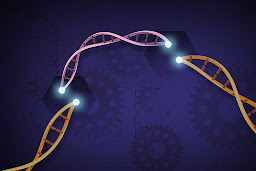
 

The Code Breaker (2021) by Walter Isaacson sets the stage in the real world as it tells the story of our growing ability to edit genes and raises some serious ethical questions. As our ability grows, where does it end? Is there a distinction between curing an illness carried within the genes or manipulating genes to increase intelligence or physical abilities? And what does the latter imply for our world where there is unequal economic access to the very thing which can alter opportunities in life? Do we in fact create a permanent divide in classes of people passed on through generations genetically? Does that in turn force us to abandon ideas of equality that underlie our political system? Certainly people are born with different capabilities today and economics may influence their ability to pursue them, but this could take it to a whole other level. As our abilities become more “God-like,” what responsibility do we carry in how we deploy them? As always, Isaacson knows how to take facts and shape them into a compelling story. 
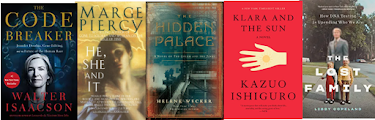


I have long been a fan of Marge Piercy’s poetry, but I was surprised to learn of her novel  He, She and It (2010). Set in the middle of the 21st century, this very dystopian world, weaves together artificial intelligence, enhanced humans and the golem of myth.  It took me awhile to step into it as first I needed to learn the rules of this new world which it portrayed, but once I agreed to its premise, it became quite gripping and sometimes surprisingly prescient given when it was written. 


The theme of golems continued with The Hidden Palace (2021) by Helen Wecker, following the characters from her earlier book The Golem and the Jinni (2013). I would suggest reading the earlier book first which I think was stronger. The golem, a rather earth-bound creature as defined by the very clay out of which she is created, explores and stretches the limits of her being.  And the recent book Klara and the Sun (2021) by Kazuo Ishiguro explores gene editing and “artificial friends” through the eyes of an artificial friend who has a child-like understanding of the world coupled with a deep level of humanity.


While I was on the theme of genes, I read The Lost Family (2020) by Libby Copeland which explores how a simple DNA test can upend lives, revealing a different history from that we were raised to believe about ourselves and calling identity into question. Each of these books deals with identity, what is ordained by our genes or shaped by the world in which we live.


This was also the year of Ann Patchett  as I read Run (2009) and The Dutch House (2019) along with her wonderful essays in This is the Story of a Happy Marriage (2013) and Precious Days (2021). I especially appreciated her essays where she opens herself up to her reader. She shares who she is and what she thinks and feels and you in turn feel as if you know her.  She reveals her insights into her writing process and her reflections on how essays afford her a different way to approach her writing, a form of expression less pressured by the lengthy timeline which a novel requires to bring it to life.
 

Other books that intrigued me were Cloud Cuckoo Land (2021) by Anthony Doerr, a complex weaving of stories, and it is indeed about stories and how they preserve us even as their recorded form is threatened with destruction through the forces of time. Dara Horn’s book of essays People Love Dead Jews (2021) has a rather startling title that is quite apropos. In one essay she explores how a young man who worked at the Anne Frank House was told to hide his yarmulke under a cap on his job lest he reveal his Jewishness and hence “non-neutrality” even as they celebrate a young woman who was murdered because she was Jewish. Lots of things in this book to contemplate. 


And finally I need to give a shout out to Heather Cox Richardson, a historian whose twice weekly talks on history and politics have enriched my year. Her book How the South Won the Civil War: Oligarchy, Democracy and the Continuing Fight for the Soul of America (2020) expounds on many of the concepts in her discussions and is a rather timely topic. Having a historical framework is both disturbing and comforting. Disturbing in that one realizes how long we have been struggling with these same issues and comforting in that we have at times managed to transcend them, moving forward into a truer democracy and perhaps a deeper sense of humanity.


Other good reads to check out in the realm of historical fiction:

The Indigo Girl by Natasha Boyd on the story of Eliza Lucas Pinckney

The Women of the Copper Country by Mary Doria Russell

Dreamers of the Day also by Mary Doria Russell


Tuesday, January 5, 2021

Thwack . . .Thud: Welcome to 2021


Thwack. . .thud. Thwack . . .thud. So began our 2021 as the neighbor teens welcomed the new year by whacking away on the hockey rink that graces the property line next to our own. The light from the rink trained on our home, lit our windows brightly casting odd shadows within. By 1:00 am our neighborly tolerance had reached its end and my husband went out to our deck to alert them to the fact that they shared their universe with others.

If we learned anything in 2020 it was this. We are not self-contained. Our actions affect our neighbors, our community and the very earth we live on. Despite an oft-held ideology of individualism, we are a community whether we like it or not and we bear a responsibility to that community.  It underlies the impact we have on our environment, an awareness that others may have different experiences than our own, the many ways racism is embedded in our society, and how we affect the health and well-being of each other. 


It was a year that affected each of us differently. Among many of my friends, the challenges were being unable to see their grandchildren except over Zoom. New rituals developed to substitute, with grandparents reading to grandchildren online. The common theme for those who became new grandparents was to quarantine until they could hold the newborn. Many of my friends had spouses who had underlying conditions that posed particular risk. That meant a very clear awareness of their role in keeping their spouse safe. For us the challenge was my stepdaughter’s family moving across the country. How do you say goodbye in a pandemic?  And what about those holiday traditions that are no longer local, at a time when our movement is restricted?


Even as we adopted restrictions in our face-to-face interactions, I realized that we were sheltered from the problems that faced many in our larger community. At this stage in our life we don’t have concerns about medical insurance or finances, but many face challenges in paying rent or buying food. I found myself thinking back to a time when I didn’t have a financial cushion to protect me. What would I have done then? My financial cushion would have been help from my parents who were then at the stage I am now.  That is where our family history can shelter us or leave us open to the elements. Those in our society who don’t have those structures of support have faced the most severe challenges, some for the first time.


It was also a time of political upheaval. We were consumed with the political news, scared to look away lest the world meet destruction while our gaze was averted. I cheered on the protesters from my perch at home, aware that in other times we would have joined them. I felt sidelined. The week before the election my stomach was in knots. The fate of our democracy hung in the balance and I genuinely feared for it. Even now, especially now, I am appalled and disgusted by the irresponsible, self-serving or simply delusional behavior of many in our country. While heartened by those who have spoken up, I worry about the damage that has been done.


It was a time when creativity should have flourished, but I found it hard to write or paint. I need to find a place of calm from which to do that and there was no calm in 2020. I am slowly working my way back to a place of creativity.


There have been good things that arose in this chaos. I have a newfound appreciation of history and became a fan of Heather Cox Richardson’s reviews of politics and history. I read widely on related topics trying to understand the disturbing threats that have emerged in our society. I reconnected with new friends and old across the country and around the world through technology. How I defined community grew. I had been inching towards a greater sense of global community, genealogy and the arts have always been global in scope. Now the pandemic accelerated it. We all shared this difficult time.


Many offerings in the arts and other disciplines went on-line and my access to information grew globally also. I presented talks to wider audiences and had to remember to put the time zone on notices for our once local genealogy group.


I have always tended towards a fully packed schedule and used to savor the rare day with openings, what I think of as runways of time. Now I have many of them and like having blocks of time to read, work on projects or workout. I have new routines that support better health because of that newly discovered time. I still have many outward contacts with book club, genealogy, arts and nonprofit involvements moving to Zoom and I’ve taken to doing coffee chats with friends via Zoom as well. While there is a personal flavor to meeting a friend over lunch, this will suffice for now. Each week I talk with a 96-year-old friend by phone as I record her story for her family. It is our weekly touchpoint and an opportunity for me to appreciate the full arc of a life. We talk about how we will be able to meet again in person someday soon. 


While I will be grateful to have this time come to a close,  I note the learnings I will carry forward:


There is an opportunity cost to a packed schedule. 


Distance can collapse and connections grow virtually.


My community is global.


And we all contribute our small piece. 

Whether protesting, political work, dollars or our voice, we do what we are able with faith that it will join with others and ever so slowly make a difference.