Showing posts with label Ukraine. Show all posts

Saturday, March 26, 2022

A Place of Perilous Danger . . .and Hope

View of Kamenetz Podolsk 2011


Over recent weeks, I’ve watched the unfolding events in Ukraine with horror. I traveled there in 2011 to the town that my maternal grandparents came from, Kamenetz Podolsk. It is a town with a 13th century fairy tale castle in its midst, turrets rising high above the city. I imagine my family living in the shadow of those lofty spires. My  grandfather left there in 1911 to come to the United States to avoid being drafted into the army. Ten years later my grandmother came in the wake of a pogrom. All that survived was a story of their ten-year-old daughter who died in that pogrom, along with many other Jews. That was to be followed by further massacres during WWII for any family that had the bad fortune to remain. That has been my association with Ukraine, a place of perilous danger.


Recent events have certainly supported that perception of danger, now directed at the Ukrainian population. It has also caused me to feel both empathy for its brave people and not a small amount of pride in their Jewish president. Little did I expect that changes since my grandparents' day would lead to the election of a Jewish president in a landslide.  His courage and communication skills have stood him in good stead as he rises to the occasion­ –perhaps a response to perilous danger resides in genetic memory.


As with many genealogists who have ancestors from Ukraine, the thought that follows the dismay at recent events is to wonder if our history will also be wiped out within the archives. This is a war that is highly destructive to both civilians and physical infrastructure. While not as heart-rending as the assault on civilians, the assault on history is also concerning. Many of us fear the collateral damage that could occur to archives. Ukraine is even more vulnerable to this destruction as they are newer to the practice of digitization. Less is preserved in alternative form. 
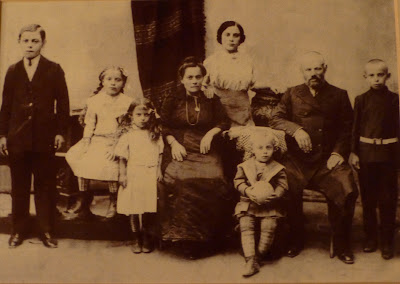
 

1897 Family Photo - my grandmother 2nd from left, great-grandfather -2nd from right

When I first began my research into my Ukrainian family in 2002, I did it the old-fashioned way, taking family stories and testing them against records. I started with a few pages written by my grandfather reporting that my grandmother left Ukraine with her brother and his wife. Shot at while crossing the border, she was taken to a hospital in France. I couldn’t quite imagine the geography of this journey but did indeed find her coming to the US from France, followed one week later by her brother and his wife. I located her brother’s granddaughter who contributed the fact from her grandmother that they had to swim a river to leave the country. I sent letters out to those who shared the rather uncommon family’s name, finding a cousin my mother had never known. Together we traveled to California to meet her. She gave us a photo of the family from 1897. Death records and other documents allowed me to build the tree out to my 3rd great-grandfather. 

The Internet was still fairly new and access to on-line records was limited, especially for Ukraine. I reached out to BLITZ Information Services and they sent an employee to the Ukrainian archives on my behalf. She was able to locate a number of family records despite an archive fire a few years earlier that damaged many holdings. Ultimately she concluded her efforts because of unrest in Ukraine, a recurring theme I had not fully understood at the time. 


Fast forward many years. . . I am doing research for a woman whose family came from Ukraine. I began our work advising her about the challenges of researching Ukrainian family. Relative to many other countries, there is still not much on-line for Ukraine, but this research pushed me to take a fresh look. 


Finding and Digitizing Records 

So how do you confirm if there are records for your towns? Miriam Weiner has done the research to populate a very useful site called Routes to Roots Foundation for Jewish and civil records. If you input the name of the town, it will tell you what information resides in the archives for what dates and which archives. It doesn't however tell you if it is on-line and if so how to find it. For that you will want to see if there are indexed records. These are created by someone familiar with the language who reviews records and extracts key names and supplemental information. For Jewish records you will want to use JewishGen’s Unified Search which pulls up available indices. 


Suppose you find something? Now you will want to determine if it is digitized and on-line. Archives in some countries such as Poland have committed to digitizing and in many cases searches will yield attached links to the records at the archives.  Even without an attached link, you can go to Familysearch  to see if they have digitized it. There you will search on the country and town in the catalog (go to search - catalog). With the details from the index, you may be able to find a corresponding digitized record.


But here’s the challenge –if records are not digitized, there are no on-line records. And if they are digitized, but information isn’t extracted into an index, you will need to have language skills to navigate those records.


Familysearch has been scanning records in Ukraine since 1994. That is a fairly recent history. Political upheaval delayed their efforts for a number of years after they began.With the appointment of new archive leadership in late 2019, an agreement was made to begin digitizing later in 2020. Of course Covid presented delays and now we have a war that could endanger the very documents we hope to preserve.


The recent agreement grew out of extensive work by Ukrainian Alex Krakovsky,a researcher of Jewish history, who has taken branches of the Ukrainian Archives to court many times so he could scan records from the archives without being charged an exorbitant fee. He has pursued this with a sense of mission, posting more than two million records on a Wiki page. Many of these scanned records are now in the queue to be indexed by the Ukrainian Research Division at JewishGen, something that will take some time.


Ukrainian records that are scanned but unindexed are available on-line and can be accessed through the TSAL Kaplun Foundation. This includes an interface to the Alex Karkovsky records. You can also find useful links at the blog Lost Russian FamilyYou can use translation tools at stevemorse.org  to learn what the name looks like in cursive, converting from English to Russian print and then to cursive. If you locate a record that looks like that name, post the document on a genealogy Facebook page or Jewishgen’s Viewmate site to get a Russian speaker to translate it further. This is all pattern recognition and not for the faint of heart.


Failing the ability to access Ukrainian records, you may find as I did that you can discover a surprising amount of information from US records. Look for death certificates with parents’ names and immigration manifests that note family members they were traveling to and who they left behind. In the meantime, we are fortunate to have the records scanned by Alex Karkovsky and over time that backlog will be whittled down. And if we are very lucky, the archives and our history, along with Ukraine itself, will survive these perilous times.

Thursday, August 23, 2012

In America We Become Russians

One of our most interesting interviews was with Rakhil, a 94-year-old immigrant from Kiev, and her daughter Liana. I had interviewed Rakhil with an interpreter in my first series of interviews and was quite charmed by her. Even with a language barrier her warm personality came through. She had told me stories about her mother and sang me songs that her mother would lead them in at Pesach. Rakhil told me about a time when Jews lived in friendship with the Ukrainians and shared holiday treats with each other.

That all came to an end in 1933 when the Soviet government began a program of forced farm-collectives. A famine resulted, killing an estimated seven million people. This was an effort to destroy Ukrainian nationalism and the capitalism implicit in the success of small farmers. Homes and livestock were confiscated, people who resisted were deported or executed. Grain was expropriated or sold on the international market while the people starved. It is a horrific story of which I knew little.

Rakhil told me that the Jews were tradesmen and craftsmen and they survived better than did their Ukrainian neighbors. Rich Ukrainians who had shops in the middle of Kiev often hired them. Jealousies resulted and fed the anti-Semitism we often associate with the Ukraine.

During the war Rakhil and her family evacuated Kiev and worked on a collective farm. Twenty-eight members of her mother’s family sought shelter in Kiev and were killed at Babi Yar in the largest single massacre of the Holocaust.

Rakhil enlisted and worked in communications. Her ability to understand German made her valuable as a translator. She made it all the way to Berlin during the war and won many medals. Her daughter later told me that she entered Majdanek and Auschwitz with the Russian army, horrified at what she found.

On this second interview I was relying on her daughter to translate for her as well as to share her own story. I had found that the elderly Russian immigrants I had interviewed, typically came to the US to follow their children. While I knew of antisemitism in Russia, I had never talked with a contemporary about their experience.

We began by asking about their decision to immigrate in 1989. Liana talked of the antisemitism in the Soviet Union which prompted it.

 “You just kind of learn with years, you learn to live with it. You just know that you are second-hand kind of person and certain fields, certain places, you will never be able to get to.”

 She told of seeking to enroll her son in a school which specialized in English. Those who graduated received an interpreter’s certificate and it is usually for military interpretation. The director told her that while her son could enroll he would never receive the certificate. “Why?” she asked. “Because you are Jewish, don’t you understand,” replied the director. Ultimately the decision to immigrate came in search of more opportunity for their son and themselves. Her mother followed three years later.

When I asked about the family’s experience being Jewish, Rakhil replied that her mother was not religious, but kept kosher and celebrated the holidays. Rakhil was born at the time of the revolution so she knew what she learned from her mother. Liana was reliant on what her mother had learned from her mother, but could not practice Judaism. There was one synagogue for 4 million people. Generally older people who had nothing to lose attended. Attendance was monitored and penalized at jobs and universities. Ironically Liana’s daughter-in-law has since become an Orthodox Jew so her grandchildren are now being raised in the Orthodox tradition. Rakhil proudly related how the oldest grandson led them through the Pesach service.

Liana spoke of something I observed in Lithuania, that being Jewish is treated as a nationality, not a religion. If one is Jewish that is noted on your passport rather than Russian or Ukrainian. It is on line 5 so people would say, “Is your line number 5 OK?” It means, “Are you Jewish or not?” In the US we think of ourselves as Americans and Jewish. Imagine living in America, but not being considered an American because one is Jewish. This is essentially what Liana experienced in Russia.

She commented on the oddity of now being labeled as Russians because that was their geographical home.

 “You see we’ve been all of our lives Jews. In America we become Russians. We’re Russian but we’re not. We’re from Russia, but we’ve never been Russian. We’ve always been Jews. Jews here and Jews there. But here we’re Americans, American Jew. Over there we were just Jew. Period.”

I especially enjoyed the Russian jokes that Liana used to illustrate the duplicity of the then Soviet government.

 "When one Jewish man was crossing the road and it was green light and policeman said, 'you can go now,” he said,“I don’t believe them.”

"He doesn’t believe in the country he lives, it’s like a gang. So he doesn’t believe whatever they say to him. Because they say it should be one thing and their knowledge is completely different. We’ve always said, “if you want your refrigerator to be full of food, you have to plug it in the radio”. Because on the radio and on the news this (Russia) is the best country in the world."

I asked Liana if it has changed. She said she thinks so, but isn't sure how much.

When we spoke of her father’s history I felt as if I had stepped into a novel, a rather tragic one. Her father along with his brother and sister were orphaned when their parents were murdered during a pogram. The children hid, but saw the murder. They then walked through the winter to get to an orphanage. I just read the wonderful book The Little Russian where the author, Susan Sherman, paints vivid pictures of such events. I was able to visualize it all too well.

“How does one make sense of that experience, of that history?” I asked.

She replied, “It makes me look different on a situation in the country, be very politically involved, be very pro-Israel, be a huge supporter of our country. You know to feel that you can be fair citizen here, everybody treats you like equal. And that’s what I’m grateful for and appreciate so much. And like I said, have all this legacy with us. It makes us stronger, and it makes us bring different views to United States. Makes us hard workers, makes us people who not spoiled by having everything.”

Some of our lighter moments came when I asked about food and Rakhil began to describe how to make gefilte fish. A family recipe that came from Rakhil’s grandmother has yet to make it to Liana, but we witnessed the promise to pass it on. Using hand gestures Rakhil illustrated how it is made as Liana translated.

 “You bring the fish and I make it,” Rakhil told us.

 “It’s a long procedure.” said Liana. “ People don’t have time anymore. It’s better to go to Costco to buy it.”

When Rakhil came to the United States she decided she wanted to become a citizen. At age 80 she went before the official and told him her name and age in English. She then shared with us the English spoken sentence, “Me-morial Day ees holiday” that got her citizenship. Very somberly she recited the sentence and then illustrated the amazement of the judge at this elderly Russian woman.

Our visit ended with Rakhil singing Yiddish songs for us with a vigor that belied her age. Her joyous spirit affected us all and we told her we hoped to return with a Klezmer musician who will accompany her singing.

This project has been made possible in part through the Arts and Cultural Heritage Fund through the vote of Minnesotans on November 4, 2008. Administered by the Minnesota Historical Society.

Tuesday, May 3, 2011

Hiding in Caves

Sometimes it seems like there are connections between everything I encounter. On Sunday we went to the Yom HaShoah Holocaust Commemoration in Minneapolis. The speaker at the event was Christos Nicola, co-author with Peter Lane Taylor of the Secret of Priest’s Grotto: A Holocaust Survival Story.

Nicola related the story of 38 people who survived the Holocaust hidden in a network of caves in the Borshchiv Raion within western Ukraine. Priest’s Grotto is actually one of the longest caves in the world with 77 miles of passages that have been explored. He put up a map of the region and there was Kamenetz-Podolsk, just 25 miles away. Last month when we drove to Kamenetz, the ancestral town of one set of my grandparents, our guide had pointed out Borshchiv as we passed and mentioned the story.

Nicola, a cave explorer, first discovered the cave and heard stories from local residents about Jews hiding in the caves. After ten years of searching he finally found a member of the family who had survived in the caves now living just blocks from him in New York. Relying on a memoir written by the matriarch of the family in 1960 as well as recollections from family members, he went back to the cave to document the existence of the family within the cave. His efforts were underwritten and reported by National Geographic. Some of the family members, from toddlers to a woman over 70, had resided there for 344 continuous days, the longest instance on record of uninterrupted cave living.

Nicola talked of their survival without any of the equipment and clothing that is commonly used by cavers today. They basically learned how to survive in this new environment. They tunneled to create an escape route which they had to use when they were discovered in the first cave. In the second cave they found a natural lake, learned how to dry the moisture on the walls and adapted to living in darkness.

Several family members who survived were killed by Ukrainians after the war had ended. Most of the family immigrated to the US and Canada.

To learn more you can find an interview on NPR and read the article in National Geographic’s Adventure magazine.