At the second interview we were joined by his daughter and his son and daughter-in-law. I began our interview by playing the video from the first interview. They watched with interest and I asked them if there were any surprises in it.
“He never talked about this when we were kids”, replied his son. He was referring to Walter’s history as what was known as a “Ritchie Boy”, a name that was given to the group of mostly Jewish soldiers, immigrants from Europe, who were trained to interrogate the Germans because of their language proficiency, A film came out about them in 2005 and it was only then that Walter spoke of this experience and the tightly-knit group within which he spent his early years in the US.
As we spoke, his children recalled him saying something when they were growing up about interrogating German prisoners. It had seemed so unlike their father with his quiet demeanor that they hadn’t known what to make of it. He had never added any color and it remained a vague recollection until the movie came out and he became involved in telling its story.
When we continued our interview, Walter and his children offered memories of his wife and her mother, both of who had even more harrowing survival stories. His wife had been in France studying nursing during the war and had successfully crossed into Switzerland when France was no longer safe. Her mother was not so fortunate and ended the war in Auschwitz and Bergen-Belsen. The rest of her family perished in the camps. This history lingered over Walter’s children and was perhaps the source of their active involvement in human rights. His daughter was deeply involved in her work in support of human rights and dignity and palpable emotion underscored that passion. Their Jewish heritage was best reflected in this deep commitment to the values of human rights.
I asked Walter’s children what they recalled that best reflected their father’s legacy. His interest in people and commitment to family they replied, sharing examples of his active efforts to stay connected with his family that was spread around the country. They recalled that each week for decades he had written a letter to family on carbon paper. Copies were sent to family around the country even as they each wrote their own letters. They recalled grandparents and siblings all participating in this pre-email round robin. His daughter still has many of the letters, an amazing legacy of shared lives.
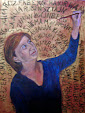
And so I have concluded my series of interviews, seventeen in total. When I began this project I was in search of source material for my artwork. I found far more than that. Even as I was to be a dispassionate interviewer, I felt an emotional connection to each of my interviewees. A similar thing happens when I paint someone. It is as if our boundaries become more porous when we connect to someone else and it stirs something inside of us.
I have learned a great deal from this project. Some of those lessons were practical ones on interviewing, video recording and video editing. I have also had an opportunity to reflect on Jewish identity and the various forms that it takes, from the “yiddishkeit” of which Fannie so eloquently spoke, to the movement from oppression to freedom of religion experienced by Liana and Raychel, to the expression of Jewish values through Walter’s children. The Jewish experience may be religious, but just as often it is expressed through values embedded both in the religion and in the Jewish experience within society.
As I reflect on these interviews I am struck by the way in which the experiences of our parents and grandparents continue to reverberate throughout our lives. They can easily become disconnected from their origin, yet reverberate nonetheless. We remember the survival skills, the values and the resourcefulness, but forget the circumstances that bred them into our heritage. It is story that provides the connection; that reminds us of why we hold these beliefs and attributes that have become our legacy.
This project has been made possible in part through the Arts and Cultural Heritage Fund through the vote of Minnesotans on November 4, 2008. Administered by the Minnesota Historical Society.


 Posts
Posts