Sunday, April 15, 2012

Evolution of a Painting

I often make changes to paintings after they have been considered finished for some time.  I’ve learned that “finished” is a relative term.  That’s why I always struggle to answer the question about how long it takes me to do a painting.  The initial painting can sometimes develop quite quickly, but the incremental changes happen gradually after I live with the work for some time. When I review the series of photos that I take throughout the process, I am always surprised at how much a painting changes over time.

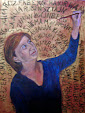
 The first painting that I did in the Jewish Identity and Legacy series was titled Sleeping with the Chickens and told the story of a woman who remembered sleeping at her grandmother’s with a box containing two live chickens by the bed.  They terrified her at night and became dinner the following evening.   I was never quite satisfied with it and decided to change it in two ways.  The original painting is above.

The woman had told me of how she was terrified of the chickens and I thought about what that felt like physically.  I realized that when we recoil in fear, our eyebrows rise and our mouth opens so I sought to get that effect in the painting.


I also had never liked the distinct lines that seemed to segment the painting into separate spheres.  I often use my Ipad to enlarge and crop an image visually.  When I did this, I found that I focused on the connection between the woman's
 gaze and that of the chicken’s.  I thought about how I could emphasize that while minimizing the lines that were less relevant to the story.  I took a wash of white paint and extended the covers, letting the box show through.  The line of the blanket echoed the line between their gaze.  The blanket still was too large of an expanse and needed to be broken in some way.  She had spoken to me of the big feather bed, no doubt filled by the feathers of past chickens so I decided to extend the idea of feathers flying.  The addition of several feathers in this space echoed those above and balanced the image.  I also extended the feathers of the chicken to make it feel more menacing.  The effect of these changes is to further the telling of the underlying story.

Saturday, April 7, 2012

Reinvention In The Public Eye

Having a blog, an art site and two websites (Radom, Dunilovichi) on ancestral towns means I am pretty accessible on the Internet. I also do talks, workshops and exhibitions of my artwork. Some people would find that a bit too much exposure, but it opens me up to some interesting connections. Between all of those avenues I hear from a wide variety of people.

This week I have been communicating with a woman in France who hired me to research a branch of her family, a woman from Israel who discovered her family in one of my Kehilalinks (ancestral websites) and a woman in England who has a connection to a branch of my British family. Closer to home I connected with a woman through Facebook who is researching the family name of my Ukrainian great-great grandmother and a woman who heard me speak locally who sought some assistance on her family research. I rounded it out with a discussion with a woman who is a writer who sought my input for her nonfiction book involving an escape from the Radom ghetto.

For almost six years I have been busy reinventing myself with a focus on my artwork and family history. I’ve found that one of the fundamental principles of reinvention is visibility. It is hard to reinvent yourself in a vacuum. You have to let people know what you are up to. I remember thinking enviously as a kid about the people that moved to a new high school. They could be whomever they wanted, leaving their awkward old self behind, no longer useful in their new and popular life. When I went off to college I decided to perform the feat of reinvention and found that it is a much more gradual process than I had hoped. Years later, when I left my career in finance, I didn’t seek to deep-six who I had been. I had finally gotten to a place where I was comfortable in my own skin. Instead I sought to let some other sides of me flourish. I was smarter this time around and I realized that who I was will always be part of who I am. That analytic part of me that I used in finance is the part that helps me write these blogs and is often called upon in my genealogy research and even my artwork. The balance between artist and analyst gives me some challenges, but also some gifts.

I often reflect on what has enabled me to perform this reinvention more successfully than my early college attempt. When I first left my job I contacted the Jewish Historical Society to volunteer. When they learned that I was deeply involved in genealogy they suggested I give their annual genealogy talk. My first thought was a resounding NO!!! Public speaking was not the direction I had anticipated. Then I caught myself and that inner voice said, “New life, new ways”. I did the talk and discovered much to my surprise that it was fun. This was a revelation to a self-described shy person. Had I never risked that exposure, I would never have discovered the joy of speaking about something I love.

When I did my first solo art show I also felt exposed. There is something about putting your artwork out there that is rather scary. I don’t like everything that I do from one day to the next so how can I expect someone else to. I still fight the urge to bring a paint brush into a gallery where my paintings hang and do a little touch up. I frequently will rework paintings between shows until there is that magical moment where I am pleased with the result. It doesn’t always happen. Paintings evolve just as I do and sometimes they need a bit of reinvention too. Putting them out before they are fully reinvented is not too different than putting myself out there before I am fully reinvented. You start with where and who you are and let the process work.

When I started a blog I again experienced that sense of being exposed. I started out keeping a shield of privacy and gradually have begun to reveal more of my own views and my own experience. Having left my career, I feel a greater sense of freedom to reveal who I am, to expose myself to scrutiny and worry less about others’ judgments. I hadn’t realized how much having an employer caused me to rein myself in until I no longer had to.

I was struck by a sentence in a book I've been reading, Imagine: How Creativity Works by Jonah Lehrer. He writes: "We are so worried about playing the wrong note or saying the wrong thing that we end up with nothing at all, the silence of the scared imagination." So being “out there”, taking the risk that people won’t like my artwork, my talk, my writing, me, is all part of reinvention and embracing creativity. Along the way I am always deeply grateful for the people who enjoy what I paint or say or write and offer their encouragement to continue taking those risks.

Tuesday, April 3, 2012

A Stream of Yiddish Fish

I am involved in many pursuits and often have people ask how I can keep them all straight.  I am convinced they all inform each other and thus are part of a cohesive whole even if not readily apparent to the outside eye.  Lately I have been reading the book Imagine, How Creativity Works by Jonah Lehrer .  I am finding that it validates much of my own observations with information on the brain science behind creativity.  The fundamental premise is that creativity involves the combination of disparate information in new ways.  Our ability to hold disparate information in our working memory increases "intelligence" by increasing the ability to make these connections.  The author writes about the creative process often involving having to face a barrier.  Achieving a relaxed state of mind is important to allow our brain to find the less obvious connections.  If we try to use our analytic selves we bring too much focus to it and miss those connections.  When we retell the story of our creative insight we often omit the struggle that preceded it and in doing so leave out the germ of the creative process.

I think a lot about those different approaches because I am such a blend of analytic and creative.  In the studio I often have to trick myself into letting go of my more analytic active brain.  You know that brain, the one  that doesn't want to shut down at 3am.   When I am struggling with a painting, I often will take a brush and smear the paint or add a light coating of white or gold paint.  Sometimes I use reflected images as source material.  The common thread behind these approaches is that they force me to see in a different way. They take me away from the precision of my left brain into a more suggestive right brain.  Even when I start with an idea, I need to distort it to allow the free associating to kick in.

Let me give you an example. I am working on artwork that captures the stories collected in an oral history project from Jewish elders, now in their 90s.  One woman told me about "those damn fish" in her father's butcher shop that she was scared to pick up for customers when she was a child.  She also told me about how all the records were kept in Yiddish and she spoke Yiddish to all the customers.  I started with the idea of "those damn fish" and Yiddish.  My analytic side went out on the Internet and pulled pictures of Jewish shops.  I started with imagery from a fish market with a young woman behind tins of fish and a scale hanging on which to weigh the fish.   Over a portion of it, I wrote out several names in Yiddish.  Up until now my analytic side was in the driver's seat.

But  I didn't like the strict lines of the tins so my right brain said "move over" and took the wheel.  It covered much of the painting with white paint, but left the young woman and the suggestion of the writing.  Around the writing I drew a much larger fish and in the foreground I draped a fish over a much larger scale.  Originally I had included the top of the scale that identifies the weight, but decided it became too much of a focal point.  Exercising my right brain's artistic license,  I decided to omit it.

I had struggled for some time with a not bad, but not quite right painting.  Now that I had destroyed the original structure, free association began to work.  When I think of a butcher shop I think of butcher paper that they might use to wrap the fish.  I hadn't liked the rigidity of the tins, so what if I unroll a sheet of figurative butcher block paper.  I added a swath of white sweeping around the now enlarged scale on which a flopping fish resides and up above to cover the form that had been the top of the scale. Rigidity was exchanged for fluidity.   And how do I know this fish is flopping?  I added an echo in white of fish tails in movement with color framing the actual tail.   The young woman is now quite small relative to the fish which seemed somehow appropriate as seen through her child's eye.  The butcher block paper reminds me of a stream and a stream would have fish in it, but Yiddish fish.  The word for fish in Yiddish reminds me of fish scales so I fill the stream with Yiddish fish by writing the word over and over.  Across the central fish, I write an excerpt of her comment in English about "those damn fish".    Some paintings survive in their more analytic form, others get reworked by my free associating right brain.  I'm not sure if this is done yet, but I am much more pleased with its direction.

As described in the book, I had to achieve a relaxed state of mind where I stopped forcing it.  For me, the swath of white paint frees me from the structure I had imposed.   Choosing fluidity over rigid lines allowed me to free associate from butcher block paper to a stream filled with Yiddish fish.  And by changing the proportions, I changed the emphasis to "those damn fish".  Now my right brain hands the wheel back to its more analytical brethren who makes sense of it all to explain it to you.

Sunday, April 1, 2012

The Power of Kehila (Community)

A few days ago I got one of my favorite kinds of e-mails. A woman in Israel contacted me because she had discovered the Kehilalink that I had built for Dunilovichi. On the site she had found the tombstone of her great-great grandfather."Who are you?" she asked. "And do you have more on these names"?


Dunilovichi is a shtetl in Belarus that is about 75 miles outside of Vilnius. It is the town from which my grandmother and great-grandparents came. In 2009 I visited it when I was in Vilnius. Upon my return I built a Kehilalink on the town, a website for Jewishgen.org, as my volunteer effort for people who were researching family from there. When I was researching the town prior to my visit I had connected with a woman who had a transcription of the cemetery and photos of the tombstones that enabled me to locate my great-great grandfather’s tombstone. She gave me permission to include the tombstones on the site and to submit them to the Jewish On-line Worldwide Burial Registry.


Building Kehilalinks is a wonderful activity for those of us who have already progressed pretty far in our own research, but aren’t quite ready to relinquish the search. Jewishgen.org offers an on-line class to learn how to construct them which doesn’t require a high level of technical expertise. I’ve found the knowledge quite useful in building out my art website as well.

When I can assist someone in finding their family member, it reminds me of why I do this. I then took her question about whether I had more on her names to heart. I had created several finding aids on the Kehilalink. I have a tab titled Family Names and I went there to see if her name was listed anywhere else. There I have a link that lists out who lived in the town in 1939. There were two entries with her family name. But were they hers? I returned to her family tombstone for more information. There I noted that her great-great grandfather who died in 1918 was named Ben-Zion and his father was Dan. One of the 1939 residents with her family name was also named Dan, quite likely the son of Ben-Zion. Ashkenazic Jews name their children after a deceased grandparent or great-grandparent so it is likely that this person was a family member.

Also on the Family Names tab is an index that I built for the cemetery, immigration records, Yad Vashem and the 1850 census. I had taken each name and identified if it was found in one of those sources and the spelling as there were frequently several variants. From the index I saw that her family name showed up in the immigration tab and a quick search for the record on stevemorse.org informed me that his nearest relative in Europe was his father Dan and he was going to his brother Barnett in Chicago. Hmm, the pieces are beginning to connect. I sent her an e-mail asking if she was familiar with this person and she returned a scan of a scrap of paper with his name that she found in her father’s papers, but indicated she knew nothing more about him.

A few searches on Ancestry.com led me to the 1920 and 1930 census and the naturalization record. As I expected the young man had named his son Benjamin after his son’s great-grandfather who had died just four years earlier. A little good fortune also awaited. It appeared that someone had a family tree on Ancestry which indicated living relatives as well. The woman who contacted me will likely be able to expand her family tree in both directions, discovering a great-great grandfather and the name of her ggg grandfather as well as living relatives in the United States.


Sunday, March 25, 2012

Recommended Reading VI: More Favorite Fiction

Lately I've read some excellent fiction on a variety of Jewish themes that I wanted to share in these pages.  While the themes may be Jewish, these books would appeal to a broad audience and all offer excellent writing and unique perspectives.

It occurs to me that my approach to reading reflects somewhat my approach to my artwork.  I take a subject that interests me and approach it from multiple perspectives. My current show on Holocaust related work  has three bodies of work, one that addresses the responses of Eastern Europe to the Holocaust history, one that looks at pre-war Poland and a third that looks at individual survivor stories.  Similarly these three books circle a topic of interest to me, addressing the way in which Poland deals with its Jewish history, the response of both Americans and the British to refugees in their midst and the memory of lost  loved ones that haunt survivors as they rebuild their lives.


My latest favorite book is a first novel titled A Day of Small Beginnings by Lisa Pearl Rosenbaum.  The story is told through three generations with the connecting thread being Freidl,  the spirit of a woman who once lived in a small shtetl in Poland.  Each generation brings a greater understanding of their heritage and the reader shares their journey.  The first segment begins with a young boy in the early 1900s who is forced to flee his shtetl and comes to America.  In the second segment we find his son, a college professor, in Poland for a lecture.  While there he decides to visit the town from which his father came.  His father had shared little of his past and had rejected religion in his life.  The third segment of the book focuses on the granddaughter, a dance choreographer who goes to Poland to create a performance with a Polish dance company. There she falls in love with a Polish Catholic musician and struggles with the latent anti-Semitism she encounters in Polish culture even as the former Jewish culture is romanticized in other parts of Polish society.

Her journey actually takes her in transit through my ancestral town of Radom and she writes of Krakow and Kazimierz Dolny, both places I got to know well in my travels.  As a result, I could easily picture the locations and it gave an added resonance to her story.  I also could appreciate her struggle to bridge the two cultures and find the common humanity despite historical differences in perspective.  I especially liked the mystical flavor and wisdom as expressed through Freidl juxtaposed with modern day Poland.

In its own way it is a very spiritual book and I found myself touched by its wisdom. It gave me pause, often connecting with my understanding of the world and eloquently giving it voice.

A second book that I found quite captivating was also written in three voices. The author succeeded in making each voice feel very genuine.  Too Jewish by Patty Friedmann is in part based on her parents’ lives.  The first speaker is Bernie, who escaped to the United States at the cusp of WWIl, but was unable to get his mother out as well, a failure that consumed him. He joined the service and found himself in New Orleans where he married a woman who while Jewish came from a long-established family who saw Bernie as a different class.  His accent and religious background made him “too Jewish” in a world where their focus was on fitting into a very hierarchical society.  The second section of the book was in his wife’s voice.  While she and her husband have a genuinely loving relationship, she is in her own battle to prove her life choices to her judgmental parents.  The third section is told in the voice of their daughter who the author clearly identified with.  The book provides interesting insight into Southern Jewish communities and the class distinctions that I had thought fell by the wayside much earlier.  It also addresses the survivor guilt that many refugees carried with them throughout their life.

The third book that I would recommend is called The List by Martin Fletcher. This book also explores the experience of those who escaped, yet still must deal with the loss of family.  It is set in England and is based on the author’s parents’ story.  It addresses the anti-Semitism that arose in England after the war when the refugees were viewed as overstaying their welcome yet had nowhere to which they could return.  The national conscience ultimately objected to segments that espoused those views.  The title of the book refers to the list they keep of family members as they seek to learn their fate even as they rebuild their shattered lives.  Interwoven with the story is the story of Israel as Jews challenge British forces who bar entrance to many refugees.  The Palestinian Jews are divided in their approach with a segment arguing for violence against the British and a subplot in the book which highlights this resistance movement.

Monday, March 19, 2012

The Freedom Journal

While at the museum conference I became aware of a project sponsored by the Janice Charach Gallery in Michigan.  The project is called the 100 Journal project and is designed to bring together a loose network of artists around creating artist books on a variety of common themes.  The books may include writing, painting or whatever is permitted within the rules created by the first artist.  The first artist determines the theme and any rules and then does the cover and one page.  Subsequent artists do one or two pages each.  Ultimately the journals are exhibited and sold with proceeds going to charity.

I began to brainstorm some possible topics for a journal with a friend and we concluded that the theme of freedom would be a broad and topical subject.  With freedom as my theme it didn’t seem appropriate to establish rules.  A desire for freedom as well as its opposing forces is especially present in our world today.  It is embodied in the Arab Spring, in women seeking control of their bodies and in gays seeking the freedom to marry.  In these very political times, we see a rising resistance to freedom. It is perhaps a last gasp as the next generation has incorporated a much more open world view than that which is being fought for so strenuously through constitutional amendments and restrictive laws.

Each project is an opportunity to experiment with new approaches.  In this effort I used medium generously to build up the ocean and desert as I sought to capture the idea of freedom embodied in the Israelites’ crossing of the Red Sea and the desert.  It is a passageway, a process, and yet crossing the passage is only the beginning.  The resignation of leadership in Arab countries only set the stage for a multitude of possibilities.  Whether they ultimately resemble freedom will remain to be seen.  The reality is that freedom is forged through challenge.  In the case of the Israelites they had a forty year sojourn in the desert where they faced challenges and stresses that tested and defined the scope of that freedom.  Sometimes an earlier generation is ill equipped to embrace freedom and it is left to subsequent generations to approach it without the encumbrances of old beliefs.  This too occurred with the Israelites as those who were afraid of change dissented and clung to old ways.  They ultimately were forced to stay behind while the next generation moved forward.

Tomorrow I send the book off to the next artist in St. Louis.  If you are interested in participating in this book, please contact me.

Tuesday, March 6, 2012

The Tenth Man


In an earlier post I referenced the significant Jewish population in urban areas, although more often in the surrounding suburbs.  I did want to speak of some of the Jewish institutions that I had an opportunity to visit during CAJM that serve the significant population of the Detroit metro area.  These included the JCC of Metropolitan Detroit, the Holocaust Memorial Center and Temple Israel, the largest Reform temple in the United States with 3400 families, roughly 10,000 people.  While these super-sized institutions were impressive, I was also intrigued by the vestiges of the former Jewish presence in Detroit and a small resurgence at the Isaac Agree synagogue, the last synagogue left in Detroit. 

The draw for me in attending the conference this year was that a portion of it would be held at the Holocaust Memorial Center.  I knew of the center as the originator of an exhibition on the Ritchie Boys.  You may recall that in my interviews for the Jewish Identity and Legacy project, I had the opportunity to interview Walter Schwarz, a Ritchie BoyThe Ritchie Boys were mostly Jewish refugees who became soldiers trained at Camp Ritchie to use their wits to interrogate German prisoners.  Fluent in German, they were trained to know as much as possible about the German experience so as to make use of that knowledge in extracting information from the POWs. 
Guy Stern, a charming 90 year old gentleman whose energy belied his years, took us around the exhibit.  Guy originated the exhibition and was a key person in the film on the Ritchie Boys.  He told us stories of their interrogations in which one of their techniques was to impersonate the Russians of whom the Germans were quite fearful.  A strong camaraderie developed between these soldiers, many who had left families behind in Europe who perished in the Holocaust.  Within the exhibition they had information on my friend Walter both prior to the war and after. 

The other experience I wanted to make mention of was our visit one evening to the Isaac Agree Synagogue and Larry Mongo’s speakeasy next door.  An interesting combination, these two locations have a somewhat symbiotic relationship.  The Isaac Agree synagogue is a vestige of the former downtown Jewish community.  It is reported to be the last synagogue in downtown Detroit, a small counterpoint to the large Jewish communities now in the suburbs.

Club de Mongos next-door is run by Larry Mongo.  When Larry wanted to start his club, he was told that there was no way he would be able to get a liquor license next to a synagogue.  He met with the rabbi and they struck a deal.  If the synagogue ever needed a minyan to pray, he would come over and be the tenth man.  In exchange the rabbi would support his application for a license. He got the license and opened the club and sure enough that call for the minyan came when the place was packed.  Mongo told us that he felt he owed something to the Jews for the efforts they made for blacks in the past, giving free legal assistance and supporting them in housing and business.  Mongo has also built a relationship with many of the young Jews who are now running the synagogue and trying to preserve it as a Jewish presence in downtown Detroit.