Showing posts with label Raychel. Show all posts

Sunday, January 20, 2013

From Her Mother


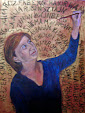
I’ve been returning to the studio as of late to work on the remaining paintings in the Identity and Legacy Series. I've been speaking with Sholom Home about doing a show at two of their facilities later in the year. To that end I hope to do five more paintings and then close out the series with a total of eighteen paintings that include at least one of each interviewee. Of course many of those that remain feel more challenging as I began with those which had clear imagery. I remind myself that sometimes what seems a mystery unfolds as I begin to paint. The one I recently finished is no exception.

One of my favorite interviews was with Rakhil and her daughter Liana as they talked of their experience in coming to the US from the former Soviet Union. To do a painting, I need to ponder the essence of their story and as I reread the interview I was struck with the way in which legacy was passed through food and song from mother to daughter. Even at a time when practice of religion was difficult the cultural handoffs managed to keep that history alive.

This theme came up many times. When I asked about food I was regaled with stories of making gefilte fish, an old family recipe that Rakhil had learned from her mother and she in turn from hers. Rakhil recalled her mother leading them in song at the Pesach table and shared the songs that she had learned from her mother. When I asked about religious practice itself I was told that Rakhil’s mother (who would have been born around the late 1800s) was proudly Jewish and sang Jewish songs and celebrated Jewish holidays. Rakhil was born around the time of the revolution when religions, especially Judaism, were persecuted, but she knew about the holidays from her mother and what she remembered she told her daughter. I began to imagine a long line of women extending back in time, each passing on the traditions. Having it go from mother to daughter felt especially meaningful in that being Jewish is passed through the mother. I looked at images I had taken of Rakhil singing and decided to start with that image.

I also was interested in the stories I had heard about the Russian passport that indicated if one were Jewish. This designation often contributed to job discrimination for Jews. As it was on line five, the question, “Is your line 5 OK?" took on additional meaning. It meant that if your line 5 indicated you were Jewish you would encounter difficulties. I originally was thinking of overlaying the passport to incorporate this part of the story.

As the painting developed I had to edit. The challenge with many stories is one can have too much of a good thing and end up with confusion. I discarded the idea of the passport and thought perhaps it might find its way to its own painting. I developed the image of Rakhil and a line of women behind her. I then pictured them all sitting at a table and began to sketch in ovals before each woman, imagining them blending into one table that they shared.

One of the things that I have always found fascinating about cemeteries is the way they compress time, joining those of different generations and time periods around one table. I had that same sense of compression as I developed this painting. Food, song and culture compressed time, joining different generations together.

I sketched in the Kiev Synagogue to the side. Liana had told me that only those who had nothing to lose would go there as she would have been persecuted had she gone. Around Rakhil’s neck she wore a Star of David. We had talked about its significance for them as they could not have worn any Judaica in the Soviet Union. To be able to now say who they are and express their pride in it is very special. As I drew in Rakhil’s necklace, I also added it to all of the women who came before her.

I now had a shape that resembled a shofar going back in time, filled with generations of women in a figurative horn of plenty. Hmm, maybe there was a way to put the suggestion of the passport in. Where the line of women ended, I drew the number five, behind it another smaller 5 and behind that yet another. The five was in fact symbolic of their Jewish identity so it became a proxy for the women themselves.

So the painting is developing and now I need to live with it to develop it further. I like the way it intersects with story in a way I hadn't fully anticipated when I began. And of course the name of the painting is FromHer Mother to reflect the tradition handed from one woman to the next.

Thursday, August 23, 2012

In America We Become Russians

One of our most interesting interviews was with Rakhil, a 94-year-old immigrant from Kiev, and her daughter Liana. I had interviewed Rakhil with an interpreter in my first series of interviews and was quite charmed by her. Even with a language barrier her warm personality came through. She had told me stories about her mother and sang me songs that her mother would lead them in at Pesach. Rakhil told me about a time when Jews lived in friendship with the Ukrainians and shared holiday treats with each other.

That all came to an end in 1933 when the Soviet government began a program of forced farm-collectives. A famine resulted, killing an estimated seven million people. This was an effort to destroy Ukrainian nationalism and the capitalism implicit in the success of small farmers. Homes and livestock were confiscated, people who resisted were deported or executed. Grain was expropriated or sold on the international market while the people starved. It is a horrific story of which I knew little.

Rakhil told me that the Jews were tradesmen and craftsmen and they survived better than did their Ukrainian neighbors. Rich Ukrainians who had shops in the middle of Kiev often hired them. Jealousies resulted and fed the anti-Semitism we often associate with the Ukraine.

During the war Rakhil and her family evacuated Kiev and worked on a collective farm. Twenty-eight members of her mother’s family sought shelter in Kiev and were killed at Babi Yar in the largest single massacre of the Holocaust.

Rakhil enlisted and worked in communications. Her ability to understand German made her valuable as a translator. She made it all the way to Berlin during the war and won many medals. Her daughter later told me that she entered Majdanek and Auschwitz with the Russian army, horrified at what she found.

On this second interview I was relying on her daughter to translate for her as well as to share her own story. I had found that the elderly Russian immigrants I had interviewed, typically came to the US to follow their children. While I knew of antisemitism in Russia, I had never talked with a contemporary about their experience.

We began by asking about their decision to immigrate in 1989. Liana talked of the antisemitism in the Soviet Union which prompted it.

 “You just kind of learn with years, you learn to live with it. You just know that you are second-hand kind of person and certain fields, certain places, you will never be able to get to.”

 She told of seeking to enroll her son in a school which specialized in English. Those who graduated received an interpreter’s certificate and it is usually for military interpretation. The director told her that while her son could enroll he would never receive the certificate. “Why?” she asked. “Because you are Jewish, don’t you understand,” replied the director. Ultimately the decision to immigrate came in search of more opportunity for their son and themselves. Her mother followed three years later.

When I asked about the family’s experience being Jewish, Rakhil replied that her mother was not religious, but kept kosher and celebrated the holidays. Rakhil was born at the time of the revolution so she knew what she learned from her mother. Liana was reliant on what her mother had learned from her mother, but could not practice Judaism. There was one synagogue for 4 million people. Generally older people who had nothing to lose attended. Attendance was monitored and penalized at jobs and universities. Ironically Liana’s daughter-in-law has since become an Orthodox Jew so her grandchildren are now being raised in the Orthodox tradition. Rakhil proudly related how the oldest grandson led them through the Pesach service.

Liana spoke of something I observed in Lithuania, that being Jewish is treated as a nationality, not a religion. If one is Jewish that is noted on your passport rather than Russian or Ukrainian. It is on line 5 so people would say, “Is your line number 5 OK?” It means, “Are you Jewish or not?” In the US we think of ourselves as Americans and Jewish. Imagine living in America, but not being considered an American because one is Jewish. This is essentially what Liana experienced in Russia.

She commented on the oddity of now being labeled as Russians because that was their geographical home.

 “You see we’ve been all of our lives Jews. In America we become Russians. We’re Russian but we’re not. We’re from Russia, but we’ve never been Russian. We’ve always been Jews. Jews here and Jews there. But here we’re Americans, American Jew. Over there we were just Jew. Period.”

I especially enjoyed the Russian jokes that Liana used to illustrate the duplicity of the then Soviet government.

 "When one Jewish man was crossing the road and it was green light and policeman said, 'you can go now,” he said,“I don’t believe them.”

"He doesn’t believe in the country he lives, it’s like a gang. So he doesn’t believe whatever they say to him. Because they say it should be one thing and their knowledge is completely different. We’ve always said, “if you want your refrigerator to be full of food, you have to plug it in the radio”. Because on the radio and on the news this (Russia) is the best country in the world."

I asked Liana if it has changed. She said she thinks so, but isn't sure how much.

When we spoke of her father’s history I felt as if I had stepped into a novel, a rather tragic one. Her father along with his brother and sister were orphaned when their parents were murdered during a pogram. The children hid, but saw the murder. They then walked through the winter to get to an orphanage. I just read the wonderful book The Little Russian where the author, Susan Sherman, paints vivid pictures of such events. I was able to visualize it all too well.

“How does one make sense of that experience, of that history?” I asked.

She replied, “It makes me look different on a situation in the country, be very politically involved, be very pro-Israel, be a huge supporter of our country. You know to feel that you can be fair citizen here, everybody treats you like equal. And that’s what I’m grateful for and appreciate so much. And like I said, have all this legacy with us. It makes us stronger, and it makes us bring different views to United States. Makes us hard workers, makes us people who not spoiled by having everything.”

Some of our lighter moments came when I asked about food and Rakhil began to describe how to make gefilte fish. A family recipe that came from Rakhil’s grandmother has yet to make it to Liana, but we witnessed the promise to pass it on. Using hand gestures Rakhil illustrated how it is made as Liana translated.

 “You bring the fish and I make it,” Rakhil told us.

 “It’s a long procedure.” said Liana. “ People don’t have time anymore. It’s better to go to Costco to buy it.”

When Rakhil came to the United States she decided she wanted to become a citizen. At age 80 she went before the official and told him her name and age in English. She then shared with us the English spoken sentence, “Me-morial Day ees holiday” that got her citizenship. Very somberly she recited the sentence and then illustrated the amazement of the judge at this elderly Russian woman.

Our visit ended with Rakhil singing Yiddish songs for us with a vigor that belied her age. Her joyous spirit affected us all and we told her we hoped to return with a Klezmer musician who will accompany her singing.

This project has been made possible in part through the Arts and Cultural Heritage Fund through the vote of Minnesotans on November 4, 2008. Administered by the Minnesota Historical Society.