Soon it was time for our presentation to high school students at the Resursa. We arrived at the Resursa which is a grand building with figures atop it and a statue in front of it.
 Jakub had advised us that it was a Citizens Club long ago and was used as an officers club by the Germans. Now it is an arts and culture center for the city with a variety of programs and exhibitions. They had a large auditorium which slowly filled with students. Dora, Jakub and I were on stage together with our interpreter. As I entered the auditorium and arrived at the front row I saw our young friend Michalina who had been so helpful to us on our prior trip. We hugged warmly and I was then whisked on to the stage. I had just a minute to ask Michalina to translate for Dora’s son as they had decided only to translate from English to Polish. Dora was quite determined to speak in Polish, no small feat after 70 years of not speaking it, but she accomplished it masterfully.
The format of the session was to have Jakub ask us questions to which we would respond, with most of the questions directed at Dora as the focus was on her recollections of her life in Radom. The questions for me related to what drew me to Radom, researching my family history and how I felt about Radom. As Dora replied in Polish, I would recognize a similar word to English and instantly know which story she was referencing. As I sat and listened to the stream of Polish words I counted the students in the auditorium, about 100 filled the room.
Midway through the presentation we learned that there was a class of Israeli students who had come to the presentation. They understood English, but not Polish and as no one was aware that they had joined us they had missed a portion of the presentation. The program then switched to English with a promise to the class to provide them with Dora’s written memories in English that I had provided to Jakub. After the presentation we invited the Israeli students up to the stage to meet Dora. She conversed with the teacher while her son spoke with them in Hebrew. The students surrounded Dora eagerly taking pictures of her. Dora also had an opportunity to speak with the teacher of the nearby school which is memorializing the school, The Friends of Knowledge, that Dora attended and gathering information on its attendees.
After the session we had some time to explore the town. We walked towards the archives where we planned to exchange the slip of paper for our documents. As we walked we noted many abandoned buildings or buildings propped up with wood. We had learned on our last visit that the buildings that were abandoned by Jews upon their deportation often deteriorated as there was no clear title to them. The city would periodically place an ad in the paper so they could begin the process of taking them over.
At the archives we found that some of our documents had been copied, but the identity papers were on a CD. Papers in hand, we took advantage of the nice weather to stroll down Zeromskiego, the main commercial street that is closed to traffic. We stopped for a quick bite to eat and it was soon time to return to the Resursa for the opening.
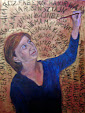
As we entered the Resursa we were greeted by a very dapper Jakub. He advised us that some press were in the room. We soon saw our friend Michalina. Her parents who had hosted us at their home on our last visit, greeted us warmly. They had invited us to visit after the opening. The room soon filled with people and it was time for comments. Jakub made some brief comments and Dora spoke warmly of her experience in returning to Radom doing her comments in both Polish and English. I spoke about the development of the artwork that was there, my ties to Radom and my collaboration with Dora. They presented us with flowers and we were whisked to yet another room to do a radio interview.
Our beautiful day had now turned rainy and we piled into the car of Michalina’s father. On our last visit, the men had shared a number of shots of vodka so it appeared that they had cleared any barriers to a repeat performance. The plan was for Michalina’s mother to drive us home as the designated driver. Dora sat in front and in no time was chatting with Michalina’s father in Polish. We arrived at their home to a spread of salads, herring and meats. This was followed by a tasty fish dish combined with vegetables and then a coconut dessert. Wine and vodka flowed freely throughout. While I’d like to report on the conversation, much of it was in Polish with Dora and Michalina’s parents engrossed in conversation. Finally our evening came to a close with fond goodbyes as our time in Radom concluded.


 Posts