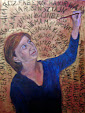
Having a blog, an art site and two websites (Radom, Dunilovichi) on ancestral towns means I am pretty accessible on the Internet. I also do talks, workshops and exhibitions of my artwork. Some people would find that a bit too much exposure, but it opens me up to some interesting connections. Between all of those avenues I hear from a wide variety of people.
This week I have been communicating with a woman in France who hired me to research a branch of her family, a woman from Israel who discovered her family in one of my Kehilalinks (ancestral websites) and a woman in England who has a connection to a branch of my British family. Closer to home I connected with a woman through Facebook who is researching the family name of my Ukrainian great-great grandmother and a woman who heard me speak locally who sought some assistance on her family research. I rounded it out with a discussion with a woman who is a writer who sought my input for her nonfiction book involving an escape from the Radom ghetto.
For almost six years I have been busy reinventing myself with a focus on my artwork and family history. I’ve found that one of the fundamental principles of reinvention is visibility. It is hard to reinvent yourself in a vacuum. You have to let people know what you are up to. I remember thinking enviously as a kid about the people that moved to a new high school. They could be whomever they wanted, leaving their awkward old self behind, no longer useful in their new and popular life. When I went off to college I decided to perform the feat of reinvention and found that it is a much more gradual process than I had hoped. Years later, when I left my career in finance, I didn’t seek to deep-six who I had been. I had finally gotten to a place where I was comfortable in my own skin. Instead I sought to let some other sides of me flourish. I was smarter this time around and I realized that who I was will always be part of who I am. That analytic part of me that I used in finance is the part that helps me write these blogs and is often called upon in my genealogy research and even my artwork. The balance between artist and analyst gives me some challenges, but also some gifts.
I often reflect on what has enabled me to perform this reinvention more successfully than my early college attempt. When I first left my job I contacted the Jewish Historical Society to volunteer. When they learned that I was deeply involved in genealogy they suggested I give their annual genealogy talk. My first thought was a resounding NO!!! Public speaking was not the direction I had anticipated. Then I caught myself and that inner voice said, “New life, new ways”. I did the talk and discovered much to my surprise that it was fun. This was a revelation to a self-described shy person. Had I never risked that exposure, I would never have discovered the joy of speaking about something I love.
When I did my first solo art show I also felt exposed. There is something about putting your artwork out there that is rather scary. I don’t like everything that I do from one day to the next so how can I expect someone else to. I still fight the urge to bring a paint brush into a gallery where my paintings hang and do a little touch up. I frequently will rework paintings between shows until there is that magical moment where I am pleased with the result. It doesn’t always happen. Paintings evolve just as I do and sometimes they need a bit of reinvention too. Putting them out before they are fully reinvented is not too different than putting myself out there before I am fully reinvented. You start with where and who you are and let the process work.
When I started a blog I again experienced that sense of being exposed. I started out keeping a shield of privacy and gradually have begun to reveal more of my own views and my own experience. Having left my career, I feel a greater sense of freedom to reveal who I am, to expose myself to scrutiny and worry less about others’ judgments. I hadn’t realized how much having an employer caused me to rein myself in until I no longer had to.
I was struck by a sentence in a book I've been reading, Imagine: How Creativity Works by Jonah Lehrer. He writes: "We are so worried about playing the wrong note or saying the wrong thing that we end up with nothing at all, the silence of the scared imagination." So being “out there”, taking the risk that people won’t like my artwork, my talk, my writing, me, is all part of reinvention and embracing creativity. Along the way I am always deeply grateful for the people who enjoy what I paint or say or write and offer their encouragement to continue taking those risks.


 Posts