Showing posts with label mitzvah. Show all posts

Monday, September 17, 2012

Yiddishkeit

I always find the development of a painting to be an interesting process. One often thinks that the artist knows where it is going, but as in life they may start out with an idea that changes and evolves. I’ve learned to watch the process with interest as it often takes me to surprising places.

My process begins with story. In my current series on Jewish Identity and Legacy I review the interviews that I’ve done and see what speaks to me. Fannie, who I referenced in the earlier blog entry is very much a story teller and also deeply involved in her Jewish heritage. She speaks with energy and passion so her stories drew me in.

During my first interview with her she began to expound on Yiddishkeit. Yiddishkeit is defined as Jewish character or a Jewish way of life.


Because if you’re Jewish and you don’t display or tell or show that you are Jewish, you’ve lost it and then we’ve lost it, we’ve lost something. I don’t like people who are ashamed of being Jewish.

Here she referenced someone who she knew who she felt was uncomfortable with being Jewish as she mimicked, “Don’t act like that, act nice, act normal.”

What is acting “like that?” I asked.

Well you see, you don’t flip an accent, and you don’t say a joke and you don’t say a Jewish word, you don’t say Oyyyyy. You don’t use expressions like that. And when you’re with me you walk straight, you don’t wiggle around. And you don’t sort of show so that they know you’re Yiddish.

I would use my hands, I still do today, I use my hands. And maybe I don’t walk just prim and proper.


I was amused at the energy with which she expressed these sentiments, but understood that she was speaking of that very energy and spontaneity as Jewish characteristics. I often have reflected on the fact that I have always had many Jewish friends, even when I was not actively engaged in a Jewish community. The common thread was often the very traits that she referenced.

But it was more than personality traits. She explained, “It’s everything, it’s everyday. Yiddishkeit is everyday. You can’t just put it aside before Rosh Hashanah and Yom Kippur. Yiddishkeit has to be spontaneous, it isn’t locked in little cubby holes.

It’s a way of living, it’s a way of living.

It’s part of being part of the synagogue, no matter which one it is, it’s part of being body and soul of everyday living and believing of what they do and knowing what it is Tzedakah and Mitzvah. Those are natural words and natural things, they are things that happen and you make them happen and you learn to give from the time you’re that high. It just comes naturally and it has to and that’s Yiddishkeit.


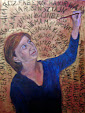
In painting this I began with the idea of cubby holes, compartmentalization versus spontaneity. I built up a background of color and squares. First with words spilling out of them, then painting over that early effort to create a waterfall of words, only later noting that it resembled a prayer shawl. The words I used are the words that have meaning to me and are very much about Jewish values. You can find the words Mitzvah (Good Works), Tzedakah (Charity) and Tikkun Olam (Repairing the World) spilling forth from the waterfall that pools at the bottom of the painting. What else conveys spontaneity? Hands, those hands that gestured throughout her riff on Yiddishkeit. The irrepressible energy she couldn’t contain. So I painted them in, but they seemed a bit disembodied so I sketched in her face as well. I hadn’t planned on a portrait, but Fannie’s energy found its way in, almost as if her hands parted the painting and the rest of her followed.

Is it done yet? I'm not sure. Normally I like to live with a painting for awhile before I decide it is finished, but I hang a show tomorrow and would like to include it. So for now it's done, always subject to future revisions.


This project has been made possible in part through the Arts and Cultural Heritage Fund through the vote of Minnesotans on November 4, 2008. Administered by the Minnesota Historical Society.

Monday, August 1, 2011

Many Hands Make a Mitzvah

One of the satisfying things about my work with genealogy is when I am able to help another person make an important family connection.  As I have created two Kehilalinks, websites for others searching their family history, I often have the opportunity to do that.  It frequently takes many hands to make a mitzvah (a kindness for someone else) and a recent experience illustrates that well.

The first step in the making of a mitzvah was an e-mail that I received last November from the head of the Radom Society in Montreal.  He advised me of the discovery of 72 previously unknown Jewish tombstones that had been erected into a monument in the Jewish cemetery in Radom, Poland.  As most of the tombstones in the cemetery had been used by the Nazis to pave the roads, the discovery of intact tombstones was a very important event. His uncle Haim Kinczler, head of the Israeli Radom Society, had been instrumental in discovering these tombstones and assuring that they would be available to those visiting Radom, a huge mitzvah in itself.  The Israeli prison system and the Polish prison system collaborated with the help of Polish prisoners and a British/Israeli philanthropist to build the structure that houses the tombstones. For more information on this project see my prior post Unusual Collaboration Unveils Lost Tombstones.

When I heard about the tombstones, my first thought was that I needed photos.  The tombstones potentially belonged to the families of those researching family from Radom and I had the means to reach them through the Radom Kehilalink. With the information that was provided, I contacted a friend at the Resursa, the Arts and Culture Center in Radom.  I had met Jakub on my last visit to Radom when he secured the key to the former cemetery for me so I could visit it.  I asked him if he might be able to take photographs of the tombstones for me and he graciously went out to the cemetery in the middle of winter to do just that and sent me a CD with the photos.

I then needed to get them translated so posted a request for help on the JRI-Poland e-mail list.  Two volunteers did the translation.  One of the translators, an Israeli friend with ties to Radom did an additional step cross-referencing it to the Book of Residents, a kind of ongoing census that records family groupings.

Up until now I was choreographing, arranging for photos and translations.  Now my hands-on work began as I had to isolate each picture for a web album, clean up the information into a format for the web and build the appropriate pages and links to publish it on the site.  I also submitted the photos and translations to the Jewish On-line Worldwide Burial Registry which will add them to their database that is easily accessible to researchers.  Finally I completed the circle by sending an e-mail to JRI-Poland’s email list to announce its availability.

Now I had only to wait to see where it led and it didn’t take long.  I already knew that one of my translators had found a family member in the tombstones that he had translated.  This week I spoke with a woman who is planning a trip to Radom who had discovered the Radom Kehilalink.  She reported that in looking at this database she discovered her grandmother’s tombstone.  The links to the Book of Residents further added to the information on her grandmother.

In order to connect a woman in Detroit, the child of a survivor, with her grandmother’s tombstone in Poland, it took many Israelis and Poles to create the structure, someone in Montreal to communicate it, the help of my Polish friend to photograph, two translators, one American and one Israeli and finally me to organize the effort and build it into the website.  Many hands make a mitzvah.