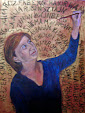
A mentsh trach un Got lacht.- Man thinks and God laughs. Edith Gordon (nee Ginsberg) Evelyn’s Grandmother
Today was the first day that we skipped our classes to go on an adventure. Evelyn, one of our friends and classmates, hired our guide Regina to accompany her to the shtetl from which her grandmother’s family came. She kindly invited Fran and me to accompany her.
Regina had hired a driver and the five of us squeezed into the car and started out towards Pilvishok.(in Lithuania known as Pilviskiai). As we began our trip Evelyn shared her family history. When she was in 10th grade she had an assignment to create a family tree. At the age of 15 she interviewed her grandmother and got information that went back to her great-great-great grandmother. Fran and I were quite envious as all genealogists wish they could go back in time to interview those long-gone relatives. In the 1990’s Evelyn transferred the information to a PC. Five PCs later, she pulled it up on her Blackberry as we sat in the car.
Regina asked us our Yiddish level and told us that she wanted to make sure we didn’t totally miss our Yiddish practice. She pulled out a Yiddish book about Lithuanian shtetls and villages and proceeded to read it aloud. After each sentence we haltingly tried to translate. We found that we could get the gist of the meaning with assistance from Regina. From the text we learned that between 1839 and 1855 they had a subscription program to Talmudic commentaries. Seventeen people contributed money to print the commentaries and have access to them; kind of a book of the month club. Regina pointed out that the population of Pilvishok was about 1300 at the turn of the century, but had dropped to around 700 before the war. The town experienced many hardships, especially a fire in 1887 which led to the immigration of many people. Despite hardships, the town found the resources to help the poor among them and create a library. They had a scholarly correspondence with St. Petersburg soliciting books for the library.
During the drive we were amazed to hear Regina answering the phone in various languages as she spoke with other shtetl shleppers. We passed through a beautiful area of lakes and orchards. We were especially fascinated by storks perched in high nests. They nest in the region then migrate all the way to Africa for the winter. We hoped to get a photo of them, but Regina assured us that we would find many of them in Pilvishok. She mentioned that the movie Defiance, based on a true story about partisans in Belarus, was actually filmed in this area.
When we approached Mariampole, Regina directed our driver towards a small Jewish cemetery that potentially contained tombstones of Evelyn’s family. She knew she had seen a Ginsberg (one of Evelyn’s family names) in the area. There we found a circle of tombstones, but no Ginsberg. The original cemetery had been destroyed by the Russians. The tombstones which had survived had been grouped in this small circle. As we walked around the circle Regina pointed out one tombstone and asked us what was unusual about it. Part of the inscription on the tombstone was an acrostic, similar to the one we had found in another shtetl visit. It consisted of a poem in which the first letter of each line spelled out the name of the deceased when read vertically. As we found none of Evelyn’s family names we continued onward.
Mariampole is a larger city and appeared to be prosperous. We learned that they do a big business brokering second-hand cars. They get them from Western Europe and sell them in Asia and Russia. Many Russian Asians are here as they are engaged in this business. In Mariampole we also found the former synagogue building with the ten commandments perched at the top now painted over.
We continued on towards Pilvishok. As we approached it we found a field full of the storks just as Regina had promised. While we were delighted to have found them, we bemoaned the fact that we were driving too fast to photograph them in their nests high above the buildings. When we entered the city we went over the Sesupe River. This river joins with the Pilve River at the junction of the town. We pulled over to a side street dotted with traditional wooden homes that were representative of a shtetl home.

Regina told us that unlike the yellow painted homes that we observed on our visit, shtetl homes were made of unpainted wood and were grey in appearance.
By now it was early afternoon so we stopped at a nearby restaurant. Regina directed us to order food that would be prepared while we visited the nearby cemetery. We ordered traditional Lithuanian fare of meat stuffed blinis, stuffed cabbage and herring and potatoes. Regina then gathered us together and offered umbrellas and jackets for what was now a rainy day. Evelyn had forewarned us that it is always cold and blustery when she visits any of her ancestral shtetls. We were hustled to an area next to the restaurant which contained a small commemorative cemetery. Again the original cemetery had been demolished and a handful of remaining tombstones gathered together in this area. As we entered the cemetery, Evelyn was drawn immediately to a particular tombstone. In large Hebrew letters, she clearly saw the name Ginsberg. She did a little happy dance and Regina joined her. Regina translated the tombstone and where the stone was worn she felt the letters with her fingers.

It looked as if she was pulling the words out of the stones. She translated the Hebrew for us as “ A man of faith, his deeds were very good and complete, his name was known in glory for prayer. He was a reader (in synagogue) and took care of the house of prayer.” He died in 1931. Regina had a blessing which she read while Evelyn recited the name at the appropriate juncture and then proceeded to place a stone on the tombstone. We noted that other stones were already on the tombstone indicating someone else’s visit. We returned to our lunch thrilled with our discovery.
Afterward we went in search of the killing fields, a mass grave for the Jews who were murdered. We stopped when Regina saw an elderly man standing with his bicycle outside a convenience store.

Regina asked him for directions and if there was a hotel in the town. She later noted that this question told us something about the size of the town as a hotel was an important indicator of its importance. Seeing that he was forthcoming she asked him additional questions about the Jewish community. She also asked him if I could record him and he agreed. The man told us he was born in 1922 so would have been 19 at the time the Germans invaded. He recalled that on the first day of the war (6/23/1941) there was a blitzkrieg at 4:00 AM. By 9:00 AM everything was leveled. The Russians who had occupied the town, retreated to the river. The bridge had been blown up and many drowned.
He remembered different Jewish families who had lived in town, Simberg(ai), Markson(ai) and Frismon(as). The Goldberg’s had a restaurant and the Neimark(as) family had the biggest shop. The Soviets later used the Neimark home for the shop for the collective farm. He recounted that when the Germans came they first killed the Communist youth. They then waited several months before killing everyone else.
The Jewish cemetery had been destroyed when the Soviets put a sewer system in during the 1960s as the pipes went through the cemetery. Afterwards they collected the remains and made the cemetery which we had visited. The synagogue had been next to the square and stood next to the shops. He remembered that the Jews used to “throw away their sins” in the Sesupe River on Rosh Hashanah (the ritual of Tashlich).
Following his directions we made our way towards the killing fields. Without obtaining these directions the typical visitor would have no idea where to look. It was only when we entered an empty field that we found two granite markers designating the site ahead. We walked through a field where we found a low fence and behind it a grove of trees. There we found a memorial that dated back to Soviet times. Regina translated it as “In this place in August 1941, Hitler’s Fascist and Lithuanian Bourgeois Nationalists ferociously killed 1000 people from Pilvishok. Let the memory of the victims of the fascism be eternal.” We noted that it made no mention of the fact that they were Jews. Interestingly it made note of the collaboration of the Lithuanian nationalists, something we have observed considerable denial about today.
Regina had brought a candle for Evelyn to light and together we haltingly said the Kaddish, the prayer for the dead. Our guide sensed that there was another site and discovered it down a path along the creek. There was a similar site and plaque in a nearby wooded area. Again we said the Kaddish.

As we celebrated our discoveries later over dinner we reveled in a successful and fascinating journey. The day was full of discovery and wonder, evoking a wide range of feelings from sadness to delight. We even found our elusive stork nest on our return trip.Regina’s energetic personality together with her knowledge and humor had added an important dimension to our experience.
 Alex told us the spheres were mistletoe. It was a warm, sunny day and landscape formed interesting silhouettes against the sun. We passed a cemetery of crosses set amongst the trees with their mistletoe ornaments. Across the road, truncated trees mimicked the form of the crosses.
  Storks nested high above the houses having just returned from Africa. As we drove, people walked along the side of the road, many were older women with babushkas on their heads and canes in hand. Roosters and chickens and the occasional turkey wandered by the roadside.
 deal. I had seen pictures of it, but one soon realizes that a picture does not do justice to this town. Below the castle is the area of Karvasary, where the Jews lived in earlier times.


 Posts
Posts