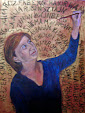
Voices of Wisdom... What does that conjure up for you visually? And what exactly is wisdom? Those were questions that faced me when I began the fourth year of the Jewish Artists' Lab with the theme of wisdom. The lab is a group of about thirty artists who gather twice a month to explore a theme through a Jewish lens. At the end of the year we have an exhibition as well as an opportunity to do a reading or performance piece.
I remember my first year in the lab. In hindsight I entered it with some unease. I looked around at some of the very accomplished artists in our group and wondered where and if I fit within them. And then there was that Jewish part. "Was I Jewish enough?" I wondered. Being Jewish was part of my identity, but more culturally than religiously. I found to my surprise that the group had a wide range of Jewish practice. It has been a welcoming place despite one's personal definition and equally important, an intellectually stimulating place.
I like what I call idea art. Idea art takes a broader concept and uses it to inform the art, to draw the viewer in visually, but also intellectually. There is often a use of metaphor and juxtaposition of ideas. The lab approach grows out of ideas so it often exemplifies this kind of art which has ultimately made it a good fit for me.
So back to that wisdom thing... I began this year's lab just three months after my mother had passed away. She was indisputably a wise woman, compassionate, non-judgmental and intellectually curious. She listened with her heart, understanding human frailty, yet seeing the potential in those she encountered. She was a teacher, but also a learner. When we were asked to define wisdom she was my yardstick, the gold standard.
At the time I was going through her home disposing of belongings, but also looking for traces of my mother, not quite ready to let her go. In my search I stumbled across a file titled Notes on Books Read. In it were excerpts from books that spoke to how we can live a meaningful life, face fears and grow into who we are meant to be. Her wisdom gatherings came from diverse sources and disciplines and held a number of Jewish sources. I've written about their contents in The Roundness of Things Part-1 and Part-2. I knew that she would be represented in my wisdom artwork through the words she had gathered, but had to figure out how to translate this visually. I was an artist in search of a metaphor.
I settled on the apple, that classic gift from a child to their teacher and the fruit of the Tree of Knowledge. In fact in Genesis it notes that the fruit was desired to make one wise. As I dug further I found rabbinic literature that referenced the time from the Exodus until the giving of the Law as the same time frame for blossoms to mature into fruit. Developing wisdom is a maturation process and I liked this juxtaposition. So now my question was how to express that visually. There are artists who plan ahead, doing sketches, thinking through ideas and then executing their vision. I'm not one of them. I start with a kernel of an idea, dive in and see what comes to me in the process.
 So I started painting, apple trees and apples, thinking about the light source, polishing my apples with light and shadow. I had people come through my studio who liked that simple image of the apple tree. "Don't do anything else" they said. I knew I had to ignore that advice. When you paint you can't be afraid to ruin it. It is something we struggle with, when to push it, when to stop. I still had ideas to express so I knew I had to keep going. I wanted to incorporate my mother's words and decided to do that through a book that fans open in the corner. I wrote out her words on thin decorative paper and added pieces that folded creating a three dimensional feeling.
So now what?

I added a few books in a niche of the tree, then named them. One is titled the Pirkei Avot-Ethics of the Fathers, a Jewish text of wisdom which is studied in the period from the Exodus to the giving of the Law (between Passover and Shavuot), another juxtaposition with the apple and our maturation into wisdom. Then I added a book titled Notes on Books Read. In a moment of whimsy I hung a book over a branch with pages spilling out. Those pages curled into a fluid movement, born on a wind upward and out of the image. Smaller open books out of folded paper were added, taking bird-like shapes and adding to the movement. Apples sat on some of those pages, symbols of wisdom carried out into the world on the wings of books.
As we neared the end of the lab, we met with others in our group and discussed our work. I was asked about the as yet unnamed open book hanging over the branch. "What is its name?"
"I don't know." I confessed.

The next day it came to me. It would be the complement to the Pirkei Avot, which is the Ethics of the Fathers. My book would be the Pirkei Imahot - Ethics of the Mothers and contain their wisdom. On its front is written the name in Hebrew with the English on its spine. No such book exists, but it touches our lives through mothers everywhere. For me it represents the wisdom I witnessed daily in my own mother. What wisdom did you get from your mother?
and for those of you in the Twin Cities, stop in to see the show at:
and for those of you in the Twin Cities, stop in to see the show at:
Voices of Wisdom
Tychman Shapiro Gallery
and Shared Walls Exhibition Areas
Sabes JCC
4330 Cedar Lake Road S, Minneapolis
June 16-August 28, 2016
Opening Reception: Thursday, June 16 from 6-8
Art Beat Event: Sunday, August 28 from 5-7


 Posts
Posts