Showing posts with label Jewish genealogy databases. Show all posts

Wednesday, March 2, 2022

Other People's Families

When I first began doing genealogy, I signed up to join a group of Jewish genealogists in Utah for a week at the Family History Library. For many years it was an annual event. There are a select few who welcome a week of library research with happy anticipation. Given a choice, most people would opt for a beach vacation. What I didn’t realize at the time was that I was plotting a course that would carry me into a satisfying future of immersing myself in other people’s families. One of the things that came out of those annual visits was a community of people who shared that rather unusual enthusiasm. In 2008, one of my fellow researchers asked if she could hire me to do research on her ancestor who came to Minnesota in the 1800s. She was a genealogist herself so I knew I was going to be working on the gnarly puzzles she couldn’t solve but living in Minnesota I had the benefit of proximity to the sources.

I discovered that I enjoyed this opportunity to extend my family, for I began to take personal ownership and adopt them as my own. On some level it is an intimate thing to know the nuances of someone's family. I've found stories of re-invention among immigrants who went on to build successful lives, but also stories of deep sadness. Recently I found a family that lost most of its children within a few months, presumably from an illness. And there are the stories of events that were often not spoken of – love triangles and mental illness and of course the illegalities. I’ve looked up records from Leavenworth prison and followed stories of bootleggers. Usually enough time has passed that it has become an interesting story without the anguish of the moment, but I always imagine the weight of those events on their life and that of their children. 

Projects tend to find me and I need to then consider what is in my lane and whether I can add value. My lane is largely Jewish genealogy even though many of the skills I have cross over to general genealogy. Even within Jewish genealogy, there are areas of expertise. For example, I do a lot of work in Poland and Lithuania and can navigate records written in Russian with some facility. On the other hand, I know little about Hungarian or Czech genealogy so steer clear of such projects. Then there are the grey areas where I start working on a family with Lithuanian roots and they just happen to have German roots as well. Suddenly I am thrust into totally new territory to navigate with the skill set I’ve developed for other countries.  


I recently found myself in just such a situation. As someone who always wants to pull the rabbit out of the hat, it is a bit unnerving. Can I do that when I step out of my lane? I remind myself that there was a time when all of this was new to me. I’ve learned that once you figure out the resources that are unique to a region, the core process of puzzle solving is the same. You look for the loose thread where a gentle tug will begin to unravel the puzzle and then leapfrog from one source to another. Sometimes I find that thread in a surprising place. 
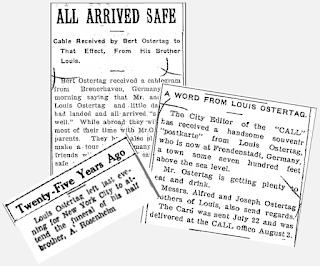


I begin my research with a newspaper search. Sometimes there is little, but in smaller towns one may find surprisingly granular information. A client’s great-grandparents were fortunate to leave Germany in 1939. On their immigration manifest, they noted a son in Ohio. A search soon revealed two sons in an Ohio town that had about 12,000 people in 1900, around the time they first showed up there. My search of the local paper found reports of their many trips back to Germany in the intervening years. One of the most unusual discoveries was from a newspaper report on an event that happened twenty-five years earlier. You know those look-back columns? The local paper had one that in 1937 looked back on an event from 1912 when this family member was called to NY to attend the funeral of a half sibling. We hadn’t known of any half-siblings so combining that knowledge with a search of NY records, I found the death record that cited my client’s great-great grandmother and her first husband. I then located probate records on the half-brother that cited the entire family in both the United States and Germany, providing me with the married name of an unknown daughter. With this information, I could access Holocaust records for family members who remained in Europe, drawing additional information on who remained from immigration manifests and survivors cited in obituaries of the American siblings. We discovered a significant impact of the Holocaust on this family, all history of which my client had not been aware.


Another branch came from the region that moved from Germany to Poland after WWII. The objective was to trace family in records overseas. I began with JewishGen, the beginning point for Jewish genealogy. There I found one promising indexed record but as the original record was not on-line I contacted the JewishGen Town Leader for that particular town. Not only did he provide me with the record, but he also clued me in to BaSIA, a unique Polish site that allowed me to search successfully for many of the records in what is referred to as Greater Poland (Wielkopolski), a region that was once part of Prussia. In addition to that source, I located helpful Polish sites such as Geneteka, a database hosted by the Polish Genealogical Society. While not Jewish specific, its indexed records included Jewish records. Often sites will provide some translation to English and failing that I could easily navigate using Google Translate on my phone with its camera option to translate Polish text. 


My takeaways – don’t hesitate to ask for assistance and look for country and regional sites that may index records within the archives. And don't forget that translation support is easily available on your phone. While such projects may feel initially intimidating even to an experienced genealogist, there is often an entry point that can lead to surprising discoveries.

Saturday, July 10, 2021

The Fluidity of Names

I love solving puzzles. I often have a “spidey sense” about the answer before I have the logical reasons to lend it credence, although in this case I sense what is right rather than what is amiss. There is something operating beneath the surface that I can’t fully explain, but I study my path to try to grasp its secrets.

I am drawn to genealogy in much the same way that I am drawn to reading. It is a way to imagine the lives of other people in other times, plus it has that added benefit of allowing me to solve puzzles. There is an impatient part of me that wants to rush the process, but I have learned it cannot be rushed or pre-judged. I need to remain open to possibilities as they unfold. 


Recently, I was hired to find what I could for a client who knew very little of one side of his family. He started as do many of my clients, with the names of his grandparents, Harry Hoffman and Esther Ackerman. They were from Romania – Bucharest he thought. He wasn’t aware of any family beyond his grandfather who came over and when I went to the records on JewishGen from Romania nothing came up in that region. I could feel those butterflies that always begin a search. What if I come up empty-handed? I can only work with what is there and sometimes it just isn’t there. As I couldn’t draw on overseas records, I focused my search on the US which can often shed some light on their ancestral town. 


I started to circle the problem, pacing mentally, looking for threads to tug on. I started by building a base of public information, searching both mainstream press and the local Jewish press, I combed city directories and located census records, beginning to build an address list, tracing them as they moved to different locations. I found the people who shared their names and time period but were not them.  I needed to be careful not to confuse their records. I located death records, finding the names of Esther’s parents within them.


Having exhausted my options, I went back to my original notes, looking for a clue. My client recalled a visit to his family from a woman named Bess Propper from New York, perhaps she was related in some way. When I shifted to New York, the ground began to shift as well, yielding its secrets. I found Bess and discovered  that her maiden name was Ackerman, like Esther’s. Then I traced her father Harry and found his naturalization paper under the name Henry, tied to the names of his wife and children as listed in the census.  It revealed his ancestral town was Galatz, originally in Moldova, now in Romania. 


I often find success searching via stevemorse.org, a better front-end search engine.  I went to the section on deaths and marriages where there are multiple ways to search for this information in NY. I chose Family Search because they often have parents’ names. In this case I found the parents of Harry Ackerman. They matched those on Esther’s death record. Siblings! 


This is the first delicate thread of fact on which I begin to build and I soon weave a tight connection between a series of facts. I do a search in the NY marriage records for the two grandparents’ surnames and find one such record in 1903, the year of marriage indicated in the census. It is between a Harry Hoffman and an Ernestine Ackerman. Harry gives his father's name as Morris, which just happens to be my client's middle name, reflective of Jewish naming patterns. Could Esther have gone by Ernestine? Using that name, I search the immigration records and find her coming in from Galatz, Romania in 1903 which  ties to the year given in her census records. She is going to “her brother, H Ackerman.” Ernestine and Esther are indeed the same person. 


I still have to connect NY to Minnesota where Harry and Esther end up. I go online to the Ackman and Ziff Family Genealogy Institute at the Center for Jewish History. They hold  the index for the Industrial Removal Office, a program in the early part of the 1900s that assisted Jews in leaving NY for the interior of the US. There I input Hoffman and clicked on the Industrial Removal Office, then searched for records from Minnesota. There it was, H. Hoffman and his wife Esther going to St. Paul. I took the index information from this site and went to Ancestry.com where I searched the card catalog for the Industrial Removal Office records. Yes, the index and the documents are in two different locations. You just need to marry them up. Now I line up the dates and realize that in the space of one month, Ernestine arrives, marries and is on a train with her new husband to Minnesota. 


I then turned my attention to Harry. Perhaps there is a name variance for him as well. I review my notes and find that he is listed as Herman in several census and directory records. When I searched on Herman Hoffman, I discovered an immigration manifest for Oct 1899 coming from Galatz, the same town as his brother-in-law Harry Ackerman and his fiancĂ© Ernestine. I then searched for census records and found Herman Hoffman living with his sister’s family a few months later in the 1900 census, a family member of whom we knew nothing. His sister's marriage record also gives her father as Morris, corresponding to that of her brother.The year of arrival in the census corresponds to the immigration manifest so I am fairly sure the Herman in the manifest and the census are the same person, but how do I confirm that this is also the Harry in Minnesota?  A few more records allow me to prove it out. In the NY naturalization records, I find a declaration from April 17, 1900. This was before naturalization records gave us much information, but in concert with other records it told me what I needed. The address given matched to that given in the 1900 census record. Then I found the next step in the naturalization process, the petition which was filed in Minnesota. I know it is the same Herman as it references his prior filing in New York by the corresponding date and court.


So here’s our story:


Herman arrives in NY Oct 1899

In 1900 he is living with his sister in NY at the address he notes in his first naturalization filing.

The father’s name for both Herman and his sister is the same in their marriage records

Similarly Esther and Harry Ackerman also share the same parents in their records.

Ernestine arrives 6/10/1903 and goes to her brother in NY

Harry and Ernestine marry 6/21/1903

They arrive in Minnesota 7/8/1903

Herman finishes his naturalization process in 1906


One final puzzle still stood. The transcription of the marriage record gave the father of Ernestine as Jak. According to her death record, it should be Isak. Not a big difference is there? I ordered a copy of the original marriage record to see for myself. The writing is hard to read, but it could certainly be read as Icek. And an interesting detail. The witnesses were H. Ackerman, the brother of Esther/Ernestine. And representing Harry was someone with the married surname of his sister. Each had their nearest relatives present.


So, what did I find as I study my path? Names are fluid. They tried them on and discarded them. Harry Ackerman also went by Henry, Harry Hoffman  by Herman and Esther by Ernestine(a). Harry seemed to use Herman for more official documents, but not always. Esther came over as Ernestine, later shedding it for Esther. Herman and Ernestine are common names in the Romanian records. Had I insisted they had to be Harry and Esther, I would never have found the records. 


Ages also were quite fluid. In this case the age range between Harry and Esther fluctuates from 8 years at marriage, 10 years on their immigration manifest, an average of 13 years across 5 census years and 16 years at death. The takeaway– if other elements match, don't be overly concerned about ages. They were of far less importance to them than they are to us.


Similarly, people aren’t static. They came into St. Paul via train but lived in Minneapolis. It isn’t that hard to cross the river. And a record by itself may not tell you much, but when you marry it up to related records, you begin to weave them together into a timeline which reveals a piece of the story. It is often by tilting the lens ever so slightly that we begin to solve the puzzle.

Monday, May 5, 2014

Cracking the Code

When I'm not at the studio painting, I am often immersed in genealogy. I've delved deeply into my own family history and now the discoveries are few and far between. I do some genealogy consulting for others as I miss that rather addictive thrill of discovery. I am always fascinated by process, how we get from point A to point B. It sometimes seems like I am pulling a rabbit out of a hat when I present someone with the result, but much of discovery is knowing the route to follow and understanding what data is available and how it connects. Having a basic familiarity with Cyrillic Russian often proves critical in the part of the world I research. A few community ed classes in Russian have given me enough so that I can find family names in records and was able to translate signs when we traveled to Lviv.


When I was a kid, my brother did magic tricks at birthday parties. I used to sneak into his room to examine the way the tricks worked and I remember studying a yellow cabinet into which he would drop a marble. It would disappear behind a wall of mirrors and miraculously reappear. So I am about to tell you a bit of the magic behind discovering family history, but no mirrors are involved.


I was contacted by an individual whose one branch came from a small town in Poland. He knew the names of his grandparents who died in the Holocaust and that two family members had survived. Beyond that the history was unknown.. Now that didn't give me much to go on as privacy laws mean that records from the past 100 years are not available on-line. They can be accessed if you go to Poland and prove your family connection, but as a researcher I was limited in what I could find. I estimated when the grandfather would have been born and thought I might be able to find a birth record older than 100 years. We always begin with what we know and tug on a thread.


Now if you are searching for Jewish records in Poland, the starting place is indisputable. JRI-Poland.org has indexed many of the Polish records so I began with a search on name and town. I came up with one record that matched the name with a birth year of 1891. I soon realized that I was quite fortunate. The Polish archives has begun to digitize records and the actual record was accessible on line from the JRI site.. My elation soon turned to dismay when I was reminded that the record was in Cyrillic Russian, handwritten Cyrillic Russian. Even if you learned your textbook Russian, handwritten languages don't look like the printed text.

I decided to see if I could decipher any of the names as I knew the father's name was often at the top as well as the first name below the record. The mother's name is further down in the body. They also had assisted me by capitalizing the names, but you will notice there are quite a few capitalized words, the name of the town and witnesses are also capitalized so knowing the location in which to look is important. Now despite the fact that I know some Cyrillic, I also drew on Stevemorse.org for some help. I input Nahum Stern and translated it to printed Russian. Then in a second step I translated it to handwritten Cyrillic. This is one of the options that it gave me.

Then I started looking for something similar. In the third line you will see the father's name and the last name appears to be Shtern, but the first letter is different.

I had been looking for the letter that sounds like "s" and looks like a"c" rather than the "sh" sound, but assumed it could also have been spelled in this fashion. In front of it is a common Jewish name that looked familiar even in Russian, Mordko.


The mother's name usually comes before the child's name so I looked for Nahum. At the end of the 11th line is a word that is capitalized and looks like it begins with Hoxum. In Cyrillic, what appears as an H is pronounced as an N and the x sound is a ch, close enough for Nahum which is often pronounced as Nachum.

In the prior line is a word which starts with a B which is a V in English and often pronounced as a W. I deciphered the first few letters and came up with a name that began with Wolf for the mother's maiden name.

Back to JRI-Poland to do a search on a Mordko Stern which quickly uncovers many records for Mordko Stern and his wife whose last name is Wolfenfeld.

Now I circle back to my client to see if 1891 sounds like the appropriate birth year. He's not sure. My dilemma is whether this record, from which I'm working backwards, belongs to the right family. I need to confirm that this is the right family or I can build a wonderful tree that lacks a solid foundation. I recall the grandfather died in the Holocaust so do a search for testimony on Yad Vashem. Success! A record has been submitted by an uncle who gives the birth year of 1891 and the parents' names which match my record.

Working back from one record to another I quickly realize that I can get back to his fifth great-grandparents, certainly back to the 1700s. There are marriage records for great-grandparents and great-great grandparents, always valuable for the wealth of information they provide, parents names on both sides.

Now the work is by no means done. Now I need to order records from the Family History Library or from the Polish Archives and get translations for them. I will build a tree with what I know and build the details from the records into it. But our process has begun, using sources of JRI-Poland, Yad Vashem, stevemorse.org and the Polish Archives. With those resources together with some basic Cyrillic and knowledge of the layout of records, I can crack the code.


Tuesday, August 16, 2011

New Resources and Improved Access

I am always on the lookout for genealogy databases that might open a new avenue for my research.   At the International Jewish Genealogy Conference, I learned today of an upcoming release at the Jewish Joint Distribution Committee (JDC).    The database offers some unusual sources of information.  During WWI the JDC assisted in transmitting funds between Americans and their family in Poland, Romania, Palestine and Russia.   Their records indicate the flow of funds and the sender and recipient.  I remember my father’s cousin, the one survivor in our family, speaking of my grandfather sending a $10 bill back to Poland and I wonder if he might have sent money back during WWI, a few years after his arrival in the US.

I hadn’t fully appreciated the range of situations that involved the JDC and the records illustrate the variety of their involvement.  Some of these situations include aiding Polish Jews imprisoned in Siberia, financial aid to prominent rabbis and Russian Jews trying to contact their American relatives.  In addition to funds, the JDC also assisted Jews in Eastern Europe who were requesting other forms of assistance from their American relatives.

During the Nazi period refugees and emigrants were assisted across Europe.  The well-known case of the SS St. Louis also became involved with the JDC.  This was the ship that carried over 900 passengers seeking escape from the Nazis.  They sought to land in Cuba and were denied entry.  They ultimately were forced to return to Hamburg as no country would provide safe haven.  Ultimately the JDC got the agreement of Holland, Belgium, England and France to accept the refugees and posted a guarantee of their support.  Needless to say many did not survive the war.

During the war many Polish Jews escaped temporarily to Vilna, Lithuania where the JDC provided aid.  Similarly they aided Jews who escaped to Kobe, Japan and Shanghai.  Many Polish Jews survived the war in Russia and are listed by the JDC Location Service when they were sent back to their home country.  CARE packages were sent to displaced persons after the war and identify the location of relatives who sent them.

The new release will occur in fall 2011 and will be found at JDC.org.archives.

Some records are already available at www.jdc.org/SharedLegacy.  There you will find a Names index that contains individual records associated with WWII and the JDC Emigration Service in Vienna and Munich.  I input several names of survivors and found records on their immigration to the US.  Also in the database was a list of Polish Jews who immigrated to Vilnius trying to stay ahead of the Nazis.

At another session I heard some welcome news on JRI-Poland.  JRI-Poland provides tremendous value for those of us researching family roots in Poland.  They have indexed 4.7 million records many of which are searchable on the Internet.  It used to be possible to order records with a credit card through JRI due to an agreement between JRI and the Polish archives.  Several years ago the then new head of the Polish archives terminated the agreement between the archives and JRI.  Suddenly the process of securing Polish records became very challenging requiring translating Polish and wiring money internationally.   I have ordered records several times through this rather intimidating process and am quite sure it has proven a barrier for many.   A new agreement will soon allow a return to the earlier process of ordering by credit card from JRI as well as the initiation of the indexing that had gone on hold.  At this point most available records through 1905 are indexed, but a backlog of newer records will need to be indexed.