Showing posts with label genealogy. Show all posts

Wednesday, March 2, 2022

Other People's Families

When I first began doing genealogy, I signed up to join a group of Jewish genealogists in Utah for a week at the Family History Library. For many years it was an annual event. There are a select few who welcome a week of library research with happy anticipation. Given a choice, most people would opt for a beach vacation. What I didn’t realize at the time was that I was plotting a course that would carry me into a satisfying future of immersing myself in other people’s families. One of the things that came out of those annual visits was a community of people who shared that rather unusual enthusiasm. In 2008, one of my fellow researchers asked if she could hire me to do research on her ancestor who came to Minnesota in the 1800s. She was a genealogist herself so I knew I was going to be working on the gnarly puzzles she couldn’t solve but living in Minnesota I had the benefit of proximity to the sources.

I discovered that I enjoyed this opportunity to extend my family, for I began to take personal ownership and adopt them as my own. On some level it is an intimate thing to know the nuances of someone's family. I've found stories of re-invention among immigrants who went on to build successful lives, but also stories of deep sadness. Recently I found a family that lost most of its children within a few months, presumably from an illness. And there are the stories of events that were often not spoken of – love triangles and mental illness and of course the illegalities. I’ve looked up records from Leavenworth prison and followed stories of bootleggers. Usually enough time has passed that it has become an interesting story without the anguish of the moment, but I always imagine the weight of those events on their life and that of their children. 

Projects tend to find me and I need to then consider what is in my lane and whether I can add value. My lane is largely Jewish genealogy even though many of the skills I have cross over to general genealogy. Even within Jewish genealogy, there are areas of expertise. For example, I do a lot of work in Poland and Lithuania and can navigate records written in Russian with some facility. On the other hand, I know little about Hungarian or Czech genealogy so steer clear of such projects. Then there are the grey areas where I start working on a family with Lithuanian roots and they just happen to have German roots as well. Suddenly I am thrust into totally new territory to navigate with the skill set I’ve developed for other countries.  


I recently found myself in just such a situation. As someone who always wants to pull the rabbit out of the hat, it is a bit unnerving. Can I do that when I step out of my lane? I remind myself that there was a time when all of this was new to me. I’ve learned that once you figure out the resources that are unique to a region, the core process of puzzle solving is the same. You look for the loose thread where a gentle tug will begin to unravel the puzzle and then leapfrog from one source to another. Sometimes I find that thread in a surprising place. 
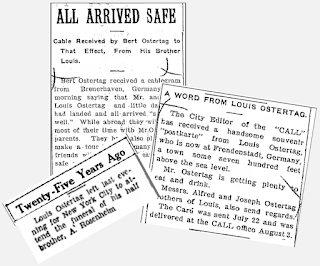


I begin my research with a newspaper search. Sometimes there is little, but in smaller towns one may find surprisingly granular information. A client’s great-grandparents were fortunate to leave Germany in 1939. On their immigration manifest, they noted a son in Ohio. A search soon revealed two sons in an Ohio town that had about 12,000 people in 1900, around the time they first showed up there. My search of the local paper found reports of their many trips back to Germany in the intervening years. One of the most unusual discoveries was from a newspaper report on an event that happened twenty-five years earlier. You know those look-back columns? The local paper had one that in 1937 looked back on an event from 1912 when this family member was called to NY to attend the funeral of a half sibling. We hadn’t known of any half-siblings so combining that knowledge with a search of NY records, I found the death record that cited my client’s great-great grandmother and her first husband. I then located probate records on the half-brother that cited the entire family in both the United States and Germany, providing me with the married name of an unknown daughter. With this information, I could access Holocaust records for family members who remained in Europe, drawing additional information on who remained from immigration manifests and survivors cited in obituaries of the American siblings. We discovered a significant impact of the Holocaust on this family, all history of which my client had not been aware.


Another branch came from the region that moved from Germany to Poland after WWII. The objective was to trace family in records overseas. I began with JewishGen, the beginning point for Jewish genealogy. There I found one promising indexed record but as the original record was not on-line I contacted the JewishGen Town Leader for that particular town. Not only did he provide me with the record, but he also clued me in to BaSIA, a unique Polish site that allowed me to search successfully for many of the records in what is referred to as Greater Poland (Wielkopolski), a region that was once part of Prussia. In addition to that source, I located helpful Polish sites such as Genetekaa database hosted by the Polish Genealogical Society. While not Jewish specific, its indexed records included Jewish records. Often sites will provide some translation to English and failing that I could easily navigate using Google Translate on my phone with its camera option to translate Polish text. 


My takeaways – don’t hesitate to ask for assistance and look for country and regional sites that may index records within the archives. And don't forget that translation support is easily available on your phone. While such projects may feel initially intimidating even to an experienced genealogist, there is often an entry point that can lead to surprising discoveries.

Monday, February 7, 2022

The DNA Rabbit Hole

One of the areas of genealogy that attracts many people is DNA.  While I am deep down the rabbit hole of genealogy research, I hesitated for some time before taking a deeper dive into DNA research. It was only when I received an email from a woman who reported that her husband had a high level of DNA connection to my late father that I began to pay close attention. I had heard of those “non-paternal events” which essentially mean the father isn’t who he is expected to be, but I hadn’t anticipated anything nearly so interesting within my own family. 


The level of DNA match is measured in a unit called a centimorgan (cM). A parent-child relationship would typically have around 3500 cMs and other relationships scale down from that to a distant cousin at 8 cMs.  Different testing firms can vary in the amount, but the basic relationships are fairly consistent.  Long ago I had convinced my father to get his DNA tested and had then uploaded our DNA to GedMatch, a site that provides tools to analyze the data. They had languished there for some time as I wasn’t quite sure what to do with them. Neither did I know what to do with the string of emails I was receiving from the original testing company announcing matches. Now I had new motivation.


In this case my Possible Relative (who we’ll refer to as PR) had a match to my father on GedMatch around 434 cM and about 132 cM for me. Raised in Puerto Rico, he had suddenly discovered with some surprise that he was 50% Jewish.  He was curious, but also concerned about causing discomfort in his family as no one had broached this subject with him previously.


I looked up a chart on FamilySearch that told me the likely cM match for different relationships. I eliminated those that were older than my father’s generation as PR was just shy of 50. From the chart, I concluded that the relationship to my father was likely through a first cousin and PR was either a son or perhaps a grandson of that cousin.  If he was the son of a cousin then we would share a common set of great grandparents and would be second cousins. That was the closest relationship I had ever sourced through DNA so now I had some incentive to come up the curve. 


I knew I needed to bring in reinforcements so I contacted a friend, Dan Kastrul, someone who was far more knowledgeable in DNA than I was. He suggested I look at DNA Painter which provides a similar chart as well as a tool that will tell you the odds of likely relationships. 


With his guidance I went into GedMatch and we looked at the X matches of PR to see if it would shed any light on which of his parents was Jewish. A man inherits his X chromosome from his mother so we looked at PR’s X matches on the GedMatch One to Many comparison tool. We saw no Jewish names in the multitude of X matches even though many of the DNA matches that were not X matches clearly had Jewish names. Thus we concluded that the mother was most likely not Jewish and the father was. My next step was to consider which of my father’s male cousins were likely candidates, considering cousins on both my father’s maternal and paternal sides. 


My grandfather had been the only one of his family to come to the United States in the early part of the 1900s. As a result, he was the only sibling who survived as the Holocaust sent most of our family to their death in Treblinka. My father had sixteen male cousins, twelve in Eastern Europe and four in the United States. We were fairly certain of those in Eastern Europe that only one had survived the Holocaust. After the war, Meyer, the son of my grandfather’s sister Bayla, tracked my grandfather down through someone he met in Germany who had an uncle who played cards with my grandfather – a story which gives new meaning to Jewish geography. I considered the five cousins I knew who had been alive fifty years ago and focused on two, one of whom was Meyer. He would have been 52 at the time of PR’s birth.  My hope that his branch of the family had survived may have influenced my focus, but on a practical level I considered that he had been single and lived in Florida, with some proximity to Puerto Rico. 


In the meantime there was a complicated personal story unfolding as PR finally decided to approach his mother with his questions and learned that he was in fact adopted. His adoptive mother produced the adoption file and it gave us additional information about the mother and the likely father. There was no direct line on the father, but some possibilities that still seemed to include those I was considering.


At this point I began to look for photographic relationships.  I had compared a picture of PR to my father and was struck by the resemblance, same forehead, same ears, same coloring. Now I went a step further back. From my genealogy research, I  had identity papers for my grandfather’s sister, Bajla, and her husband, the people I believed were possibly PR’s grandparents. These were papers that the Nazis required to be completed in 1941, along with a photo, as they prepared to  murder my family the following year. I positioned a photo of PR between his purported grandparents and there was a striking resemblance to Bajla. 


What I wanted was a picture of Meyer, the possible father.  I had an identity paper with a photograph, but it had Meyer’s brother’s name on it. Then I remembered a story I had been told. When Meyer left the displaced persons’ camp he had taken his late brother’s identity to get into the United States. He had heard it was easier to enter if you were younger and his late brother was eight years younger than him. He had some explaining to do when it was time to collect Social Security. The picture I had assumed was his younger brother was in fact him under his original name.  I continued to search Holocaust records, now using his original name and at Arolsen Archives I discovered a picture of him at an older age after the war. In the picture there was a deep cleft in his chin which matched that of PR. Based on photographic evidence, I was pretty sure I was on the right track, but I needed the DNA evidence to support it and I knew just where to go.


When I first started doing genealogy twenty years ago, my late aunt had suggested that I speak with her friend Phyllis about family. I was a bit confused at first as to the relationships. Phyllis and her husband rented my aunt’s Florida apartment. How would she know about family? I soon learned that she was far more than a renter. In fact she was a survivor from Radom, our common Polish ancestral town, and her family and mine had worked in the same business. She and Meyer had been in Auschwitz together. There were marriages between the families and Phyllis and my father were both cousins to Meyer, my father on Meyer’s mother’s side and Phyllis through his father’s side. I had done a lengthy interview with Phyllis years ago and learned more of the connections, and that story about Meyer assuming his brother’s identity. She has since passed away but I have kept in touch with her daughter, a contemporary of mine. If Meyer was the link, then Phyllis’ daughter should test similarly to me. 


When we ran the test my theory indeed proved out. Her test showed a similar level of centimorgans to PR as mine. I also ran my DNA against that of Phyllis’ daughter and learned that we didn’t have any direct relationship. I now felt confident that my theory was correct. Photographic evidence and genealogical research were supported by a DNA connection tied to both sides of Meyer’s family. 


Saturday, July 10, 2021

The Fluidity of Names

I love solving puzzles. I often have a “spidey sense” about the answer before I have the logical reasons to lend it credence, although in this case I sense what is right rather than what is amiss. There is something operating beneath the surface that I can’t fully explain, but I study my path to try to grasp its secrets.

I am drawn to genealogy in much the same way that I am drawn to reading. It is a way to imagine the lives of other people in other times, plus it has that added benefit of allowing me to solve puzzles. There is an impatient part of me that wants to rush the process, but I have learned it cannot be rushed or pre-judged. I need to remain open to possibilities as they unfold. 


Recently, I was hired to find what I could for a client who knew very little of one side of his family. He started as do many of my clients, with the names of his grandparents, Harry Hoffman and Esther Ackerman. They were from Romania – Bucharest he thought. He wasn’t aware of any family beyond his grandfather who came over and when I went to the records on JewishGen from Romania nothing came up in that region. I could feel those butterflies that always begin a search. What if I come up empty-handed? I can only work with what is there and sometimes it just isn’t there. As I couldn’t draw on overseas records, I focused my search on the US which can often shed some light on their ancestral town. 


I started to circle the problem, pacing mentally, looking for threads to tug on. I started by building a base of public information, searching both mainstream press and the local Jewish press, I combed city directories and located census records, beginning to build an address list, tracing them as they moved to different locations. I found the people who shared their names and time period but were not them.  I needed to be careful not to confuse their records. I located death records, finding the names of Esther’s parents within them.


Having exhausted my options, I went back to my original notes, looking for a clue. My client recalled a visit to his family from a woman named Bess Propper from New York, perhaps she was related in some way. When I shifted to New York, the ground began to shift as well, yielding its secrets. I found Bess and discovered  that her maiden name was Ackerman, like Esther’s. Then I traced her father Harry and found his naturalization paper under the name Henry, tied to the names of his wife and children as listed in the census.  It revealed his ancestral town was Galatz, originally in Moldova, now in Romania. 


I often find success searching via stevemorse.org, a better front-end search engine.  I went to the section on deaths and marriages where there are multiple ways to search for this information in NY. I chose Family Search because they often have parents’ names. In this case I found the parents of Harry Ackerman. They matched those on Esther’s death record. Siblings! 


This is the first delicate thread of fact on which I begin to build and I soon weave a tight connection between a series of facts. I do a search in the NY marriage records for the two grandparents’ surnames and find one such record in 1903, the year of marriage indicated in the census. It is between a Harry Hoffman and an Ernestine Ackerman. Harry gives his father's name as Morris, which just happens to be my client's middle name, reflective of Jewish naming patterns. Could Esther have gone by Ernestine? Using that name, I search the immigration records and find her coming in from Galatz, Romania in 1903 which  ties to the year given in her census records. She is going to “her brother, H Ackerman.” Ernestine and Esther are indeed the same person. 


I still have to connect NY to Minnesota where Harry and Esther end up. I go online to the Ackman and Ziff Family Genealogy Institute at the Center for Jewish History. They hold  the index for the Industrial Removal Office, a program in the early part of the 1900s that assisted Jews in leaving NY for the interior of the US. There I input Hoffman and clicked on the Industrial Removal Office, then searched for records from Minnesota. There it was, H. Hoffman and his wife Esther going to St. Paul. I took the index information from this site and went to Ancestry.com where I searched the card catalog for the Industrial Removal Office records. Yes, the index and the documents are in two different locations. You just need to marry them up. Now I line up the dates and realize that in the space of one month, Ernestine arrives, marries and is on a train with her new husband to Minnesota. 


I then turned my attention to Harry. Perhaps there is a name variance for him as well. I review my notes and find that he is listed as Herman in several census and directory records. When I searched on Herman Hoffman, I discovered an immigration manifest for Oct 1899 coming from Galatz, the same town as his brother-in-law Harry Ackerman and his fiancĂ© Ernestine. I then searched for census records and found Herman Hoffman living with his sister’s family a few months later in the 1900 census, a family member of whom we knew nothing. His sister's marriage record also gives her father as Morris, corresponding to that of her brother.The year of arrival in the census corresponds to the immigration manifest so I am fairly sure the Herman in the manifest and the census are the same person, but how do I confirm that this is also the Harry in Minnesota?  A few more records allow me to prove it out. In the NY naturalization records, I find a declaration from April 17, 1900. This was before naturalization records gave us much information, but in concert with other records it told me what I needed. The address given matched to that given in the 1900 census record. Then I found the next step in the naturalization process, the petition which was filed in Minnesota. I know it is the same Herman as it references his prior filing in New York by the corresponding date and court.


So here’s our story:


Herman arrives in NY Oct 1899

In 1900 he is living with his sister in NY at the address he notes in his first naturalization filing.

The father’s name for both Herman and his sister is the same in their marriage records

Similarly Esther and Harry Ackerman also share the same parents in their records.

Ernestine arrives 6/10/1903 and goes to her brother in NY

Harry and Ernestine marry 6/21/1903

They arrive in Minnesota 7/8/1903

Herman finishes his naturalization process in 1906


One final puzzle still stood. The transcription of the marriage record gave the father of Ernestine as Jak. According to her death record, it should be Isak. Not a big difference is there? I ordered a copy of the original marriage record to see for myself. The writing is hard to read, but it could certainly be read as Icek. And an interesting detail. The witnesses were H. Ackerman, the brother of Esther/Ernestine. And representing Harry was someone with the married surname of his sister. Each had their nearest relatives present.


So, what did I find as I study my path? Names are fluid. They tried them on and discarded them. Harry Ackerman also went by Henry, Harry Hoffman  by Herman and Esther by Ernestine(a). Harry seemed to use Herman for more official documents, but not always. Esther came over as Ernestine, later shedding it for Esther. Herman and Ernestine are common names in the Romanian records. Had I insisted they had to be Harry and Esther, I would never have found the records. 


Ages also were quite fluid. In this case the age range between Harry and Esther fluctuates from 8 years at marriage, 10 years on their immigration manifest, an average of 13 years across 5 census years and 16 years at death. The takeaway– if other elements match, don't be overly concerned about ages. They were of far less importance to them than they are to us.


Similarly, people aren’t static. They came into St. Paul via train but lived in Minneapolis. It isn’t that hard to cross the river. And a record by itself may not tell you much, but when you marry it up to related records, you begin to weave them together into a timeline which reveals a piece of the story. It is often by tilting the lens ever so slightly that we begin to solve the puzzle.

Wednesday, March 31, 2021

Preserving Their Words

When I do genealogy research, I am interested in both the public and private story. To capture both, I begin with oral history and a newspaper search. Often my newspaper search reveals only the basic framework of a life. I’ve learned that to search for a woman, I need to search under her husband’s name as her given name was by no means a given. If I’m lucky, I may find a marriage announcement or an obituary. On occasion I have found more dramatic stories, bootlegging, prison sentences, love triangles. When I encounter dramatic stories, I often imagine the underlying story behind the public report. 


It is through oral histories that you can capture the private story that I can only conjecture. When I suggest oral history, I am often met by the protestation that there is no one left to interview. I suggest talking to cousins as other people may have gathered those stories through conversation. And I always add, look for letters.


A story in my family is that my grandmother was shot when leaving the Ukraine. Many people left illegally as the papers to cross the border were expensive and difficult to obtain. She was believed to have traveled with her younger brother and his wife. Ultimately she ended up in a hospital in France and indeed left Europe from a French port. The brother and his wife arrived in America one week later.


Years later I took my own advice and tracked down that brother’s granddaughter. She had been close with her grandmother and heard her stories. I had first encountered her brother who ironically was a history professor. He studied royalty, but sent me on to his sister as the one who knew the family history. My newly discovered second-cousin added another thread to the story. They had to swim a river to get out. I imagined bullets flying as they swam. How she got to France is a mystery but she did indeed immigrate from France and according to my mother's report had an indentation on her arm that might have been a bullet wound.


How did I even know this story? My grandfather told me. Well not me directly. He wrote a few pages of his life history and gave it to my mother. Many years later she gave it to me, the third link in the chain. This history is what got me started in genealogy as I tried to document the story he related. It is from this history that I learned the story of my grandmother’s immigration beginning with her brother’s story.


 My grandfather writes of how her brother was a revolutionary and “someone informed on him and he was caught and later pulled through the streets of the town by a very strong cord and used as an example to the people of what would happen to them if they became also revolutionaries. His parents felt that it would be better for him to go to the United States where he would stay out of trouble.  So, he got married and he, his wife and my wife came to the United States of America.  While crossing the border they were shot at. My wife was taken to a hospital in France, where she remained for quite a while.”  High drama indeed!


My grandfather was also a letter writer and my mother moved away from New York when she married, thus the recipient of letters. Even more importantly, she kept them and ultimately shared them with me. When I began to search for my grandparents’ immigration manifests, my efforts were in vain, nothing emerged. One day I was sharing this frustration with my mother when she recalled that my grandfather had changed his name and that she had a letter that reported that. She sent me the letter where he writes it was too hard to spell so he selected a new name for this reinvention of his life. That letter led me back in time to his immigration manifest.


Donate the Knowledge 2007 S.Weinberg


My grandfather wrote another letter that didn’t deal with his history but gave me a flavor for what he valued. My mother had returned to college as an adult and graduated with honors as a teacher. In his letter to her on this occasion, he wrote a phrase that echoed for me.  “It is good to donate the knowledge to somebody else.” My grandfather closed his letter with another telling phrase. “I’m glad you could be your boss.”  A tailor in the NY garment industry, he never felt that he had that control of his life. It was one of the most important things he could wish for his daughter.


Tuesday, September 15, 2020

Finding the Tendrils of History


 I was first drawn into genealogy when the immigration records went on-line. There was something about imagining that journey that fascinated me. It can become pretty frustrating however, when you can find no trace of it, as if family miraculously appeared, leaving no tendrils of history trailing behind.


I’ve learned the key to solving puzzles is addressing the blind spots created by our assumptions. We can test our assumptions, but if we consider them to be givens, they block our path to the true story.  I’ve learned to approach every puzzle with skepticism, especially when evaluating what we think we know. 


Recently someone asked my help with an immigration dilemma. He gave me the name the family went by in Europe, Svirnofski, and the name of a well-known relative. He suspected that his family members might have come on the same boat as that relative. If we could find that manifest, we might find his family members or at least a likely trajectory to the United States. One of the common approaches in genealogy in breaking through brick walls is to look at cousins. That is easier when they are well-documented cousins. In this case his relative was David Sarnoff, a well-known figure in broadcasting who headed RCA and founded NBC. When I begin a search, I want enough information to verify that I am looking at the right family. Dates and names were often fluid so you don’t want to spend your time chasing the wrong person. I figured the biographical data should be available for a well-known figure like Sarnoff.


I looked him up on Wikipedia where I confirmed that his father was Abraham and his mother Leah. The same names showed up in his 1917 marriage record on Familysearch.org. He was born in 1891 and came over in 1900. I always search within a band of years, knowing that memories are often imprecise and even dates reported by the participants are often incorrect.


With that information, I did a search for a naturalization record which after 1906 would tell me the name he entered the country under, when he came and on which ship. The 1920 census said he was naturalized in 1915, but that record wasn’t coming up. Instead I found a good substitute, a passport filing gave me an arrival of July 1, 1900 from Liverpool and the ship’s name which appeared to be the SS Agentic. 


I started with stevemorse.org, a website that provides a more efficient search engine. I did some preliminary searches looking for a name that “sounded like” the pre-Americanized version we believed it to be. I also did searches with the ship’s name. I wasn’t meeting with much success. Did a ship of that name even come to the United States? I knew I could find out.


Stevemorse has a ship lists search that pulls up the manifests if you input the dates and ship’s name. I put in the dates with a range around them and looked for a ship name that resembled what I had found on the passport file.  No such ship appeared. It occurred to me they may have come in through Canada, but was there something similar to the stevemorse search for Canadian ships? I don’t have to know everything, just how to find it. I googled “ships from Liverpool to Canada 1900” and it took me to a Government of Canada Library Archives Page with Passenger Lists from 1865-1922. My knowledge base had just expanded!  I went to “search database” and entered the information I was fairly sure of, Liverpool and 1900.  The page returned the names of ships and the dates of arrival. One of the ships was Lake Megantic, named after a body of water in Quebec.  I was pretty sure that was the ship as I weighed that name against the Agentic that he had recorded when applying for his passport. I could imagine him digging into his memory trying to surface that name that was just beneath the waterline. 


While the site had passenger lists, it is tedious work to go through a manifest line by line and there was a ship on June 1st and July 5th. I guessed that Ancestry would have it indexed if I could get to the right ship and they did. As I wasn’t sure how they spelled the name, I searched for David as the first name and S* for the last. I soon found David Swenowsky age 9 along with his brothers Mosche and Salomon coming to America with their mother Lena. Not exactly Szirnofski, but then neither is Sarnoff. Names were indeed fluid. So where was Abraham? Typically, the men came to America first, found work and a place to live and then sent for their wife and children. Often older children came first and the mother stayed with younger children until they were old enough to travel. The Swenowsky children were 6, 7 and 9. In fact they had been separated from Abraham for some time. A newspaper article noted that father Abraham had come six years earlier. Most families don't have the luxury of a bio in the New York Times. Abraham left Lena with a newborn and two toddlers. Travel would have been most challenging for her at that time.


We were curious about when the name change occurred. We traced David's father from his immigration, through the birth of two more children and up to his death in 1910. He died with his original name. By 1915, David Sarnoff had emerged in the 1915 census, reinvented as an American with a new streamlined name. His family had later followed suit.


I am always intrigued with the paths that lead to solutions and frequently retrace my steps to follow what is often intuitive logic. We have a tool kit that grows as we do research. Then we need to know what tool to use when and the interrelationships between them. And there is a sequential nature to solving a puzzle, so we need to understand that as well. When you can combine all of those elements, magic can happen.


In this case, we started with uncertainty about names and spellings and with the usual assumption that they came to New York. It wasn’t until I gathered more information on the date and ship, then tested whether that ship existed in the universe where we were looking, that another path presented itself. I learned something new when I googled the Canadian ships and discovered I could check the names. And I didn’t commit to one name option until I could see what presented itself, realizing that people’s names were especially fluid during this time. While we didn’t find the other family members, we now know that the Canadian path is likely to be the doorway for other family members.

Tuesday, September 1, 2020

Teasing Out the Story


My stepdaughter and her family are moving to California. In the twenty-five years my husband and I have been together she has always been here. Weddings, babies, homes and holiday celebrations  leave a trail of memories. Some years ago, her sister’s family left Minnesota for California and they have built a satisfying life there. My husband worries a bit as fathers do. I remind him that they are competent adults with family there to cushion the adjustment. We have learned that relationships change, but also deepen with moves. Longer visits create time for the casual, but often important conversations. 


And what does this mean for us? We no longer have parents or children anchoring us to Minnesota or the Midwest. Do we visit for extended stretches or pick up roots ourselves in time? For now, we’ll see how they like it and plan a more extended visit when the world is a safer place. 


My thoughts are colored by our experience with the pandemic. The world does feel more connected across distance. Despite months of isolating physically, I’ve remained connected with friends around the country and in my own city via Zoom. Would some of that continue if we were to move? For now, It is strange to say goodbye in the midst of a pandemic. How do you do that when socially distancing? It is an oddly dislocating experience. 


As a genealogist, I find myself considering the ways families once spread out around the country. Often it echoed the chain migration of our ancestors, the pioneers ventured out and were followed by others emboldened by the success of their adventurous family members. That began with coming to America, but it continued as they explored cities outside of New York. It is not too unlike my present-day experience, but without the instant communication we've become so accustomed to.


I’ve been deeply immersed in genealogy consulting this year and a case I am working on has given me new insight into how our ancestors moved from New York  to clusters of family within the country. We tend to think families used to always live nearby and the divisions of geography are new.  I’m not so sure it is. About seventy percent of immigrants entered through New York. Many of them remained there where they were often the first contact for subsequent immigrants from the family. Others dispersed across the country forming a nucleus around which others gathered over time. After one leaves one’s family behind, perhaps to never see them again, a second move may seem less daunting.


I’ve been studying records of the Industrial Removal Office, a service designed to move Jewish immigrants outside of New York in the early 1900s, assisting them with transportation and jobs. It is a rather odd name for the purpose. Companies contacted them with jobs to fill, individuals with pleas to help with the costs of sending family. In the 1907 records, I found my client’s great-grandfather born in the 1850s. He was sent to Minneapolis three months after his arrival in the United States. Accompanying him was his soon to be married daughter, already trying out her new name. One week after arrival she and her fiancĂ© got their marriage license and she remained in Minnesota where she had five sons. Her father returned to New York where we find him in the census, both 1910 and 1915. He died soon after and by 1920 his widow was in Minnesota living with one of her children and in 1930 with another. "What should we do with mom?" I could hear them debating.


I knew of the younger children who came over on the boat with their parents, but older siblings had come earlier. One of the ways that I often learn of the broader relationships is by tracing the person that a new immigrant goes to upon arrival. Often it is an uncle, a sibling or an adult child. I had begun exploring that ancestral couple I referenced earlier, the great-grandparents of my client. I was looking for a possible Lithuanian marriage or birth record that linked their two surnames, Katz and Jaffe. In the process, I stumbled across a young man whose parents shared the same two surnames. In following his path I discovered two young men traveling to America, each carrying one of those names. Who were they and was there a relationship? In fact, they were going to a common uncle who lived in New York and shared the maiden name of the great-grandmother in Minnesota, likely a brother. Now I needed to determine if there was a Minnesota connection. 


My starting point had been an immigration record, but vital records and tombstones helped solve the puzzle. Death and marriage records frequently have parents’ names, even maiden names. Jewish tombstones will frequently have the Hebrew name of the father as well as the Hebrew name of the decedent. These names often clue me in on the name they went by in Europe before they Americanized it. That's the name I search for when looking for immigration records.


In this case, I knew the name of the great-grandmother's father was Itzaak from her tombstone. Now I just needed similar information for her possible brother, the New York uncle to the two young men. I knew that stevemorse.org, a very efficient search engine, was a good source for access to New York records. I also knew that familysearch.org, a free data source, typically listed parents’ names if available. Armed with this knowledge I went to the stevemorse.org website and found the section on birth, death and marriage records that searched the familysearch.org database. At the top of the page, I could toggle between them as I tried each one, tracing people through their various life stages. When I found the death record for the uncle, his parents’ names did indeed match his sister's parents. Ultimately I was able to match two additional siblings by examining people who shared the same surname in New York and comparing their parents’ names. Soon I had confirmed the great-great grandparents and four of their children, not to mention those two young men in the next generation, one of whom moved to Minnesota while the other stayed in New York. Often I trace them through obituaries to validate the ties.


This is the part of genealogy that I find most fascinating. Teasing out relationships and connecting the information, reuniting families if only on paper.

Monday, February 17, 2020

Smoothing the Way for Immigrants

History doesn't make a very sturdy platform from which to project the future. When we imagine the future, we think in terms of what we already know, not the unthinkable. We weigh today's events against our shared understanding of history, looking for common reference points between then and now. But what if the unfolding story of tomorrow is different than anything we could imagine?

I was recently reminded of that possibility when a friend recommended a book on the Jewish immigrant experience. The book History of the Baron de Hirsch Fund: The Americanization of the Jewish Immigrant was written in 1935 by Samuel Joseph, founder of the sociology department at City College in NY. It explores the efforts of the Baron de Hirsch Fund to settle the influx of Jewish immigrants from Russia in the late 1800s/early 1900s. Baron de Hirsch was an extremely wealthy man who was committed to helping the Russian Jewish immigrants. His fund created agricultural communities and trade and agriculture schools focused on turning Russian Jews into American citizens. Much of their work was experimental with no certain outcomes.

I felt a bit as if I had stepped into a time capsule, rocketing back to different points in time on my journey. Published in 1935, the author observed pre-WWII Germany as the German Jews  were desperately trying to get out. He drew parallels to the 1880s. 

The situation at the end of the Eighties (1880s), strange and sad to say, is being rehearsed in almost identical form in our own day. We need only substitute the German-Jewish refugees of today for the Russian Jews. 

He returns to the period of history with which he was familiar. 

‘Whither to flee?’ agitated the Pale.* The question was debated in hamlets and villages, on street corners, in synagogues and wherever men congregated. As in Nazi Germany today there was a confusion of counsel. Should the Jews migrate in masse or demand their rights as citizens and human beings?

Little did he conceive of what was to unfold as he tried to force it into the framework he had known to date. It reminds me that we sometimes don’t have the capacity  to conceive of the scope of destruction that is possible. 

As he compares the flight of the Russian Jews of the 1880s to that of the German Jews in the 1930s, he adds what is meant to be a comforting note, the fate of the Jewish refugees from Germany had become a matter of formal international concern, an improvement over the 1880s. The League of Nations had appointed a High Commissioner for Refugees. We know of course that came to naught as countries slammed their doors to refugees.

Back in the time capsule I zoom back to the 1890s. A time in which Joseph reports that local immigration officials violated the law and interpreted it aggressively to exclude Jews.  Those actions had the support of some key government officials. Immigrants often had to argue their case before immigration boards and sometimes appeal to Washington.  Both the courts and challenges from the fund alleviated some of the opposition.  In 1910/1911, following a large influx of Jewish immigrants, executive actions were implemented under a federal statute which made the actions of immigration officials non-reviewable in court. New rulings were then introduced to require immigrants to have $25 in their possession or be considered a likely public charge and refused entrance. Offers of aid to immigrants from anyone who was not legally required to provide support  were rejected. The fund took these issues to court and got a clarification that judicial review was permitted when there were fundamental errors committed against the alien. The $25 requirement and banning of outside aid were also overturned. 

In response, the efforts of the immigration officials just became more devious.  A new claim was made that if a man’s wife and children remained overseas, that was also his residence, even if he had been in the US for some time. When restrictive quotas were introduced, they did not allow for a man bringing his family to join him. Even a loophole that exempted naturalized citizens from this restriction was in danger of being closed. By the 1930s raids were occurring where aliens were arrested wholesale and deported without an investigation. Only one sixth of aliens were able to make bond or hire counsel.

The fund made arguments that sound surprisingly familiar today, arguing that criminality among immigrants living in the US was less than that of natural-born citizens.

So,what else did the fund do for immigrants?  Aid was given to immigrants at the port. Lost baggage and addresses of family members were located.  Gradually these functions were transitioned to other organizations with support from the fund.  Jobs were found, shelter provided and trades were taught. An agent was assigned to assist immigrants who were threatened with deportation. Other organizations also stepped up, often with funding from the Hirsch fund. The National Council of Jewish Women copied down names of women from the manifest between the ages of 12-25.  Correspondents in 275 American cities monitored their progress in getting situated and finding work. HIAS,  the Clara de Hirsch Home for Immigrant Girls and the Hebrew Free Loan Society all worked to settle immigrants into American society with the de Hirsch money often smoothing the way.

I felt gratified that my ancestors had support from the Jewish community when they stepped on American soil, that they weren't alone in this strange new world. I hope that remains the case for today's immigrants who are often facing not too dissimilar obstacles.

* the Pale was the area of Russia in which Jews were forced to live.

Wednesday, October 23, 2019

Filling the Gaps with Story

Every so often, I encounter something unexpected when I am doing genealogy. A puzzle beckons. It is then that I step in with a bit of imagination coupled with some research. It helps to have read a lot of fiction. I try to contemplate the human dimension as I fill the gaps with conjecture, an imagined story that becomes my hypothesis. I consider the period of time in which the event occurred and how larger events may have had an impact.

Over the years I have accessed many naturalization records. They require the person to go through a series of different filings, meeting a residency requirement before they can reach the final stage of citizenship. Generally, it occurs about seven years after arrival, but I’ve seen a few filed later in life. I have always assumed that it was driven by a desire to collect social security. I’ve never seen one turned down, until recently. 

Sam was 52 and had been in the United States for twenty years. His wife had become naturalized while they were married, but the naturalization of a wife was distinct from her husband after 1922 so it didn’t affect his alien status. After his first wife had passed away, Sam remarried in 1947, something I discovered from the naturalization papers. I learned that he had filed a petition in 1942 and at the bottom it indicated that his petition was denied because he “ failed to establish good moral character.”  What was that about? I wondered.  


With that tantalizing clue, I began to search for something in his history to explain that statement. My hunch was that it had something to do with bootlegging so I began a deeper dive into Prohibition history which ran from 1920-1933. I soon found an article from 1927 noting an arrest of someone with his name at a nearby farm with a still and 500 gallons of mash. Was this the same person?


As I explored bootlegging in Minnesota, I learned that Stearns County was the hotbed of it.The German Catholic farmers began to grow the Minnesota 13 strain of corn to make what was a premium whiskey to save the family farm during the Depression. Most of the population was involved in some fashion in the business. The biggest still was run and owned by the monks at St. John's Abbey where praying became an effective cover when the Feds came to visit.  Whiskey needed distribution and this was an ecumenical business. Isadore Blumenfeld, better known as Kid Cann, a well-known Jewish gangster, was involved with a bootlegging operation known as the Minneapolis Combination or the Syndicate. Sam’s brother-in-law was arrested hauling 119 gallons of pure grain alcohol as part of the smuggling ring between Chicago and Minneapolis. And Sam was living in Stearns County in the 1930s.

After Prohibition ended, a relationship with that world continued through the relationships of his second wife. In the late 1940s Kid Cann was unable to get a liquor license because of a Prohibition era conviction for bootlegging. it was charged that he was acting as an undisclosed owner in a local bar. When it was incorporated in 1937 it listed three owners, Sam’s future wife, her sister and brother. So, three siblings were fronting ownership for Kid Cann. I imagine it was difficult to say no to him.

We don’t know for sure whether Sam was involved with bootlegging although these articles indicate that his relationships would have put him close to it. That would have been a plausible reason for the response to his petition for citizenship. 

In 1949 he took another run at citizenship, disclosing the prior denial. This time he received citizenship. Perhaps the view of bootlegging had changed with the distance of time.

Monday, May 27, 2019

We Were Them

I’ve been doing talks around the country on immigration history, weaving in video clips from my interviews with Jewish elders. The interviews and history combined with artwork are part of my book We Spoke Jewish:A Legacy in Stories. This article explores that history with a few genealogy tips.

The United States is a nation built on immigration, yet the reality is our history has often been decidedly unfriendly to the immigrant. As immigration has once again become a topic of much debate, it is useful to revisit our nation’s history to better understand the past and inform the present.

For the early part of our history we really didn’t have much in the way of immigration requirements. If you’ve ever looked at a manifest from the 1800s, you will find few details. In 1812 the ship captain was required to keep a manifest with the name, age, sex, occupation and country of those entering the US. 

After the Civil War the Supreme Court found that immigration was a responsibility of the federal government. The government obliged in 1882 with the first immigration law, The Chinese Exclusion Act. This law banned those of Chinese ethnicity, trapping many young Chinese men in bachelor communities in the United States. They were unable to return to China for a temporary visit to family and unable to bring a wife to the United States. Most had come here during the Gold Rush and had moved from mining to building the railroad. 

As fate would have it, an "act of God" offered them a respite with the 1906 earthquake which destroyed San Francisco birth records. This allowed them to claim US birth as no one could prove otherwise. A thriving business in paper sons began where sons were claimed by these new citizens and the papers sold to others who wished to come to the US. They assumed the new name and identity to do so.

Having cut their teeth on this law, the government issued a spate of laws to restrain immigrants from entering our shores. In 1882 we blocked idiots, lunatics and convicts. Still greater impact came from restrictions on those deemed to be a likely public charge. This was frequently applied to women and children traveling alone. If a male didn’t show up to take responsibility they could be sent back. 

If they were detained, you will see an X to the left of the name. At the end of the manifest, you will find a listing of detained aliens and who, if anyone, picked them up. You can gauge the number of days they were held by the number of meals they were fed.

In 1892 Ellis Island opened and the Immigration Service took over management of manifests. By 1906, the manifests were expanded to two pages and now identified the town of origin rather than the country. They also tell you who the nearest relative was in Europe and who they were going to in the United States, useful information to work back to family in Europe. 

Restrictions continued in 1907 with a ban on persons with physical or mental defects, tuberculosis and children traveling without a parent. They would however let children remain if a parent picked them up. In my family there is a mystery child who came with my grandmother’s sibling, claimed my great-grandfather as her father and promptly disappeared. No doubt she was a cousin or friend aware that under this law she ran the risk of being sent back if not claimed. 

In 1917 virtually all Asians were banned, and we expanded physical and mental defects to include homosexuality, not to be removed until 1990. 

The naturalization documents paralleled that of the immigration manifest, sketchy at first, more extensive after 1906. The naturalization document offers an important source for name changes, noting the current name and the name under which they entered the country if different. It also provides the names, ages and place of birth of the applicant and his family. Citizenship for a wife followed the husband with her naturalization accompanying his. Similarly, her loss of citizenship also followed. If a natural-born female citizen married a non-naturalized male, she lost her citizenship. It was not until 1922 that citizenship was dealt with on an individual basis.

Despite the laws cited, immigrants continued to flood the US. Between 1900 and 1920, 14 million immigrants entered the country, 13% of the population. In the first quarter of the century, over 1.75 million Jews came to America. This number was dwarfed however by the 3 million Italians who came between 1900 and 1915. This was a time of racial prejudice, a belief in eugenics and high unemployment (“They’re taking our jobs!”). The Russian revolution had ignited the first Red Scare and nativism and xenophobia were at a peak.  All of these were factors behind the Immigration Act of 1924, an effort to turn back the clock. In fact, the law sought to make time stand still by putting a quota system in place based on the percent of each group in the 1890 census. This advantaged the British, Germans and Irish who made up 70% of the early population and severely limited the number of Jews and Italians at whom it was aimed. The national origins system remained in place until 1965.

A visa was now required to enter the United States, and this included an extensive packet of information: a photo, birth certificate, certificate that they were free of trachoma and character certificate. In a bow to eugenics one must have never been in a prison or hospital for the insane and one's parents must never have been treated for insanity.  This information can now be ordered from the US Citizenship and Immigration Service.

The Jews that entered the country during this period frequently lived and worked in an insular geographic area. Antisemitism often played a role in this, limiting where they could live and work. Virtually everyone in their community spoke Yiddish and old-world customs were common.

The next wave of Jewish immigrants came after WWII, survivors of the Holocaust. Antisemitism in the State Department and Congress restricted the response of the United States to save Jews during the war. A 1939 proposal to admit 20,000 Jewish children, similar to the Kindertransport, was defeated in Congress with opposition from 60% from the public.  The ship, the Saint Louis, with over 900 German Jews, was turned away with many sent to their death. The US had visa capacity for German Jews but dispersed only 30% of the German quota during the war. 

For three years after the war there was no legislation to allow refugees entrance and by the time it occurred, most had gone to Israel. Truman was frustrated by this inaction and took an executive action in 1945 to apply any remaining visa capacity to these refugees. This brought in 15,000 Jewish refugees, most who had family in the US.

The larger question of legislation was finally addressed in 1948 allowing 200,000 refugees of which 80,000 were Jewish. Jewish leaders purposely sought to widen the scope to all refugees, certain that something directed at Jews would not pass. In fact, in 1948, 53% of the public favored admitting displaced persons, but 60% favored placing restrictions if most of them were Jews. Legislation favored agricultural workers, a slant that Truman called flagrantly discriminatory against Jews.

This was the time of the Red Scare and the Rosenberg trial when 21% of Americans believed most Jews were Communists. Two thirds of those questioned by McCarthy’s Senate committee in 1952 were Jewish. Upon immigrating, survivors were queried about Communist involvement. 

After the war, legislation focused upon subversive acts and security. Quotas were updated from 1890 levels to 1920 levels and that 1924 law was finally eliminated in 1965 as we refocused on skills and family reunification. 

Most of the Jews from the former Soviet Union, came in under the Refugee Act of 1980, a law we see in action still today. This law deals with overseas refugees and asylum seekers. Many went via a circuitous route with Israel as the purported destination, then sought political refugee status in transit to come to the US.  There in accordance with a 1952 law, they were interviewed by consular staff and it was determined if they were refugees. 

They came to the US in hopes of leaving the virulent antisemitism of the Soviet Union behind. One of my interviewees described her US experience in contrast to that of Russia:

            We’re Russian but we’re not.  We’re from Russia, but we’ve never been Russian. We’ve always been Jews. Jews here and Jews there. But here we’re Americans, American Jew. Over there we were just Jew. Period. 

Although Jews are well integrated into the America experience, our immigrant past is not distant.  For many of us it influences values and encourages empathy, reminding us that we were once “them.”