Showing posts with label artist's story. Show all posts

Thursday, May 7, 2020

What Kind of Artist?

I’ve been thinking lately about what kind of artist I am. Every year we have a huge open studio event, Art a Whirl. This year of course it will be virtual beginning May 15, so I need to succinctly present what I do in video. It is much easier to have hundreds of people traipse through my studio for three long days and chat with them.  

I don’t think I am a typical artist, but of course there are many kinds of artists. By atypical I suppose I mean that I have many traits that are not associated with artists. I am analytical and “wordful.”  Yes, I know that is not a word. Lest I be unaware, Word underlines it in squiggly red, but I am full of words and I use them to explain and make sense of the world. To paint and experiment, I have to shut that part of me down temporarily and play. I was never very good at playing even when I was a child so it is work for me to play. I need to trick myself into the zone of free association by painting and repainting, by not thinking of anything I do as too precious to paint over again. I have learned to view the seemingly false starts as part of the story of my evolving painting. It is through that process that I discover things I could not find through an analytical process. But then, ah, but then. . .I dust off my words and my analytic side and make sense of what just happened. I write about it. I follow the thread of my process. I use all of me to complete a painting fully, just not simultaneously.


I am an artist who is intrigued with story. Story is just a way to make sense of the world. To take the things that happen to us and around us and view them through a different frame. My artwork is about story and ideas. I love when there is a idea that a story illuminates. Even better when the story is housed in a painting. One of my favorite examples was when I painted about transformation, Stepping into the Chrysalis. I learned about nature’s story of transformation from caterpillar to butterfly, first consuming itself to turn into caterpillar soup, then drawing on its imaginal discs (stem cells with a very apt name) which contain the wings of the future butterfly. Not too unlike us consuming ourselves with worry as we face change and then finding our wings within. Then I had to find visual imagery to quite literally frame that amazing and metaphorical story.

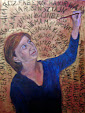
 When I think of the thread of my work, I realize I started with a puzzle. I began with a series on family history and the cornerstone was a self-portrait called Piercing the Veil. It was of me unveiling my family names with a paintbrush. Using art to tell the story of solving a puzzle. Of course, that’s what I do. It only took me twelve years from that painting to figure that out. 

I followed that series with a body of work called the Silence Speaks Loudly as I tried to make sense of how Lithuania dealt with the Holocaust. I connected stories I gathered and observed while in Lithuania. Again, making sense of this often inexplainable world.

My interest in genealogy is a quest of sorts too, to understand the lives of my ancestors, of people who lived in a different time, but contained within a body, mind and emotions much like our own. What would it be like to live in a different environment? How would it change who we are? How would we experience the tides of history as they lapped up against our life?  I have often wondered about the family members of mine who died in the Holocaust. Who were they as people? What was their day to day life like? What of them echoes in me? I began to explore that when I painted a Hole in Time, an exploration of the Jewish community in Radom, Poland.

Similarly, when I sought to make sense of my own Jewish identity, I interviewed Jewish elders. And after those interviews, I created artwork and then a book as I drilled down further into their stories to figure out how I fit within them.

When my mother lost memory and later when she died, I painted on memory, trying to find a way to make sense of first her loss of memory and then the loss of her. It was one long meditation on a wise woman who I carry within me. Absence and presence occupied me. Absence occupied me with her presence. 

For the past eight years I have participated in a Jewish Artists Lab that takes a topic to explore and then creates artwork on that theme. That has proven to be a powerful engine, introducing me to ideas I might otherwise not have discovered.  Through all of it I explored ideas that I translated into artwork. Memory palaces, transformation, imaginal discs, liminality, illuminating through parallel  stories, identity as a river finding its banks, wisdom of the mothers. 

I bring this lens to everything that I explore. Now I am working on the environment and I explore it through absence and presence, the idea of a 4700-year-old tree sounding the clarion call on global warming, arboreal ghost towns. It is a system where everything connects, a puzzle that we can solve if we can only focus on all of the pieces and each and every piece. And so, I wade into the immense puzzle of our world equipped with my paintbrush and my words.

Thursday, December 20, 2012

Setting the Table


In the last post I wrote about “happy surprises” and thought I should perhaps give a little color to what that means. I don’t know how to create the magic spark that sets them in motion, but I have learned how to set the table for them and hope they show up.

When I first left my career in finance, I decided I was going to focus on my artwork and family history, but really didn’t know how that was going to happen. Sometimes the most important thing we can do is decide that we are going to do something and announce it to others.

When I turned 30 I realized that I had invested “other people” with a lot of power. I was intrigued by overseas travel, but had never done it. I thought it was something that “other people” did. That was when I resolved to become “other people”. I began to announce to everyone that I was going to Europe that summer. Now at the time I had no idea how to put such a trip together, but as luck would have it I announced it to a new friend who said she had never been and asked if she could join me. Soon another friend joined up and the trip took on life.

Several decades later I found that deciding I was going to focus on my artwork and family history had some of the flavor of that early announcement. I didn’t know quite how I was going to do it, but the mere act of committing began to move me down a road.

I’ve learned over time that if you don’t know how to take the next step it is sometimes important to take any step. I researched what organizations existed that dealt with family history and discovered our local Jewish Historical Society. When I told them I was interested in volunteering, they quickly drafted me into delivering their annual genealogy talk. At the time I was no more fond of public speaking than most of us and soon began to wonder what I had gotten myself into. Despite those hesitations, I did the talk and had a great time doing it.

The talk was at the local JCC. After the talk, I walked out the door, my head buzzing with family history and noted that there was a gallery next door, the Tychman Shapiro. My first thought was, “That would be a great place to do a show on family history”. I soon headed to my studio and began a series of paintings on family history.

Now here is where it begins to get strange. One day my husband told me that someone he knew had recommended a show at the gallery and we decided to stop by. The gallery director was in the gallery and advised us that they had an opening later that day as well as an artist talk and we should stop back. The theme of the show was related to family history. When we stopped back, there were my friends from the Jewish Historical Society. They asked me what I was up to and I told them about the series I was working on of family history artwork. In my pre-ipad days I used to carry around photos of my paintings so with some prodding from my husband I shared them. My friends from the Jewish Historical Society gave me an enthusiastic push suggesting that I show them to the gallery director who in turn suggested that I should submit a proposal for a show.

Up until now I had entered paintings in shows, but had never thought in terms of a solo show. Emboldened by our conversation I put together a proposal, submitted it and then put it out of my mind.

I took off on a month-long trip to China. One evening I was checking my e-mail at an Internet cafĂ©, beaded with sweat in the sweltering July evening. Among my e-mails was one from the gallery director. “We’d like to have you do a show in January,” she wrote. In the e-mail exchange that followed I asked, “How many paintings does it take to fill the gallery?” “Twenty” was her reply. At this point I had 7 paintings done. I began to map out paintings in my mind, diptychs, triptychs, anxious to return home and get to work. When I returned, I also began to develop a workshop on family history collage that they had asked me to teach. By January I was ready and in fact had more than enough to fill the walls. The show received a favorable review, the talk I gave went well and I was launched.

So when I examine this experience, looking for the mirrors within the magic trick, I come up with this. Taking the first step was important, volunteering opened up a door and it was important to step outside of my comfort zone. It also formed connections with people who proved to be important to my story.

Next I took action, beginning my paintings as a personal exploration. At the time I was stuck in my family history research and thought coming at it from a different angle might open up a different perspective. Once again I was trying to solve a puzzle.

When I commit to something, a talk, a workshop, a show, I work hard. I often think about a business concept, branding. I want my brand to be that I can be counted on to deliver and to do it well.

I didn’t forget to market my work, even if it was shyly and occasionally needed a push from others. I had photos on hand of what I was doing.

Now I didn’t have control over whether they chose to exhibit my work and it was pure chance that we showed up at that exhibition. That’s where the magic spark came into play. Some call it beshert which is Yiddish for fate. Whether predetermined or not, there is something other worldly, magical about how these things occur.

That pattern repeats itself over and over, always beginning with an exploration. My next journey was to Lithuania to study Yiddish at the Vilnius Yiddish Institute, again an outgrowth of my interest in family history. There I was disturbed by the rewriting of Holocaust history that I observed. I returned and began a series of paintings that addressed that topic. Again it was an exploration of something that puzzled me. Similar to writing, painting is a way for me to sort things out.

While in Lithuania I had watched a film of interviews with survivors and was very moved. I wrote to the people who had created the film to ask if I could get a copy of it to show with my artwork. Of course I included a link to my website so they could see the work. It turned out that they had a gallery in London and asked me to exhibit my work and speak at International Holocaust Day.

Now the work I was doing was going to be cumbersome to ship so I redid a number of paintings on canvas to make it easier. I had a painting that was six feet tall that I redid on two canvases connected by a hinge. I did intensive research into shipping as well.  It took a lot of work to respond to the opportunity.

Again I had no control over their response and didn’t know that they had recently opened a gallery. That is where the magic came in.

And yet another opportunity.

I had decided to learn about my family that once lived in Poland. At the same time I had begun a volunteer effort of creating a website (a Kehilalink) on that ancestral town for Jewishgen.org. I contacted 400 people who were researching family from Radom seeking content for the site. Then I made plans to visit Radom. I did extensive research before I went and connected with a young man at the Arts and Culture Center to get the key to the cemetery.

In response to those 400 emails, I heard from an Israeli gentleman. He sent me a 1937 film of the former Jewish community. I took stills and put them on the website and decided I needed to be doing a series of paintings based on this.

I then received another email from my new Israeli friend who advised me that he knew someone in Israel who knew someone from my ancestral town who lived in my community. Now here I dropped the ball and failed to follow up, but magic can be persistent. I gave a speech at a local organization about what I was working on and another person came up to me and told me they had just been at a dinner and met a woman from my ancestral town. Same woman! This in itself has become part of the story I tell, fate tapped me on the shoulder and I ignored it, then it came along and poked me in the ribs.

I contacted Dora, the woman who shared my ancestral town. We became very good friends and have done many talks together about my artwork and her experience in the Holocaust. She had shared with me photos that she had of her prior life, hidden in the shoes of family members throughout Dachau.

As I worked on the website I coordinated with my Polish friend at the Arts and Culture Center on photos. When I told him about my artwork and Dora he invited me to show my work at an annual focus they do on the former Jewish community. The idea of showing my artwork in the town of my grandfather’s birth was too rich a concept to pass up, but there was little time to complete enough paintings to round out a show.

I had a brainstorm, what if I included Dora’s photos with my paintings of that former Jewish community. The idea was welcomed and Dora and I traveled to Radom where we showed my artwork and her photos. Dora took me around the town from which my family came and told me of the once thriving Jewish community in which they lived.

Now each of these stories has some common threads. I could never have fully planned for them as they each contain an element of synchronicity that created the spark of magic. Synchronicity is when unrelated events that would not typically occur by chance occur together in a meaningful way. I walked out the door of my talk and saw the gallery, just as I was thinking of family history. I asked for a copy of a DVD to show with my artwork with no knowledge that they had opened a gallery. I connected with a survivor from my ancestral town in my own community, then got to know the Arts and Culture Center in Radom in the course of tracking down a cemetery key. These disparate events began to connect into a meaningful whole to create my story.

Even though I can't create the synchronicity, I can create opportunities for it to occur and be prepared to welcome it. And while I await its often untimely arrival I do the following:

1) Begin an exploration, often as part of a volunteer or learning experience.  In these examples it involved a presentation, creating a website and learning a language in an overseas program. All of my projects involve a lot of front-end work. As you may note, family history is often the engine behind them.

2). Begin a series of artwork. Just as family history is the engine, artwork is the vehicle. The artwork is a continuation of the exploration, sometimes a meditation of sorts. I often read on related topics as well so I am immersed in a topic.

3) Reach out to others, often in connection with the volunteer effort. The important part is widening my network around a topic in which I am actively engaged.

4) Let others know what I am doing.  I do this in part by having a current website. By the way, I learned to do my own website by taking an on-line course to create my ancestral website. One thread feeds another.

5) Work very hard to seize the opportunity and make it happen.  Sometimes that means taking on something that at first blush seems daunting, but say yes to opportunity and then figure out how to do it.

Monday, December 17, 2012

Happy Surprises

I often write about story, in large part because my artwork is based on story. But there are layers of story that go beyond the artwork itself. When I began to exhibit my work, I realized that part of sharing my work also involved sharing my own story. I found that there is interest in an artist's story, perhaps because it is a path that is outside the scope of most people's experience.

So it dawned on me that I better figure out my own story if I was to share it. Some of the questions I had to be prepared to answer were why I did what I did, what was my process and what led me in this direction. Because my path was somewhat eclectic, I had to also explain how my prior life connected to what I now did. How did a person in finance become an artist? That in turn forced me to think about reinvention, both the new threads of my life and those which were consistent with my past experiences.

When I began to work on my interview series I found myself trying to distill other people's stories to a sound bite description. Now no one's life is quite that simple, but I do think we often have themes that are echoed throughout our life.

Sometimes we need to live enough of our life to see the patterns. What are we consistently drawn to? What factors drive our choices? And we need to examine the flip side as well. When we are drawn to something, does its opposite repel? I started my career with a social work degree and ran nonprofits. I discovered that I was good at creating something out of nothing. The more I had a blank slate, the more creative I could be. The flip side of that was when no one was exerting control over me, telling me how something must be done, it freed me to find a path that made sense to me. Just as I welcomed the blank slate, I rejected being controlled. Now one doesn't always have a choice early in one's career, but I understood early on the environment in which I flourished. I have often said I like rules, but only if they make sense. That means I have to vet them or create them. I found I had a talent for devising systems that worked and what are systems, but rules and structure. I liked solving the puzzle and figuring out a way for it to continually solve itself through a system that made sense. And solving puzzles is a way to exert control over one's life, to make sense of it.

Along the way I found myself in a situation where someone tried to use their knowledge to exert control over me in the realm of finance. I decided I better learn about finance so no could ever take advantage of me. Off I went to get an MBA in finance. I suspect my motivation was uniquely female as I doubt that most men are drawn to finance as a defensive move. Once again, having control over my life became the driver. Or better yet, no one else holding that control. Financial knowledge has proven valuable throughout my life and finance proved to be a career that actively engaged me in puzzles to solve.

The other part of my personal equation has been story. Back in the days when I was running nonprofits I was involved in fundraising. Now fundraising is all about story and it requires you to tell your story authentically and with passion, important aspects of storytelling. When I went into finance I discovered there was also story. On a broader level the story was about the larger purpose of the business and how it fit within society. The balance sheet told a story if one knew how to read it. Occasionally one sees a business that really seems to have a soul, a central core that guides them, not just lip service, but something real. When it does, it is usually because a key person in leadership can articulate the story and engage others in it. They can connect the story of the company to the individual stories of their customers and employees.

Story has always been present in my life, but it was only when I focused on my artwork that I began to realize how central it would be to my work, how powerful it was in reaching others.

So my story is very much about solving puzzles and telling stories, perhaps as a way to understand my world, to make it make sense. First I solve the puzzle, then I explain it to others through story. I've learned there is another element that I didn't anticipate. It is a late arrival to the table and ironically the opposite of control. I have become a believer in surprises. I have found that if one relaxes into life and welcomes the unknown, interesting things will happen. I came to this lesson later in life because I was much too busy trying to force the pieces to fit prior to then. My story since has often been one of happy surprises. Now this doesn't mean that I just wait around for surprises to hit. I am a big believer in maintaining momentum and positioning oneself during those lulls while we wait for the universe to help assemble the pieces. But I must confess that I've become downright mystical about how life unfolds despite the fact that I am a very "feet on the ground" person.

So when I get up to tell my story it is about the common threads that link my varied pursuits, telling stories and solving puzzles. It has a touch of magic to it as well, with things unfolding in unexpected ways. Keep in mind, I am a studier of magic. When I was a kid my brother did magic shows for children's birthday parties. I used to sneak into his room and examine those hidden mirrors that made the trick work. Now I examine my own surprises looking for the mirrors, trying to understand how they happened. And I have learned that while there are things that one can do to help the likelihood along, there is still some magical spark that sets it in motion. Those happy surprises reinforce for me that I am on the right path, doing something that is personally meaningful and contributing on a larger level.