Showing posts with label story. Show all posts

Monday, June 6, 2016

Tendrils of Story


Minneapolis Bridge Collapse (cropped) by Danielle Bora

I read an article in the paper recently that sounded like the outline for a book, one of those composed of separate stories that miraculously converge at the conclusion. The first story would begin with a swim trip for children. Their school bus ride home would end with the yellow school bus perched precariously at the split of a collapsed bridge, hanging half over water. It is 2007 and a bridge has collapsed in Minneapolis during rush hour. The story would focus on a handful of those children on the bus, both during and after, the injuries, the nightmares. Then it would zero in on one family with several children who were aboard that bus.

The second story would be eight or nine years later and explore the rise of ISIS and its impact on the Somali community of the Twin Cities. It would tell the story of young boys suddenly disappearing, reappearing in Syria with the intent to join ISIS, the families left behind puzzled and fearful.

Then back to the bridge, one boy in that family years later, receiving a settlement from the bridge collapse, using it to board a flight that takes him to Turkey, then Syria, funding his friends' journeys as well.


Stories surround us, but we need to pay attention. Reading a lot helps us to recognize the tendrils of story as we walk into them like cobwebs, but it was not until I was writing or painting that I seemed to encounter stories everywhere. It is like a second ghost-like world that always existed, but suddenly becomes visible.

My artwork tells stories and my starting point is to find the story. I began story gathering when I began family history research.  I've learned to step into old photos. To feel the person viscerally. Needless to say I've always loved well-written time travel because in a sense I try to step back in time through imagination. The essence of people is not so different despite our more modern conveniences.

When I went to Lithuania I began to collect stories that in turn became paintings. Some came from books, some I collected from others, some I observed and constructed out of threads. Some were fully formed, but others were poetry and vignettes, gaps left to be filled in by the viewer. I remember one of the old shops in Vilnius with Hebrew lettering on its storefront. In the dust on the window someone had written in Yiddish "You did not die, the nation of Israel lives".  As the viewer I had to identify the juxtaposition of ideas to paint the story.

 I remember the writing on the wall at the Ninth Fort near Kovno, a killing field for the Nazis. On the

I Was Here
wall were carved the names and towns of origin by the Jews held captive on the eve of their execution. It needed something more to complete the story, the sense of the person who carved it into that wall.  I had a painting of a person that I had painted over with just the ghost of the person remaining.  That became the base for the painting I Was Here. 

When I did a series on interviews with elders, I focused on their stories, looking for themes and the personal story arc that informed their life. I wrote poetry to enter their story, to feel it before I could paint it.

And my most recent series on memory loss... This returned me to the personal as I watched my mother go through that most personal of losses. Story was everywhere and told through motifs of memory jars and birthday greetings. I seem to have become more adept at seeing story and perhaps the personal is where it is most easily present. Ultimately story is how we explain and understand the world, how we step into someone's experience and feel it.


Sunday, February 23, 2014

The Psychology of Story

As a bit of a ruminator, I can chew on ideas for a long time, a useful attribute for a blogger. Eventually I find myself in need of new inputs which often come from books and lectures.  The University of Minnesota does a day-long gathering where professors talk on a variety of topics and my interest was piqued by one entitled The Cultural Psychology of Storytelling led by Moin Syed. As story is central to what I do, I was hopeful I might gain some new insights and was not disappointed. Syed is a developmental psychologist which is a branch of psychology that focuses on how people change over time. While many think of this area as focused on children, it is actually much broader. He noted that for a long time many people did not think much happened later in life in terms of development. I beg to differ, I thought. As one in that later stage I am often surprised at how much one can develop and grow in this very fertile period.

Syed began with a brief review of Erik Erikson's lifespan theory which posits a theory of development that contains eight tensions. It begins with trust and mistrust as infants learning to deal with the world. By adolescence we are struggling with identity or confusion and by my stage in late adulthood one is confronting generativity (legacy) or stagnation. These stages are not really linear, but at different stages in our life specific stages are more the focus of our energies. Erickson's focus was on identity and in fact he coined the phrase "identity crisis".

So the focus of developmental psychology is on who we are, what we are about and how we make sense of our past. So how does this relate to storytelling? We create story to make sense of something that is ambiguous. Storytelling is an innate practice. Syed shared a film of two triangles, one slightly larger, and a circle, moving within and outside of a house like structure. Take a minute to watch it and think about what you see. This was created by Fritz Heider in the 1940s, before you could so easily call it up on YouTube.

He asked us what we saw in this and the answers all related to relationships in one form or another. People often see bullying, domestic violence or custody battles. The finding of the study was that people project people, they anthropomorphize as their effort to make sense of the ambiguous.

I thought of the relationship of this to artwork. It is especially appropriate to the way my husband Martin Arend works as he begins his paintings with an abstract from which he identifies figurative imagery and develops it. What he sees is a reflection of his own life experience. Often others construct other stories about his imagery and his artwork may speak to a viewer in an entirely different way than he intended. Much of our response to figurative artwork is because it relates to a story that is meaningful to the viewer and the more ambiguous the imagery, the easier it is for them to project into it.

There is very little research on story, but tools that present ambiguity are often used to elicit story and hence the perceptions and experience of people. The Thematic Apperception Test picked up on my reflections on artwork as it uses visual imagery such as drawings that focus on themes of power and relationship. The viewer is asked what they see. The Rorschach blot presents an even more visually ambiguous abstract image.

Syed turned his attention to the Labovian Diamond which looks at what attributes make a good story. Created by Labov and Waletzky in 1967, he noted wryly that you don't want to be the second name as you tend to get overlooked. I can relate, I thought, often bristling at the perceived neutrality of alphabetical order. The Labovian diamond starts with "orientation" along one side. To be a good storyteller you need to create some background and orient the listener. Then you move into a "complication". This is the heart of the story, something has to happen. At the point of the diamond you "evaluate" the circumstances, before moving into "resolution", concluding with a "coda", a summary that brings it back to the orientation.

I found myself thinking of my interviewees who spurred my recent body of artwork on Identity and Legacy. Earlier this week I went to yet another funeral, an occupational hazard when you interview people in their 90s. Fannie Schanfield was one of my best storytellers and lived an amazingly full life until age 97. I thought of her stories behind my paintings and began to lay them out along the diamond. Fannie had told me about how as a child her mother designated her to preserve her stories. She would pull her in from play and tell her stories, then advise her to write it down. Ok, that's orientation. She didn't write them down and one day as an adult she came home to her mother burning papers on her history. Hmm, complication! When Fannie asked what she was doing, she retorted, "Did you write it down?", expressing concern that no one cared to retain her history. Fannie evaluated this, got her to stop and when Fannie was in her seventies she began to record her mother's stories. Aha, resolution. She ended her story with the coda, "Ma, I wrote it down". Write down your legacy lest it be forgotten. A perfect fit. (Listen to Fannie tell her story).

Ok, let's try another. Fannie told me a story about her father that the rabbi retold at her funeral. The background was that in 1926 there had been a fire in the building next to the synagogue. Her father was disturbed by this because he thought that they needed to use electric lights instead of candles, a clear complication. He considered what could be done and brought his neighbor, a tin smith in on this. The tin smith gathered spare metal from work and Fannie's father drew a template. Together they found resolution by constructing two electric candelabras that stood at the synagogue for many years. And now the coda...About fifty years later the candelabras were in poor shape and moved to a back room. Fannie paid to refurbish them so they could be at her daughter's wedding, silent sentinels who embedded the legacy of her father, shining light on yet a later generation.

Interestingly this framework for story can vary culturally. Syed related a study of children and story based in both Chicago and Taiwan and how the coda can differ. In America we tell transgression stories with humor, at least sufficiently after the fact. The classic one in my family is of me as a toddler forced to sit on my booster seat until I ate my peas which I despised. My resourceful early self announced I was done and left the table, only to have my mother lift the booster seat to a layer of smashed peas. In my family the coda is bemusement at this resourceful child with a mind of her own (but obviously not the foresight to realize how quickly her subterfuge would be discovered). That is typical of the American orientation. In Taiwan that story would likely be told with the coda a lesson on how not to behave. Don't be a bad girl and smash your peas.

Some cultures may drop the coda entirely. Japanese storytelling is more open-ended and lets people draw their own conclusions. There is actually a Rashomon effect named after a Japanese film which shows multiple perspectives.

We reinterpret our own past constantly. Syed talked of a longitudinal study which interviewed a woman at 8-10 year intervals and asked her to reflect on the same relationship. They found that she kept reinterpreting the relationship based on her developing life experience. Interestingly we change our memories, but don't remember we changed them as we lose the ability to access our prior conceptions. I mulled over some tumultuous relationships in my mind and felt that I could recall my evolving perspective, but realized the difficulty in challenging this finding without video proof. How do I know what I forgot?

Syed closed his talk by introducing the concept of Master Narratives. A Master Narrative reflects our expectation of how things work. A Coming of Age story is a master narrative. Another common narrative is the Redemptive Narrative. Here Syed presented a curve that started high, dipped down into a trough and then rose upward above our starting point. We start with a good person who falls, but ultimately turns this negativity into something positive, a typical Hollywood rehab story. The contrast to this is the Contaminated Narrative where things go from bad to worse. Clearly the division between those who perceive a glass as half empty or half full.

These narratives vary culturally although there is not much research to date. Syed related that in working with Swedes the Redemptive Narrative didn't resonate. Instead they have an Unsung Hero Narrative.

Interestingly a study of Israeli and Palestinian youth found that Israeli youth had a redemptive narrative while Palestinian youth had a contaminated narrative.

After 9/11 our master narrative was a redemptive one codified by "united we stand". We began with innocence, it was damaged by 9/11, but it brought us together. There is of course an alternate narrative of exclusion as many moved towards exclusion of Muslims, a contamination narrative.

Syed reminded us that a narrative may be one portion of a larger curve. One attendee proposed the Lance Armstrong narrative which began with a redemptive narrative as he overcame testicular cancer and then moved into a contaminated narrative as he fell from grace. Whether his story arc includes yet another redemption remains to be seen.

I am intrigued with how story and psychology relate. It builds upon the concept I've written about previously on the "intergenerational self" where children who know their family history deal better with challenges. No doubt it relates to a master narrative passed on within their family. I also found myself thinking of the two descriptors I use for my diverse activities of finance, genealogy and artwork. I've described the common threads that bind them as solving puzzles and telling stories. Perhaps there is a closer relationship between the two than I've previously identified, with telling stories as a vehicle to explain those more ambiguous puzzles of life.

Wednesday, June 5, 2013

Blogging From The Other Side of the Keyboard II

Two years ago I wrote a blog about blogging from the blogger's perspective. It dawned on me that today is the four year anniversary of my first blog entry and that invites some further retrospection.

At the time I last wrote about blogging, I wasn't sure where I was going next. Over ninety blogs later I've written about interviews, artwork and reinvention. I've begun to write on more personal subjects as well, elderly parents, my father's death, my mother's adjustment to being on her own. Jewish identity has begun to play more of a role also.

The scope of this blog has grown with me, expanding with each new exploration. The conventional blog wisdom is that one should carve out a niche and explore it thoroughly, attracting a clearly defined audience with a particular interest. I soon learned that didn't work for me. What I've discovered is that my niche in life is a broad one and so is this blog. Many things interest me and one interest soon leads to another. I write about many of them.

One option to allow for focus would be to compartmentalize into different blogs, one on art, one on family history, perhaps one on the personal, addressing the precious and often difficult time with aging parents. Much too complicated for me, the thought alone brings on a severe case of writer's block. I need to just let it flow as I live my life and respond to it.

I find that this period in my life is about breaking down the walls between my various pursuits, finding the common threads that feed them all. We spend much of our work life creating separate compartments, labeling ourselves by our career and separating work and play. This time for me is about merging interests, combining work and play, rejecting labels as limiting in their definition. Instead it is about discovering wholeness and learning to live an integrated life. Hence a blog that comes from the whole person.

While multiple topics allow me to write with greater frequency, they do make it more challenging to define an audience. I am hopeful that many of my readers have a broad range of interests and are open to exploring with me. The growth in readership seems to support that.

When this blog began, I was three years into the process of personal reinvention. I had left a career in finance to explore the things I was passionate about. With less of a focus on income, I had the flexibility to follow directions that intrigued me to see where they led. For me it has often been a process of personal discovery, an exploration of how life unfolds in interesting ways if you can give it the room to breathe. And yet, sharing the personal is often difficult as there is always the sense of being exposed, a challenge for a private person. I still sometimes swallow hard before I press publish, but I find that those are the blogs that receive the greatest response.

I began my blog when I was heading off to the Vilnius Yiddish Institute and beginning an exploration of my family ancestral towns. Over the past several years I've documented travels to Belarus, the Ukraine and Poland, home to my ancestors, as well as Lithuania, Latvia, Estonia, Hungary, the Czech Republic and even France, all with a perspective on Jewish heritage. While I was not writing in the early stage of my family history research, those giddy days of new discoveries, there were still many discoveries that got documented in these pages.

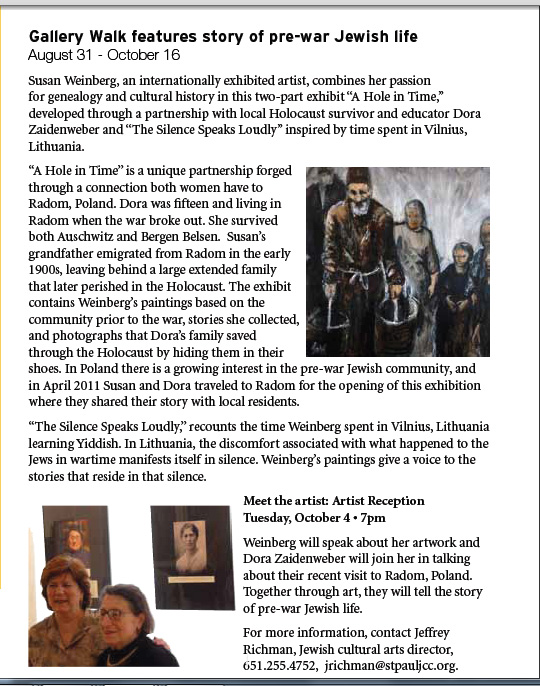
My family history exploration soon morphed into an artistic exploration. I first exhibited a series on family history shortly before I began this blog. That in turn took me into a series on how Lithuania deals with its Holocaust history and the prewar Jewish community of the Polish town from which my grandfather came. More recently I have written of the interview series with Jewish elders that fueled my current body of work. I began to tell the stories of these explorations, both the stories within the artwork and the story of the creation of the artwork.

As I explored family history it took me into the topic of Jewish identity, something that wasn't a part of my life for many years. I became interested in learning more and have found my recent involvement in the Jewish Artists' Lab a valuable resource in this exploration. And of course, I write about it.

I find myself reflecting on the broad range of activities in my daily life that are the engine for this blog. They are as varied as what I write about. Within a recent week I spent an afternoon with my friend Dora. Dora grew up in the same Polish town as my grandfather and I am currently painting some of her stories from the Holocaust. I think of her as a guide of sorts in life as well as a second mom. I attended an Artist Lab, spent a day at the studio painting and a day at the archives researching Jewish history in Minnesota. In between I read an amazing book by a former attendee of the Vilnius Yiddish Institute on how Lithuania is coming to terms with its history. This stew of friends, artwork, research and reading finds its way into what I write.

Story is central to everything I do and write about. That is driven home to me when I consider the activities that I didn't mention above. I spent a day advising on an investor presentation for a new business venture and many hours in nonprofit meetings. Surprisingly these activities use many of the same "story " skills that I use in the spheres of which I write. When I was advising on the investor presentation, part of my role was to help craft a technical subject into a story. How did this part of the industry evolve? What were the impacts that led to this product? How does the story of the entrepreneur weave into the broader story? When I presented financials at a board meeting, I told the story behind the financials rather than make it just about numbers. This is how I integrate my life, by finding the story in everything that I do. And at its heart that is what writing a blog is about, finding the story and sharing it with you.

Monday, February 18, 2013

Telling an Engaging Story

One of the fun aspects of writing a blog is that I have contact with a lot of people who are working on interesting projects. Some months back I was contacted by David Adelman and learned about his business venture ReelGenie. ReelGenie provides software to assist you in writing and creating videos to share family history stories online. Many of us who have been deeply involved with family history, eventually arrive at a point where we want to share our stories with family and friends. Our efforts are not always successful. Too often we attempt to share our excitement only to watch our audience’s eyes glaze as we talk about second cousins once removed.

Crafting a story and making it accessible challenges us to think about our audience. While not everyone shares our enthusiasm, it is a rare person who does not enjoy a well-crafted story. How we tell it matters. In the past many people created books and distributed them to family members. When I attend genealogy conferences there is a lot of discussion about new ways to tell stories to the next generation for whom books are not a particularly effective vehicle. ReelGenie offers a more contemporary means of telling stories using imagery, voice-over and story. Its approach easily integrates with social media and supports a collaborative approach to the creative process.

My experience in working with ReelGenie began with drafting a story. I decided to focus on the immigration of my grandparents as each had a story laden with mystery. I have found that mystery always makes for good stories. I had begun my genealogy research when I stumbled across a few pages of history my grandfather had written. He began by talking about his immigration to the United States in 1911 and his wife’s immigration ten years later. He wrote about her being shot at crossing the border and recovering in a hospital in France, something that seemed quite unusual to me. More surprises were in store as I pursued those threads. When I found my grandfather’s immigration record, it asked about his nearest relative in Europe. His response was none, married or single, single. Hmmm…and yet he gave his destination as his brother-in-law’s and left a wife and child behind in the Ukraine.

I searched for my grandmother’s manifest and finally found her coming from a location in France lending credence to my grandfather’s story. She was heading for Rotterdam and then New York. Supposedly she came with her younger brother, but when I found his manifest he and his wife came from Rotterdam one week later. In an era without cell phones how do you connect? Were they trying to connect and didn’t succeed? Were they unable to secure passage on the same ship? Mysteries abound.

Once at Ellis Island my grandmother was held as a likely public charge. This was typical of a woman traveling alone. She needed a man to show up and take responsibility for her. After waiting a day and a half, her brother showed up to pick her up. But where was her husband?

Part of telling a story is editing. Not everything is included in the video. For example, my grandfather changed his surname, perhaps contributing to my grandmother's difficulty in locating him when she arrived. She was still using his old name. They both Americanized their first names, Sima and Ben-Zion became Sadie and Benjamin. There really wasn’t room to include that. Too much detail makes eyes glaze. It is a delicate line, enough detail to make a story come alive, not so much that you weigh it down.

Once I had a script, I had to come up with photos. I discovered that I had one photo of my grandfather in 1922, but nothing else of him as a young man. I had a photo of my grandmother as a child and as an old woman, nothing in between except a painting I had done. I had to figure out if I had the visual imagery to support the story and in fact there were some gaps we had to paper over.

The voice-over was actually simpler than I expected. I did it within Audacity.com with a small microphone plugged into my computer and I let David suggest the accompanying music. With the ultimate product, the user will assemble the pieces. It will be easy to do everything--including recording the story and adding music--directly on their website. As this was a test, David and his team did the assembly. Along the way they sent me versions for my critique. Once the site is launched, there won't be any assistance given, but they will have tutorial videos, sample movies, and an option to work with a professional storyteller to tell the story.

You can click on this link to see the video to see how it came together. I have had challenges using it in my Firefox browser, although it plays well in Internet Explorer, Chrome and Safari.

ReelGenie will be launching its product at RootsTech and is a finalist in the SXSW Accelerator Competition. For more information, sign up at www.ReelGenie.

Monday, December 17, 2012

Happy Surprises

I often write about story, in large part because my artwork is based on story. But there are layers of story that go beyond the artwork itself. When I began to exhibit my work, I realized that part of sharing my work also involved sharing my own story. I found that there is interest in an artist's story, perhaps because it is a path that is outside the scope of most people's experience.

So it dawned on me that I better figure out my own story if I was to share it. Some of the questions I had to be prepared to answer were why I did what I did, what was my process and what led me in this direction. Because my path was somewhat eclectic, I had to also explain how my prior life connected to what I now did. How did a person in finance become an artist? That in turn forced me to think about reinvention, both the new threads of my life and those which were consistent with my past experiences.

When I began to work on my interview series I found myself trying to distill other people's stories to a sound bite description. Now no one's life is quite that simple, but I do think we often have themes that are echoed throughout our life.

Sometimes we need to live enough of our life to see the patterns. What are we consistently drawn to? What factors drive our choices? And we need to examine the flip side as well. When we are drawn to something, does its opposite repel? I started my career with a social work degree and ran nonprofits. I discovered that I was good at creating something out of nothing. The more I had a blank slate, the more creative I could be. The flip side of that was when no one was exerting control over me, telling me how something must be done, it freed me to find a path that made sense to me. Just as I welcomed the blank slate, I rejected being controlled. Now one doesn't always have a choice early in one's career, but I understood early on the environment in which I flourished. I have often said I like rules, but only if they make sense. That means I have to vet them or create them. I found I had a talent for devising systems that worked and what are systems, but rules and structure. I liked solving the puzzle and figuring out a way for it to continually solve itself through a system that made sense. And solving puzzles is a way to exert control over one's life, to make sense of it.

Along the way I found myself in a situation where someone tried to use their knowledge to exert control over me in the realm of finance. I decided I better learn about finance so no could ever take advantage of me. Off I went to get an MBA in finance. I suspect my motivation was uniquely female as I doubt that most men are drawn to finance as a defensive move. Once again, having control over my life became the driver. Or better yet, no one else holding that control. Financial knowledge has proven valuable throughout my life and finance proved to be a career that actively engaged me in puzzles to solve.

The other part of my personal equation has been story. Back in the days when I was running nonprofits I was involved in fundraising. Now fundraising is all about story and it requires you to tell your story authentically and with passion, important aspects of storytelling. When I went into finance I discovered there was also story. On a broader level the story was about the larger purpose of the business and how it fit within society. The balance sheet told a story if one knew how to read it. Occasionally one sees a business that really seems to have a soul, a central core that guides them, not just lip service, but something real. When it does, it is usually because a key person in leadership can articulate the story and engage others in it. They can connect the story of the company to the individual stories of their customers and employees.

Story has always been present in my life, but it was only when I focused on my artwork that I began to realize how central it would be to my work, how powerful it was in reaching others.

So my story is very much about solving puzzles and telling stories, perhaps as a way to understand my world, to make it make sense. First I solve the puzzle, then I explain it to others through story. I've learned there is another element that I didn't anticipate. It is a late arrival to the table and ironically the opposite of control. I have become a believer in surprises. I have found that if one relaxes into life and welcomes the unknown, interesting things will happen. I came to this lesson later in life because I was much too busy trying to force the pieces to fit prior to then. My story since has often been one of happy surprises. Now this doesn't mean that I just wait around for surprises to hit. I am a big believer in maintaining momentum and positioning oneself during those lulls while we wait for the universe to help assemble the pieces. But I must confess that I've become downright mystical about how life unfolds despite the fact that I am a very "feet on the ground" person.

So when I get up to tell my story it is about the common threads that link my varied pursuits, telling stories and solving puzzles. It has a touch of magic to it as well, with things unfolding in unexpected ways. Keep in mind, I am a studier of magic. When I was a kid my brother did magic shows for children's birthday parties. I used to sneak into his room and examine those hidden mirrors that made the trick work. Now I examine my own surprises looking for the mirrors, trying to understand how they happened. And I have learned that while there are things that one can do to help the likelihood along, there is still some magical spark that sets it in motion. Those happy surprises reinforce for me that I am on the right path, doing something that is personally meaningful and contributing on a larger level.


Wednesday, February 22, 2012

What Makes a Story

I’ve written of my exhibition of artwork related to the Holocaust.  Lately I’ve been busy doing presentations and talks around it.   I’ve been surprised at the range of audiences and the ways in which they connect to the material.  The audiences have represented very diverse backgrounds ranging from Talmud Torah students to a technical college with a class on visual interpretation.  I’ve met with students from an Adopt a Survivor program where they are matched with a survivor to learn their story and carry it forward.  For them I spoke about my observations on building a relationship, questions to elicit story and the elements that make a good story for them to retell.  I tend to do and then analyze later.  The process of preparing a talk forces me to think about my work in a different way and often leads me to new insights.

I realized that my process of developing a painting around a story closely relates to what makes a good story.  A good story is visual and sensory.  If you can picture it, odds are it will stay with you and the people with whom you share it.  Just as our memories are visual, stories that have legs can be easily visualized.  If they can be visualized, then they in turn provide good source material for painting.

I shared with the class a story that my friend Dora told me about a death march that she was on during the war.  She told me that they were given three things, a can with a picture of a chicken on it, a blanket and some bread.  The first thing they did was discard the can as they had no way to open it.  The road was strewn with cans of chicken.  Then they tied the blanket around their neck.  First they put it over one shoulder, then the other.  Quickly it became a noose around their neck and some abandoned the blankets as well.  The bread of course was precious and they ate some and saved the rest for it meant survival.  When she told me that story I found I could easily picture the road strewn with cans of chicken.  I could feel the tug of the blanket around my neck as I imagined it first on one shoulder, then the other.  It was the sensory elements of the story as well as the theme of three things that helped me to retain it.

The stories that stay with me often have some small detail buried in them that I’ve never heard elsewhere.  It is the details that make it memorable.  One of my paintings is called Bricks for Bread.  It is about how the Nazis not only destroyed the Warsaw ghetto, but then sold the bricks to the Poles, a detail that I had never learned prior to the interviews I did as part of the Identity and Legacy project.  Another detail that stayed with me was the fact that the Germans had fled the Russians, abandoning their homes.  Survivors from the camps often became squatters in those homes as they sought shelter after being freed. 

In addition to artwork,  the Identity and Legacy project has also generated some video.  I often share a brief video of a survivor’s story and then discuss how I developed artwork around that story.  In this way I can open up the creative process taking them into the source material and how I decided which elements to focus on in the subsequent artwork. 

I have come to realize that my focus in all that I do is story. Artwork, writing and speaking are all just expressions of that common theme.   Story is universal.  We grow up having stories read to us and a well-told story never fails to captivate.

Saturday, September 17, 2011

What I Do and Why I Do It

My artwork based on the former Jewish communities of Lithuania and Poland is currently in a solo show in St. Paul, Minnesota. I will be giving an artist talk in October and it has me reflecting on why I do what I do and what exactly is it that I do? Artist talks are an interesting exercise because they seek to put words to a process that evolves in part out of the subconscious. Even when I begin with a direction in mind, the painting often takes on a life of its own.

Not only does the individual painting evolve, but the series evolves over time. Often earlier work in a series is more representational and later work is more semi-abstract. It is as if I need to paint through the representational work to get to the other side before I can begin to experiment more with imagery. It is a mining process where I bring what is closer to the surface up more fully formed. The stratum below requires more exploration to take form and often takes me to interesting places because of the exploration required.

There is the individual artwork, the series of artwork and the larger structure within which it resides. For me that structure is story. Over time I’ve begun to realize that my artwork is all about story and artwork represents one medium among many that I may use to tell a story. I always include text and when I speak, I tell stories. More recently I’ve also been working with video. A friend of mine says I do performance art. I find that idea rather amusing as it conjures up images of the more dramatic performance artists, a Karen Finley smearing her body with chocolate. Not exactly me, but there is an element of performance in telling stories, albeit a little more sedate than the Finley variety.

There are different schools of thought about how much explanation an artist should provide. Should we be inscrutable and mystifying? I remember going to the Dali Museum in Figueres, Spain where Dali had no labels on his paintings. He wanted the viewer to make of it what they will. I’m at the other end of that spectrum. Very scrutable. I have a story in mind that I want to convey. You can see what you want to see in my artwork, but I also want to make sure you know what I see. I’m someone who reads everything around me, so text enriches my personal experience and I hope it does the same for my audience.

Five years ago I did an exhibition of work on family history. I learned a great deal from that exhibition that began to define how I work. I remember when I was preparing for an artist talk and expressed concern to my husband about whether anyone else would care about my family stories that were embedded in the artwork. My husband urged me to tell the stories and I was subsequently surprised to learn how much people resonate with story. One viewer wrote in the exhibition book that she didn’t know much about her family’s history, but knew it was similar to mine so pretended my family was hers as she went around the exhibit and viewed the artwork and read the text. For me that underscored that story is one of the ways we put ourselves in the shoes of another person. Of course, that is the magic of story, it allows for an empathetic response, something very important for the material with which I work. Since that exhibition, everything that I paint is about story. I often feel like a journalist asking “Where’s the story?” as I evaluate if I have enough story to spur my imagination and begin painting.

In addition to story, I also found that I needed to work with a series. While each painting may have an individual story it is by grouping multiple stories that we begin to tell a larger story, much like chapters in a book. Multiple stories can amplify each other or reveal different facets of the larger story.

I stumbled into story in my artwork, but in hindsight I realize it has been a theme in everything that I do. In fact, I often tell people that what I do is solve puzzles and tell stories. That is true of my prior career in finance and my subsequent pursuits in genealogy and artwork. And yes there are stories to be told through financial statements just as there are stories to mine through genealogy research and to tell through artwork. Those two constructs, telling stories, solving puzzles, link together seemingly disparate pursuits. It is not surprising that I’ve learned story is a guiding principle in my artwork.

If one’s focus is on telling stories through a series of paintings it follows that it is important both to focus on solo shows that share a body of work, to welcome opportunities to speak publicly about one’s work and to write about it as well. It also means that artwork is a medium for story telling rather than the end point in itself. It is a means of communication, not just about creating a pleasing image to hang on the wall. And it means that I choose stories that have depth and meaning, that are about topics I care deeply about. And that is what I do and why I do it.