Saturday, March 16, 2013

A Gentle and Embracing Heart

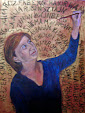
When I began the Jewish Identity and Legacy interview series, I don't think I fully appreciated what I was getting into.  I was interviewing people in their 90s which made it important to capture their story, but it also brought me to them at the final stage of their life.  Two of the 14 have passed away, at least those are the ones of which I am aware.  This week Harold Wittcoff, who I interviewed with his wife Dorothy, died at age 95. I wrote about both of them as citizens of the world because of their extensive travel with stints living abroad and their active engagement in the world.  I have been working on my painting of Harold's story which gave his death an added resonance.

It is a strange thing to spend a few hours with someone learning about their life.  To get a sense of them as a person and presume you know them based on that slight knowledge.  Yet the act of asking someone about their life does spark something, a certain intimacy.  Transcribing the interviews, editing them and then letting details bubble up into a painting to tell their story, builds on that.  I find that I feel a genuine sense of loss with their passing, as if I knew them better than time would support.  Enough so that I decided to stop by the shiva tonight to offer condolences and give his children additional copies of the recorded interview in which he told so many family stories.

The obituary captured his many accomplishments, his engagement in life, his travel and his long marriage.  I certainly learned a bit about those topics in my interview with him, but I also learned a bit more by merely observing.  Before I met them I did some research.  Enough to know of Harold's career and his many accomplishments.  I fully expected him to take center stage and wondered how we would draw out his wife's story, afraid that his would overpower.  I need not have been concerned.  I soon learned that Harold was a very humble man, far more inclined to talk about his wife's accomplishments than his own.  He was proud of her and encouraged her to tell her story.  There was a warmth and affection between them that was palpable.  At one point he reached out to cover her hand with his and I thought this is what it is supposed to be like.  This is what we all hope for.

He recounted their joint decision making process when it came to a move to another country.  It was clear that they both shared a curiosity about the world and a sense of adventure.  He attributed their meeting to "beshert", fate, and perhaps the helping hand of the Jewish community.  They were clearly well matched to share the adventures of life.

Their son and granddaughter also joined us in the interview.  Dorothy's son was born of her first marriage, a marriage that ended when her husband died in WWII.  Harold was a part of her son's life from early on and the same easy affection and humor colored their relationship.  There were strong ties of the heart that connected the family.  A gentle recounting of shared visits with his granddaughter, a teasing humor with his son and a son's pride in all his father had accomplished.  That heart was big enough to fully embrace Dorothy's son as well as a child they took into their family from the DP camps who became a son to them as well.  Together they had one more son to complete their family.

Harold was a storyteller, eager to recount the story of his parents' immigration to America in a manner that brought the listener along with them.   I could imagine him as a very effective teacher.  He understood the importance of story.  So I am grateful that I met him in that final stage of his life and perhaps can help to tell his story.  Not so much the one of accomplishments of which there were many, but the one of a gentle and embracing heart.

Thursday, March 14, 2013

Painting “Time”

The last session of the Jewish Artists' Lab* was about seeing sound, this one was about collapsing time, both thought-provoking concepts to consider through the lens of an artist.

Last week we discussed synesthesia. The word literally translates from Greek to mean “together sensation”. It is when one sense stimulates another such as seeing colors when one hears music. Our starting point had been a passage in Exodus that talks of seeing sound. At the most recent session we picked up with that passage yet again and our facilitator noted that when she translated the Hebrew it first speaks in present tense and then shifts to past tense. So the true passage reads “the entire people see the thunder and the flames, the sound of the shofar and the smoking mountain; the people stood and trembled and stood from afar”.

In discussing its meaning we talked about collapsing time with all periods existing simultaneously, especially when thinking of time in the realm of the sacred. We are to read such passages as if we too were present at Mt. Sinai, even though we stand from afar. Ritual is an important element in compressing time as it links us to the past. The question was posed as to whether we addressed or considered time in our artwork.

Now I never had pondered this question before, but anyone painting around the issue of family history and legacy has to address time in some fashion. I did a series titled "A Hole in Time" which was looking back in time through imagery that resembled a pinhole camera with muted colors and a darkened edge, just a little bit of light emitted to allow us to see and imagine the past.

 In my recent painting “From Her Mother”, I represented time in overlapping circles meant to represent generations sitting down around the same table, linked through rituals that have been handed down, literally through time. Objects and artifacts survive even as the people who used them pass on. I imagine those artifacts being passed through those circles of time, representing the rituals in which their users engaged, rituals that we may now share and continue, linking us back.


Our discussion shifted to the idea of ritual as a marker of time. Lighting the Sabbath candles delineates the beginning of the Sabbath. The Havdalah ceremony marks the end. I thought of my painting "Fire, Light and Legacy" with its 200 year old candlesticks handed down through generations and used for the blessing of the Sabbath candles. Questions were posed. What rituals do you observe? What time periods do they mark?

Before I begin a painting there are little rituals I engage in to settle into it. For my current series that is based on interviews, I first marinate in story, rereading interviews to put myself back into the story. Then I see what imagery bubbles to the top.  I may also research some aspect of the story. Only then do I paint, first building a ground by laying down color while I listen to my favorite painting music, a CD of Sephardic music I found in Cordoba, Spain. I conclude my painting by cleaning brushes, then setting my painting across the room where I can study it and contemplate next steps.

We then turned to the B'rakhot, the blessings of gratitude in Judaism which are also a ritual of sorts. Many of these blessings are around the wonders of nature. One says them when one hears thunder, sees a rainbow or sees trees in bloom for the first time in the year. Even one for when we wear new clothes. Part of the purpose of the blessing is to heighten awareness, not a mindless ritual, but a mindful one. To see through fresh eyes. To recognize and affirm gratitude for life's wonders.

The process of artwork can also contemplate time. When I saw the recent Matisse show at the Metropolitan, they showed a series of photographs of Matisse's work in process and its evolution. I take photos as I work also and it is fascinating to look back at the evolution of a painting which I would soon forget without that photographic reminder. It reaffirms for me that a painting can change in ways I can’t always imagine initially. As can life. It is a process that unfolds. Each step building on those that came before.

Our exercise for the evening was to cut geometric shapes from black paper and create time constructions on white paper. I created the shofar-like shape that I had formed in my painting "From Her Mother" of layers of connected tables as well as the suggestion of a bicycle-like vehicle moving backwards through time, my own personal time machine with a big horn to sound or perhaps "see" the way. With a roomful of artists we had many creative approaches and thought processes, often veering into 3-D constructions.


*The Jewish Artists’ Laboratory is an arts initiative through the Sabes Jewish Community Center featuring 17 artists exploring the theme of Text/Context/Subtext through study and art making.  The project is funded through The Covenant Foundation and similar projects are being done in both Milwaukee and Madison. Artists explore how the theme of Text/Context/Subtext is relevant to Jews and non-Jews, to religious and non-religious, to the community and to the individual, to the artist and the non-artist.

Tuesday, March 12, 2013

City Musings


The CAJM conference in NY was a great opportunity to explore the experiences of the city as well as its museums. It was appropriately named The City as Muse. While there, I had the opportunity to revisit the Lower East Side Tenement Museum. When I was last there I visited the residences within the building, located around the corner from where my father once lived as a boy. I recall how fascinated I was with how they reconstructed the stories of the residents who once lived there. This visit was somewhat different in that we visited the shops and bar that were once housed on the ground floor beneath the residences.

We entered what was once a German bar around 1870 when the area was largely German and traced the lives of its owners and the community that gathered there. Newspaper articles and documents aided in its reconstruction and painted a picture of the role it played within its surrounding community. Next door was another shop, actually a variety of shops over time from a kosher butcher to an auction house to an underwear discounter. The museum was faced with a choice, which store would they choose to represent? Their creative response was to represent all of them using technology that allows the viewer to place an object on a white board and pick up a phone which tells the story behind it. Documents appear on the board that expand on the story. This use of technology allows them build a story from an artifact, much in the way they reconstructed spaces themselves from documents and items found in the fireplace.

On another day we visited the Chelsea home of artist/architect Allan Wexler where he shared his work with us. Later he led us on a walk along the High Line, a former elevated railroad track that affords views of the city and soon will be the site of the new Whitney Museum expansion. Much like the Promenade Plantee in Paris, it is basically an elevated park and walkway. Public art can be found along the High Line and for the third time in my visit I saw the wonderful work of El Anatsui (Broken Bridge II Western wall between West 21st and West 22nd Streets on the High Line), a Ghanaian artist who makes use of aluminum, bottle caps and copper wire in his museum work and pressed tin and mirrors in the work along the High Line.


On the same visit I admired a beautiful piece of his at the Metropolitan Museum and many works which filled a huge area within the Brooklyn Museum.

I had the opportunity to visit the Brooklyn Museum with CAJM during the museum's Saturday event which is open for free to the public. The Brooklyn Museum has an eclectic collection and juxtaposes pieces that I would not always expect to be side by side. It was full of surprises and I suspect that helps to introduce people to the museum that might not normally seek it out. The Brooklyn Museum has been very successful in reaching out to the surrounding community and doing programming that invites them in.

On one floor they house the Judy Chicago dinner party, a triangular table with individually designed plates and tapestries that speak of the women that the creator imagined inviting to a dinner party, women who were pivotal in history and especially women's history, but frequently not adequately recognized. While I had heard of it for decades, this was my first opportunity to see it.

Earlier in the day I had been at the Metropolitan Museum where I observed films from the early 1900s. Similar films were at the Brooklyn Museum near the paintings from the same period. I was especially intrigued by these as I was reading the Inventor and the Tycoon, a book about Eadweard Muybridge and his creation of moving pictures. I could understand the delight and amazement of people as they watched images of their time as I felt a similar delight watching a windy day at the foot of the Flatiron building a century later where early NY residents grabbed their hats to save them from the wind. At the Brooklyn Museum I watched a 1901 film by Thomas Edison, who elbowed out Muybridge in the moving picture game, capture a Marilyn Monroe moment when a woman of the times walked over a grate with a gust of wind as she held down her skirt, then burst into laughter in her turn of the century garb.

On the last day of my visit we walked over to the 9/11 memorial. The design of it is both beautiful and moving. Each tower has a pool of water that echoes its footprint. Around it are the names of those who perished in its collapse. The names are grouped by logical groupings, firemen together as well as specific businesses. They are cut out of the metal so at night a light underneath illuminates them. A waterfall descends from all four sides forming rainbows. Ultimately it pours into a 20 foot square and disappears in much the same way that the towers did. The name of the memorial is Reflecting Absence.

Sunday, March 10, 2013

Fully Engaging

I recently returned from New York where I attended the conference of the Council of American Jewish Museums (CAJM). As an artist, I am not the typical attendee, but my work is very much in keeping with many of the themes that are addressed. One of those themes is how we will tell the story of the Holocaust when there are no longer survivors to tell it. My work on Lithuania and Poland addresses the Holocaust and I often speak jointly with my friend Dora, a survivor from my ancestral town. Dora and her family started the Holocaust Resource Center in our community which once was quite actively used by area schools. At one time, schools would bus children to the center and Dora’s late husband would speak to them. As school budgets tighten and there are fewer survivors, the center has been less actively used. Dora and I often debate the right vehicle to carry her effort forward in light of these changes. With that in mind, I attended a session titled Assessing Authenticity: Sources and Uses of Holocaust Narrative.

The session covered the gamut of low tech to high tech approaches. For most students The Diary of Ann Frank is their primary exposure to the Holocaust. Alexandra Zapruder sought to expand on that with publication of the book Salvaged Pages , a compilation of diaries by young people trapped in the Holocaust. Alexandra read a very eloquent passage from one of the diaries and talked about how she would work with a class of students in more deeply understanding the text. She felt that it was important to have a teacher mediate discussion, but weighed the benefits and detriments of using technology to explode topics and add enhancements. She raised the question of what point visuals begin to stifle the imagination and become overwhelming and distracting. When she teaches she slows it down from the pace to which most students have become accustom. They focus on specific words and she felt it important that process be preserved.

Linda Mills of NYU shared yet another approach through her film Auf Wiedersehen: ‘Til We Meet Again , an often comic view of her journey back to Vienna with her mother and ten year old son to retrace her mother’s life prior to her 1939 escape.

The session concluded with Stephen Smith of the USC Shoah Foundation who presented the most high tech approach in which they spent five intensive days filming a survivor named Pinchus.
They interviewed him on a variety of topics and connected the video of him with classrooms where through voice recognition they were able to have the students ask questions on a variety of topics and create a seemingly live dialogue as if he were actually present in real time. Stephen noted that in 18 months they expect to have a holographic projector which would create an even more real sense of the speaker’s presence. The result is extremely powerful, but because the filming is so intensive it is a process that would not work for many survivors.

Stephen also shared a learning approach where they had students take survivor testimony from their vast collection and cut words away, distilling it to poetry. The objective is to get students to engage with survivors’ stories and understand the essence.

I came away from this session greatly encouraged at the creativity that is going into assuring a level of personal engagement that I had not thought possible. The ability to leverage new technology presents options that just a short time ago were unavailable.


Saturday, March 2, 2013

Seeing Through Fresh Eyes

I am nearing the end of my paintings on the Jewish Identity and Legacy series and my thoughts are turning to the inevitable question, "what's next?" When I started down this road, it didn't occur to me that unlike a regular job, I have to continually create my own "what's next" , something I find alternately burdensome and exhilarating. The latter comes mainly after I've figured it out or at least have a hunch. But part of the creative process is birthing creation and not unlike pregnancy it can involve burden as well as anticipation.

How does one find inspiration? For me inspiration often comes through the ability to see through fresh eyes. That is why travel has often inspired artwork, taking me out of my everyday. I pay attention, I notice things that may not have garnered my attention on familiar turf. Seeing in fresh ways can come through changing surroundings. It can also come through new inputs and experiences from books, workshops or discussions.

I recently began participating in an Artists' Lab* called Text/Context/Subtext sponsored by Sabes JCC. Funded by a grant from the Covenant Foundation, this project is being done in Milwaukee and Madison as well as in Minneapolis. The lab is run by several facilitators, a rabbi, an educator and several arts facilitators. It includes artists of various mediums from painting to photography to poetry and more. At its meetings we discuss a text which can take many forms, it could be a religious text, a TED lecture or a film. That discussion is followed by an arts exercise and discussion of what we learned from it. One of the valuable things I hope to get from it is the opportunity to interact with other artists around topics that we all tend to address in isolation, behind the closed door of our studio.

At the last session the rabbi led off with a passage from Exodus 20:15. The passage starts with the Ten Commandments, but ends with this curious line. "The entire people saw the thunder and the flames, the sound of the shofar and the smoking mountain; the people saw and trembled and stood from afar". We discussed the curious part, seeing thunder, seeing the sound of the shofar? Ah ha I thought, thinking of the reading from Kandinsky that had been sent out. He had painted music, using one sense to tease out another. I began to think about how I would paint that passage, creating a vibrational feeling with a repetition of echoing forms.

The rabbi then introduced the Early Morning Prayer which he translated as "praised are you Adonai our God, Master of Space and Time, who opens the eyes of the blind. I liked the phrase "opens the eyes of the blind". I thought of how creativity calls for seeing the world through fresh eyes. Not a bad prayer for creative efforts. Let me see through fresh eyes.

The Kandinsky passage that we read spoke of how a creative person uses one sense to leverage others. All of our senses are passageways to creativity. Music is by its nature less representational so can offer other pathways to capturing the essence of one's subject without necessarily relying on more literal means.

The second half of the session we tried a Kandinsky-like exercise, painting to music or perhaps painting music. In this exercise we began our effort and then passed it to another person who contributed to it before passing it on to yet another person. What I found interesting was that by giving up possession, I felt that I was more free to play with it and risk, perhaps less invested in outcome. New approaches were offered by other artists that often took me off in different directions than if I were working in isolation. I often find that when I let go of control and outcome, I arrive at a more successful painting, Sometimes I paint over my first attempt and then work with what shows through. It is easy to get too invested in a painting that isn't working, but be too afraid to let go of it and start over. Not too unlike life.

So already a thought-provoking introduction. Later in the year we will do an exhibition that grows out of these discussions. I look forward to seeing where it takes me.

*The Jewish Artists’ Laboratory is an arts initiative through the Sabes Jewish Community Center featuring 17 artists exploring the theme of Text/Context/Subtext through study and art making. The project is funded through The Covenant Foundation and similar projects are being done in both Milwaukee and Madison. Artists explore how the theme of Text/Context/Subtext is relevant to Jews and non-Jews, to religious and non-religious, to the community and to the individual, to the artist and the non-artist.


Tuesday, February 26, 2013

Finding Your Passion

I find that many of my conversations with friends focus predominantly on two subjects, aging parents and finding one's passion in life. I don't think that pairing is coincidental. As parents age, we are reminded of our own shortening span. Weren't we supposed to do something that inspired passion along the way?

When I was a kid I used to wish I had an interest that inspired passion, something that fully engaged my energies. My brother had found that at an early age as a photographer. He used to take over our windowless bathroom as a darkroom as we anxiously called,"Are you dooooone yet?" I envied him that passion and I wanted one too, almost as much as I wanted our bathroom back.

But how does one acquire passion? I worried that I was a person of too much equanimity to fully experience it. Is it a temperament thing? Maybe I just didn't have the temperament for it and was doomed to a life of balance and calm. After all passion can tip the boat and my natural instinct was to right it.

In hindsight it seems like an odd thought for a kid to ponder, but I was kind of an odd kid, self contained and inward. I've been thinking of passions because recently I went to the university library archives to begin research for a possible book. As I was talking with the archivist I blurted out, " I can't wait! I love researching!" She quietly responded, "We all do". It dawned on me that I had found that passion I so longed for as a child. I am fortunate to have many passions; writing, painting, telling stories, researching...virtually all the things I devote my energy to are something about which I am passionate. When did that happen? Is passion something you grow into?

I remember that glimmer of passion in my first job. I was starting a new organization from a five page grant description. It was a new concept so I had to figure out how to build it. It drew every ounce of my creativity and I loved it. I still recall looking into my bathroom mirror one morning, that mirrored cabinet that had been scavenged and refinished by my then-husband. Odd the way such details anchor our memories. As I gazed at my image, I wondered if I would always find my work so engaging. I couldn't wait to go to work each morning. While I would love to report a career that paralleled that experience, it didn't remain at that pitch. When passion lulled, my equanimity kicked in and I found satisfaction in my work even if not at a fever pitch. But now I knew what it felt like and that I was capable of feeling it.

After that, passions built quietly before I even named them as such. Thirty years ago I took a life drawing class. Having previously drawn from photos fairly competently, I suddenly felt quite inept, like I was learning to draw anew. I still have my "ahah drawing", the one where I finally got it. For a long time I went to three drawing co-ops a week. When I spoke to people I would mentally draw their face. The way I saw the world had literally changed. It was the beginning of one of my early passions and led to a different kind of passion when I met my husband at a drawing co-op twelve years later.

When I discovered family history, I was quickly drawn in. It was the ultimate puzzle and it all tied back to me. Despite avowals to the contrary we are all still the center of our universe. I was captivated by learning the history of my ancestors and spent hours researching. My vacations became genealogy trips with a sweetener of Prague or Budapest thrown in to mollify my husband who gamely came along on many of these journeys. This certainly qualified as a passion.

People began to describe me in my work as intense. At first I didn't recognize myself in that description, but yes, I was focused and driven, all necessary prerequisites for passion. When I began to do public speaking about my artwork and story, people often commented that I was so passionate about my subject. I realized that indeed I was.

We often start with an interest, but as we devote time and energy it begins to blossom into something greater. The more energy we give to it, the more it begins to give back. You can't be non-committal and passionate, passion requires engagement. And I've seen a bit of a spillover effect. One passion feeds another until we discover we've found that ultimate passion, a passion for living and all the wonderful gifts it affords us.


Monday, February 18, 2013

Telling an Engaging Story

One of the fun aspects of writing a blog is that I have contact with a lot of people who are working on interesting projects. Some months back I was contacted by David Adelman and learned about his business venture ReelGenie. ReelGenie provides software to assist you in writing and creating videos to share family history stories online. Many of us who have been deeply involved with family history, eventually arrive at a point where we want to share our stories with family and friends. Our efforts are not always successful. Too often we attempt to share our excitement only to watch our audience’s eyes glaze as we talk about second cousins once removed.

Crafting a story and making it accessible challenges us to think about our audience. While not everyone shares our enthusiasm, it is a rare person who does not enjoy a well-crafted story. How we tell it matters. In the past many people created books and distributed them to family members. When I attend genealogy conferences there is a lot of discussion about new ways to tell stories to the next generation for whom books are not a particularly effective vehicle. ReelGenie offers a more contemporary means of telling stories using imagery, voice-over and story. Its approach easily integrates with social media and supports a collaborative approach to the creative process.

My experience in working with ReelGenie began with drafting a story. I decided to focus on the immigration of my grandparents as each had a story laden with mystery. I have found that mystery always makes for good stories. I had begun my genealogy research when I stumbled across a few pages of history my grandfather had written. He began by talking about his immigration to the United States in 1911 and his wife’s immigration ten years later. He wrote about her being shot at crossing the border and recovering in a hospital in France, something that seemed quite unusual to me. More surprises were in store as I pursued those threads. When I found my grandfather’s immigration record, it asked about his nearest relative in Europe. His response was none, married or single, single. Hmmm…and yet he gave his destination as his brother-in-law’s and left a wife and child behind in the Ukraine.

I searched for my grandmother’s manifest and finally found her coming from a location in France lending credence to my grandfather’s story. She was heading for Rotterdam and then New York. Supposedly she came with her younger brother, but when I found his manifest he and his wife came from Rotterdam one week later. In an era without cell phones how do you connect? Were they trying to connect and didn’t succeed? Were they unable to secure passage on the same ship? Mysteries abound.

Once at Ellis Island my grandmother was held as a likely public charge. This was typical of a woman traveling alone. She needed a man to show up and take responsibility for her. After waiting a day and a half, her brother showed up to pick her up. But where was her husband?

Part of telling a story is editing. Not everything is included in the video. For example, my grandfather changed his surname, perhaps contributing to my grandmother's difficulty in locating him when she arrived. She was still using his old name. They both Americanized their first names, Sima and Ben-Zion became Sadie and Benjamin. There really wasn’t room to include that. Too much detail makes eyes glaze. It is a delicate line, enough detail to make a story come alive, not so much that you weigh it down.

Once I had a script, I had to come up with photos. I discovered that I had one photo of my grandfather in 1922, but nothing else of him as a young man. I had a photo of my grandmother as a child and as an old woman, nothing in between except a painting I had done. I had to figure out if I had the visual imagery to support the story and in fact there were some gaps we had to paper over.

The voice-over was actually simpler than I expected. I did it within Audacity.com with a small microphone plugged into my computer and I let David suggest the accompanying music. With the ultimate product, the user will assemble the pieces. It will be easy to do everything--including recording the story and adding music--directly on their website. As this was a test, David and his team did the assembly. Along the way they sent me versions for my critique. Once the site is launched, there won't be any assistance given, but they will have tutorial videos, sample movies, and an option to work with a professional storyteller to tell the story.

You can click on this link to see the video to see how it came together. I have had challenges using it in my Firefox browser, although it plays well in Internet Explorer, Chrome and Safari.

ReelGenie will be launching its product at RootsTech and is a finalist in the SXSW Accelerator Competition. For more information, sign up at www.ReelGenie.