Wednesday, June 15, 2011

Unraveling the Puzzle of my Scottish Relatives

All genealogists have loose ends that they periodically tug on.  I’ve written a bit about my British and Scottish connections and recently revisited that information through the use of  ScotlandsPeople .  As its name implies this site is focused upon Scotland ancestry and provides vital records.

As I’ve written in the past, I began by tracing a family story from a late cousin of my father.  He recalled getting a gift of boxing gloves from relatives in England named Kodish.  He recalled the names Jacob and Louis.  When this cousin died I was given his old photos and discovered an inscribed picture of Louis Kodish.  “From your cousin Louis Kodish” it read.  When I first began working with family history I asked others who had been doing this for longer than I, what they did when they finished it.  They assured me it is never finished, you just move on to research cousins.  I am now at that once distant point in the horizon, tugging on threads that once seemed quite remote.

I’ve since found immigration records for Louis who came to the US in 1929 with his wife and returned to Glasgow in 1934.  He came to another family member confirming a family relationship and the Glasgow connection expanded my search still further.  It also offered his father Marks/Max as his closest relative in Scotland.

Genealogy is a process of building on each new piece of information to deepen one’s knowledge.  At the site Scotlands People, I found the death record for Louis’ father Marks or Max Kodish submitted by his brother Jacob.  In that it gave his parents names as Barnett Kodish and Sarah Rothchild Kodish.  My Raichels from Dunilovichi who came to America changed their last name to Rothchild.  They were in contact with their British relative so this shared name change seems like a legitimate linkage. I now had new names to search and to use to validate relationships.

Some records are immediately available on the site while others need to be ordered from the General Register Office for Scotland.  Among the documents that I was able to locate was the 1923 marriage record for Louis and his wife Katherine.  I was able to validate the record as it listed the correct parents of Louis, consistent with the birth record I received in his previously ordered visa file.  Interestingly the record states that rather than being done in a synagogue it was done by declaration and “warrant of Sheriff”.  Upon doing some research I learned that this was termed an “irregular” marriage similar to our civil ceremony.   They went ahead with an irregular marriage by declaration and then paid a fine to the sheriff in order to register it.  This practice went away in 1939 when civil marriages were permitted in a Registrar’s office.

A few years ago I had access to the Jewish Chronicle, a publication of the Jewish community in Great Britain.  I had copied all entries for Kodishes figuring I’d find the missing link eventually and it would then make sense.  Much of genealogy is prospective, getting ready for the big discovery that unlocks earlier data. I now went through the copied documents looking for Barnett.  There in December 1916 I found the obituary for Barnett which noted he was of both Glasgow and London.  It reported that he was the father of Max and Solomon of Glasgow and Jack of London.  A search of the Jewish Online Worldwide Burial Registry turned up a record at the Edmonton Cemetery in London for his burial.

Armed with this information I began to search the Scottish database.  I soon found the death record for Solomon that noted his parents, wife, address, cause of death and the submission of the death by his son-in-law. Working backwards with the name of his son-in-law I found the marriage record of Solomon’s daughter Lily which occurred at the Cromwell Road Synagogue as a “regular” marriage.  Solomon was a master cabinetmaker, a profession he shared with his brother Max.  Similarly my great-grandfather who was their cousin reported his profession as a joiner in his immigration manifest. I now  also have a synagogue name that may also have family records.

The brother Jacob (Jack) has a bit of a story.  Some time ago I found an immigration record for a Bloome Kodish with her three children Joe, Sid and Anna.  They came to the US in 1923.  She listed a brother with the last name of Silverman as her nearest relative in Glasgow (even though she had a husband in Glasgow as well, perhaps an early sign of trouble) and was going to another brother in Chicago.  I last saw the children listed in the 1930 census.  Then in May 1938 Jacob set out for NY to see his wife Bloome noting his brother Solomon as his closest relative in Glasgow.  He notes his original birthplace as Vilna, Russia.  The gubernia in which Dunilovichi was located was Vilna and is typically given as the place of birth by those from Dunilovichi.  His visit was short-lived as he returned in March 1939.   Working back I discovered the original Kodish-Silverman marriage in 1912.  A few years after his visit in the late 1930s he is listed as divorced as he enters a second marriage in 1941.  This marriage fared better, lasting until death parts them in 1967 as reported in his death record.

I’ve made considerable headway on a mystery that I once had little hopes of resolving.  I now know the relationship between our families and have identified many family members. I’ve also learned that the Rothchild name was assumed in both England and the US.

I was unsuccessful in finding the death record for Barnett Kodish even knowing where he is buried.  The records office had nothing on file. I decided a photo of Barnett’s tombstone would be worth locating as he likely came from Dunilovichi as well and contacted Gaby Laws of GenPals to get a photo and to see if there were other Kodish tombstones nearby.  Three days later I had the photo and confirmation that there were not other Kodish tombstones in the area.

Interestingly Barnett’s Hebrew name translated to Eli Dovid Ber son of Yehuda.  With this information I went back to the database from the Dunilovichi cemetery that I had posted on the Shtetlink I had created for this town.  While there are few surnames I did find an Abraham Hedesh, son of Yehuda who died in 1936.  I have found that names with an H, G or K are often interchangeable so I would suspect that this is a younger sibling. 

I’d like to find the death record for Sarah Rothchild Kodish as it would likely tie to the name of my great-great-great grandfather, but I’ve had no success finding a record of her death nor a tombstone near Barnett.  As Gaby pointed out, it is quite possible that she didn’t come to London and only the father and the older sons made the journey.  In the Dunilovichi cemetery there is a Sarah, daughter of Moshe (same father's name as my great-great grandfather), but no surname to offer assurance that it is the right Sarah.  She died in 1914 so may well be the elusive Sarah Raichel/Rothchild Kodish, sister to my great-great grandfather.

If you trace the threads of this journey you will find the following path:

1)    We begin with an anecdote about Louis Kodish
2)    Then discover an inscribed photo from him
3)    Examine Immigration records and find his father’s name
4)    Order a visa file from the US Citizenship and Immigration Service that provides the birth record with both parents’ names
5)    The Jewish Chronicle provides an obituary of Louis’s grandfather with related family members (obtained earlier, but made sense at this point)
6)    The Jewish Online Worldwide Burial Records offers burial information on the grandfather of Louis Kodish
7)    Scotlands’ People provides his father and uncles’ death records and various marriage records including that of Louis
8)    Back to Immigration records to explore his uncle Jacob’s first marriage and possible descendants in the US
9)    And then on to Genpals for a tombstone photo
10)    And back to the Dunilovichi cemetery to see if there are tombstones that are potentially related now that I have more information on earlier descendants.

It is this path of working one’s way through a puzzle, building on each successive discovery which keeps me so enthralled in this search.

Wednesday, May 25, 2011

Sleeping With the Chickens and Bricks for Bread

It has been a bit of a whirlwind since returning from Poland.  I recently spent a weekend in New York where I met up with my Israeli friend who set much of my Radom project in motion when he sent me the 1937 film of Radom.    While there I interviewed two survivors from Radom, one of whom lived next door to my family in Radom.   I’m not quite sure what I’ll do with the interviews, but given that most survivors are in their late 80s and early 90s, I felt that I should take advantage of the opportunity while I could. Interviewing an elder population does forestall procrastination.

Upon my return I received my work back from Poland, just one day before a huge open studio event in Minneapolis known as Art-a-Whirl.  It is always a good opportunity to interact with people around my work so I was pleased to be able to include the Hole in Time Series on Radom that you’ve seen in this blog.  Art-a-Whirl which sports a tornado as its symbol ended up with a real tornado and closed with a rainbow visible from our studio window after a weekend of  visiting with art patrons.

Since returning from Poland I’ve been winding up my oral history project on Jewish Identity and Legacy.  With most of our interviews done and the end date looming, I’ve been drafting a final grant report and teaching myself video-editing.  Many of the interviews generated wonderful stories that I hope to include in a DVD.

I have also begun to develop paintings around the stories that have emerged.  In fact, source material was my original impetus for the project although it has proven to be quite fascinating in its own right.

One of our interviews was with a woman who grew up in north Minneapolis, originally the home to much of the Jewish community.  She related the following story to us about staying with her grandmother when she was young.

I remember my grandmother had a one bedroom apartment.   She had a mattress must have been about that thick (holds hands two to three feet apart), all feathers you know, and a stool to get up.  So when it was time to go to bed, I crawled in to get into bed to sleep with her… next to the bed my grandmother had  two live chickens in a box and I was deathly afraid of chickens and that’s where I had to sleep that night with the live chickens there.


In the morning she’d go to the shocket (a kosher butcher) and have the chickens killed.  She’d carry them to the shocket and come back and flick them.  Sit in the back yard and flick ‘em.  Every time on a weekend.  She’d go like on a Friday morning before Shabbos started and get her chickens and when I’d come to sleep with her she’d have the chickens Friday.  And every time I went I had to go sleep there and I had to sleep with those chickens.  I’ll never forget that.  I was scared to death that night.


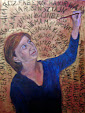
That image stayed with me and led to the  painting called Sleeping With the Chickens.

 Another story that I’ve sought to capture was provided by a subject who was a Holocaust survivor.  He told us of being sent from Auschwitz to Warsaw to help dismantle the Warsaw ghetto.  After the ghetto was destroyed, buildings were dismantled and bricks sold to the Poles.  He told me that he would go down in the basements for bricks and discover bodies that he covered with sand.


Then they (the Nazis) need a transport to go to Warsaw.  But they didn’t take any people who speak Polish, but they didn’t know … I could speak Polish.  So I got in between the French and the Italians and the Greeks and I got into Warsaw…  The Warsaw ghetto was bombed.  People were laying on the basements there like flies. So what they did is to blow up the rest of it, the rest of the building and they covered up the other ones.  Then I had to do clean up with the bricks...The Polish people came in with a horse and a wagon and they were buying those bricks from the Germans.  When they got in they had to pay so much and they had to show me a piece of paper, how many bricks they need to buy.  So I gave them the bricks they needed to buy and sometimes I ask them if they have bread or something like that. Pretty soon they got smart, they brought me a bread, they brought me a salami and I gave them those bricks.  I gave them instead of 20 bricks, I gave them 25 bricks. See the five bricks they had a hole on the wagon and they put it in the holder so the Germans, because they count the bricks when they went out. They gave them 20 bricks and going out they had to show the paper that they got 20 bricks, so they went up on the wagon and count the bricks, but they didn’t count the other ones. 


The painting, Bricks for Bread, shows the Warsaw ghetto in its destruction in the distance.  One church remained amongst the rubble.  This gentleman survived frequently by his wits and used his skills in bartering later in rebuilding his life and a business.

 These early paintings are experiments in capturing the imagery based solely on the words.  Usually I have some visual imagery to work with, but in this case I need to create my own.  When I travel I frequently take photos for reference so my photos of horse-drawn carts in the Ukraine came in handy.

  This project has been made possible in part through the Arts and Cultural Heritage Fund through the vote of Minnesotans on November 4, 2008. Administered by the Minnesota Historical Society.

Tuesday, May 3, 2011

Hiding in Caves

Sometimes it seems like there are connections between everything I encounter. On Sunday we went to the Yom HaShoah Holocaust Commemoration in Minneapolis. The speaker at the event was Christos Nicola, co-author with Peter Lane Taylor of the Secret of Priest’s Grotto: A Holocaust Survival Story.

Nicola related the story of 38 people who survived the Holocaust hidden in a network of caves in the Borshchiv Raion within western Ukraine. Priest’s Grotto is actually one of the longest caves in the world with 77 miles of passages that have been explored. He put up a map of the region and there was Kamenetz-Podolsk, just 25 miles away. Last month when we drove to Kamenetz, the ancestral town of one set of my grandparents, our guide had pointed out Borshchiv as we passed and mentioned the story.

Nicola, a cave explorer, first discovered the cave and heard stories from local residents about Jews hiding in the caves. After ten years of searching he finally found a member of the family who had survived in the caves now living just blocks from him in New York. Relying on a memoir written by the matriarch of the family in 1960 as well as recollections from family members, he went back to the cave to document the existence of the family within the cave. His efforts were underwritten and reported by National Geographic. Some of the family members, from toddlers to a woman over 70, had resided there for 344 continuous days, the longest instance on record of uninterrupted cave living.

Nicola talked of their survival without any of the equipment and clothing that is commonly used by cavers today. They basically learned how to survive in this new environment. They tunneled to create an escape route which they had to use when they were discovered in the first cave. In the second cave they found a natural lake, learned how to dry the moisture on the walls and adapted to living in darkness.

Several family members who survived were killed by Ukrainians after the war had ended. Most of the family immigrated to the US and Canada.

To learn more you can find an interview on NPR and read the article in National Geographic’s Adventure magazine.

Wednesday, April 13, 2011

Returning Home

Today we drove back to Warsaw.  Jakub met us at the hotel so we could say our goodbyes.  We were very grateful for his assistance at every step of the way and felt a real connection with him.

Before departing Radom we asked Dora if there was anything else she would like to see and she replied the train station.  It was from a nearby track that Jews were deported to Treblinka.  As Treblinka was our destination, it seemed appropriate to start from the same point. The day was rainy and only got rainier as we drove. 

Even with GPS it was difficult to locate Treblinka.  We drove through small villages with unpainted cottages and tall stork nests.  After some circling of the area we found some signs that led the way to Treblinka.  By now the rain was coming down very steadily and the day was gray.  Upon arriving we walked down a wide cobblestone path past rows of rectangular blocks, much like railroad tracks.  Dora told us they represented the long walk from the train to the execution site.  In front of us were large jagged rocks with the names of countries that were represented.  Walking past them we faced a large sculptural form surrounded by more jagged rocks that seemed to go indefinitely, each representing a community that was destroyed.  We found the Radom rock and actually noted that there were two.  We had saved some of the flowers we had been given at the opening to leave at Treblinka and placed them at both stones.  Then we pulled out my Kindle on which I have downloaded the Kaddish and recited it together for all our family members who were murdered at Treblinka.

And so our trip comes to an end.  For my husband and I it was a two part trip with a week in Ukraine at my maternal grandparents’ ancestral town, followed by a week in Poland focused on my paternal grandfather’s town.  Our Poland trip included many interactions around an art opening and exhibition of artwork, a talk to high school students and dinner with a local Polish family.  Traveling with our friends gave me a unique perspective on the town of Radom and a glimpse at how my family may have lived.

In our discussion about this trip Dora said that in her prior four trips to Radom she was a visitor.  This trip was different, rather than being a visitor, she returned to her home town.  The difference was in large part that we interacted with Poles and were received with great warmth and interest.  On prior trips her visit was more insular with no interactions save the usual travel exchanges in restaurants and hotels.  On this visit Dora told her story to the next generation and shared her pictures and stories with the residents of Radom.  There was a rich interaction that made real connections between people and it is in these connections that real understanding begins.

Presentations, Openings and Polish Friends

Our last day in Radom was a most eventful one.  The weather was sunny and warm, the first such day we had experienced in Poland.  We started the day with a stop at the post office.   When we did research at the archives the prior day we learned that we could no longer pay them cash for our records as we did the prior year.  Instead we were required to go to the post office and give them a slip of paper with the account number of the archives as well as the sum they advised us for payment.  That paper was then stamped and we could take it back to the archives to receive our documents.  Our friend Jakub accompanied us to the post office down the street from our hotel which proved to be fortunate.  Whether we paid by cash or credit card, the post office required a local address in case something went wrong and they didn’t receive payment.  Our home address in the US wasn’t acceptable for this purpose.  It was illogical even to our Polish companion, especially when paying with cash, but without his address on the slip we were unsure how to get our material.  Fortunately he was happy to assist us and we received our stamped paper.

Soon it was time for our presentation to high school students at the Resursa.  We arrived at the Resursa which is a grand building with figures atop it and a statue in front of it.  Jakub had advised us that it was a Citizens Club long ago and was used as an officers club by the Germans.  Now it is an arts and culture center for the city with a variety of programs and exhibitions. They had a large auditorium which slowly filled with students.  Dora, Jakub and I were on stage together with our interpreter.  As I entered the auditorium and arrived at the front row I saw our young friend Michalina who had been so helpful to us on our prior trip.  We hugged warmly and I was then whisked on to the stage.  I had just a minute to ask Michalina to translate for Dora’s son as they had decided only to translate from English to Polish.  Dora was quite determined to speak in Polish, no small feat after 70 years of not speaking it, but she accomplished it masterfully.

The format of the session was to have Jakub ask us questions to which we would respond, with most of the questions directed at Dora as the focus was on her recollections of her life in Radom.  The questions for me related to what drew me to Radom, researching my family history and how I felt about Radom.  As Dora replied in Polish, I would recognize a similar word to English and instantly know which story she was referencing.  As I sat and listened to the stream of Polish words I counted the students in the auditorium, about 100 filled the room.

Midway through the presentation we learned that there was a class of Israeli students who had come to the presentation. They understood English, but not Polish and as no one was aware that they had joined us they had missed a portion of the presentation.  The program then switched to English with a promise to the class to provide them with Dora’s written memories in English that I had provided to Jakub.  After the presentation we invited the Israeli students up to the stage to meet Dora.  She conversed with the teacher while her son spoke with them in Hebrew.  The students surrounded Dora eagerly taking pictures of her.  Dora also had an opportunity to speak with the teacher of the nearby school which is memorializing the school, The Friends of Knowledge, that Dora attended and gathering information on its attendees.

After the session we had some time to explore the town.  We walked towards the archives where we planned to exchange the slip of paper for our documents. As we walked we noted many abandoned buildings or buildings propped up with wood.  We had learned on our last visit that the buildings that were abandoned by Jews upon their deportation often deteriorated as there was no clear title to them.  The city would periodically place an ad in the paper so they could begin the process of taking them over.

At the archives we found that some of our documents had been copied, but the identity papers were on a CD.  Papers in hand, we took advantage of the nice weather to stroll down Zeromskiego, the main commercial street that is closed to traffic.  We stopped for a quick bite to eat and it was soon time to return to the Resursa for the opening.

 As we entered the Resursa we were greeted by a very dapper Jakub.  He advised us that some press were in the room.  We soon saw our friend Michalina.  Her parents who had hosted us at their home on our last visit, greeted us warmly.  They had invited us to visit after the opening.  The room soon filled with people and it was time for comments.  Jakub made some brief comments and Dora spoke warmly of her experience in returning to Radom doing her comments in both Polish and English.  I spoke about the development of the artwork that was there, my ties to Radom and my collaboration with Dora.  They presented us with flowers and we were whisked to yet another room to do a radio interview.

Our beautiful day had now turned rainy and we piled into the car of Michalina’s father.  On our last visit, the men had shared a number of shots of vodka so it appeared that they had cleared any barriers to a repeat performance.  The plan was for Michalina’s mother to drive us home as the designated driver.  Dora sat in front and in no time was chatting with Michalina’s father in Polish.  We arrived at their home to a spread of salads, herring and meats.  This was followed by a tasty fish dish combined with vegetables and then a coconut dessert.  Wine and vodka flowed freely throughout. While I’d like to report on the conversation, much of it was in Polish with Dora and Michalina’s parents engrossed in conversation.   Finally our evening came to a close with fond goodbyes as our time in Radom concluded.

Tuesday, April 12, 2011

Exploring Jewish Radom

We began today with a visit to the USC, the governmental office which has vital records for the past 100 years.  Dora was interested in getting her birth record and that of her brother.  People who can prove their parent was born in Poland may be able to obtain a Polish passport enabling them easier access to European Union countries.  Dora’s experience was quite smooth because she speaks the language and within an hour we had secured the birth records for both.

Our next stop was the archive which holds records that are over 100 years old.  We secured a number of identity papers for family members.  When we had been at the Warsaw genealogy office of the Jewish Historical Institute, we had obtained lists of family members who had been in the ghetto and completed identity papers.  Many of the papers were accompanied by photographs.

Using JRI-Poland.org I had been able to locate indexes of many records on Dora’s family that included her great-grandmother’s birth record and her grandparents’ marriage record.  We found the Book of Residents which included her family.  The Book of Residents lists the residents by family along with parents’ names and various events in their lives that required official notation.   My ability to decipher Russian Cyrillic came in handy and we were able to leave with the records on my list.

Our tasks accomplished, our touring now began in earnest.  Dora’s niece had secured a van to take us to different locations and we began with a chronological history.  We started at Dora’s childhood home and concluded with a visit to her home in the ghetto.  We visited the area of the former forced labor camp and I asked Dora if she ever received any compensation as the Austrian company that ran the weapons factory still exists.  She replied that a few years ago she received a very small sum.

We then stopped at her former school which is now an apartment building.  She was pleased to see that a plaque on the history of the school adorned the door.  We entered the building and I was struck by the worn stone steps on which so many students had walked.

We stopped by the Resursa to see the artwork and photos being hung for our show.  At Dora’s request we planned another visit to the cemetery and Jakub once again secured the key to the cemetery for us.  Again we said the Kaddish, the prayer for the dead, now with this enlarged group of family and friends.  It felt especially important to Dora to have her family with her in this place.

We also did a brief stop at the site of the old synagogue.  Throughout the day we had several videographers in our group recording Dora’s stories in the related locations.  Hopefully some will turn out to be useable as filming in a vehicle or on the street has its challenges.  Dora told some stories that I had heard from her previously, but they took on an added resonance when told on the site in which they occurred.

One more day in Radom, but a jam packed one.  Tomorrow we give our talk at the Resursa to high school students, then an opening in the evening and we reconnect with our Polish friends from our prior visit.

Sunday, April 10, 2011

The Form and Substance of Story

Yesterday morning we left Warsaw for Radom, the last part of our trip.  In Radom we will prepare for an art opening on Tuesday as well as a talk and interview with high school students earlier in the day.  When we left Warsaw we drove to the area around the monument to the Jewish ghetto and did a stop at the Umschlagplatz, the point where Jews were gathered for deportation to Treblinka.  The monument lists all the first names that were typically used by the Jewish community.  Dora commented that it spoke to the anonymity of those who were murdered.   At the front of the monument is an image of broken trees, much like one sees on tombstones when someone dies too early.  On the back of that image the surrounding trees are reflected.  It is a very powerful monument that inspires contemplation.

We then departed for Radom, about an hour and a half drive from Warsaw.  Upon our arrival we contacted Jakub, our contact at the Resursa, the arts and culture center where we are having the exhibition of my artwork and Dora’s photos and story.  Jakub met us at our hotel and had an opportunity to meet Dora for the first time.  He knew much of her story from the 30 pages of interviews that I’ve completed and transcribed.  He has translated portions of that story to Polish for local publication.

We soon got into a very interesting conversation that began with identifying questions that Poles might want to pose.  It led to an intense conversation about how some Poles fear that returning Jews might want the return of property and how those issues should be addressed.  We also discussed the roots of anti-Semitism, the role of the church and the cross and convent that was once located at Auschwitz, all the sensitive issues!  While our focus is on the story of the Jewish community prior to the war and what their lives were like, we are all aware that sensitive issues could also arise and need to be addressed if they do.  I have no doubt that Dora can handle such issues very adeptly.

Jakub then contacted the gypsy who has the key to the Jewish cemetery and we drove out there.  Dora had never been to the cemetery before.  When she lived here she was too young and on her prior four visits to Radom they had not gone there.  Without knowing how to access the key it would not have been an easy thing to do.  I was interested in the new monument which included 70 tombstones that had been previously hidden.  Jakub had taken pictures of it for me and I have been getting them translated.  There are very few tombstones that still remain as the Nazis paved the roads with the tombstones.  Fragments are mounted on the cemetery wall which surrounds an extremely large area, giving us a sense of the magnitude of the cemetery that once existed. 

We went to a small building where the Kaddish, the prayer for the dead, is posted on the wall behind a curtain.  On the side are plaques for each neighboring town where communities of Jews perished in the Holocaust. Dora, her son and I all recited the Kaddish together.  I looked over at Dora and saw her eyes filled with tears and tears quickly came to my eyes as well.  To say the Kaddish in that place felt especially meaningful.  Four generations of her family members were murdered, her great-grandmother, her grandmother, aunts and uncles and cousins. She knew those family members and friends personally and had individual relationships with each of them.    Later she noted that under that soil lay the remains of the Jewish community of Radom, including those of some of her family members.

I read to her the quote on the wall from Psalms (78,6), "That the generation to come, the children to be born, may know and should arise and tell their children".  It captured well the commitment Dora has made to sharing her story with successive generations. Dora later commented to me that this experience was the defining moment of the trip.  Of course the trip isn’t over yet so there may be more moments yet to come.

The following day we made a trip to Garbatka, the vacation town where she spent her early summers with her family.  Dora is especially nostalgic about this time as it represented a happy time before the war destroyed the life that she had.  We drove through forests with small white flowers on the forest floor.  Dora observed that the trees were newer, not the thick trees of her childhood.  We started our visit at the train station where Dora reminisced about how her mother and the children would be there during the summers, but her father would come on weekends.  They would greet him at the train station and then he would take them into the woods to find wild strawberries and mushrooms. As I recorded her recollections a train passed behind her and the church bells chimed.  We then drove through the town looking for a cottage that resembled her recollection of the ones she stayed in during those summers. 

Upon our return to the city we made a stop at the home where Dora had lived for the years prior to being forced into the ghetto.  She identified her bedroom window and those of her parents and brother and we walked behind the building while she pointed out the location of each of the rooms of their six room apartment.  In the ghetto they were living in two rooms with no indoor plumbing. 

We then walked through the park to the main commercial street in Radom, Zeromskiego.  Flags were flapping in the bitter cold wind commemorating the anniversary of the plane crash which took the life of the former Polish president a year ago.

Dora pointed out the building from which the German authorities had operated.  One day during the time of the ghetto, she had been sent there to repair frayed carpet runners.  When the Governor noticed her armband with the Star of David he had sent her away aghast that a Jew was in the building.  It was very strange to actually connect a physical location with this story, giving it a form and substance that words alone couldn’t convey. 

As we walked down Zeromskiego we ran into family members of Dora’s late brother.  When they had heard Dora was coming to Radom they seized the opportunity to learn more about their father’s life.  We later joined them for a dinner to celebrate this occasion that brought us all to Radom.