Showing posts with label Radom. Show all posts

Monday, September 5, 2022

Recognizing Family

I often think of my life as a bit of a Rube Goldberg creation. I set something in motion, as if I were sending a marble spinning on its path.  But that path is seldom a straight line and takes me in unexpected directions, introduces me to new people and new ideas, and often leads to surprises along the way. Just as I trace my path backwards when I solve a genealogy puzzle, I also retrace the pathways that have led me forward in my explorations in life. I am often amazed at the uncharted paths that result from that initial step.

Among the many projects that I have taken on, one has proven especially fruitful with many unexpected surprises. Twelve years ago, I created a website on the city of Radom, Poland as a volunteer for JewishGen. It is called a Kehilalink. Kehila means community and these websites document and commemorate former Jewish communities. Many of these towns no longer have any Jews in them. Judenfrei, the Nazis called that, something they achieved in many places. But they are communities with long memories. Often descendants are children of survivors and heard the stories firsthand, others like me are genealogists in search of the story of their family. 


My paternal grandfather was from the town of Radom, Poland. The entire family was involved in flour milling and he was the youngest son, his oldest brother 18 years older. My grandfather immigrated to the U.S. in 1913,  the only one of his family to depart. My theory has always been there wasn’t room in the business for him. Virtually all of the family that remained in Radom died in the Holocaust, save one cousin who survived Auschwitz and immigrated after the war. I never knew my grandfather well as I was a child when he died, but I have gotten to know the community from which he came.


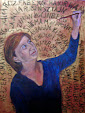
Among the beneficial things to come out of this project was meeting my good friend Dora who is 98 and a survivor from Radom. Early in our friendship, I had the opportunity to travel back to Radom with Dora and hear about the community in which my family once lived. We traveled there on the occasion of an exhibit of my artwork on the Radom Jewish community coupled with photos of Dora’s from her life in Radom. The Yizkor book, which is a memorial book created by survivors of that town, has recently been translated from Yiddish and one of my paintings from that work will grace its cover (image above).


Over the years I’ve had the opportunity to interview Dora and several others who were survivors from Radom. I’ve done research for people with roots in Radom and each of these projects has taken me deeper into the available resources. Sometimes I find records in archives that are not available on-line and as more gets digitized, I discover it, and add links to the Kehilalink. As a result, it has become a rich resource for people researching their family. I have assisted several people with information for books that are based in Radom, as well as descendants who are traveling to Radom. Through these efforts, I’ve gotten to know a network of people with ties there.


I realized I needed a more active effort to connect people to the resources. "Build it and they will come" only takes you so far. Every year there is a conference on Jewish genealogy put on by IAJGS, the International Association of Jewish Genealogical Societies. One of the features of the conference is what they call Birds of a Feather groups (BOFs), gatherings that share a common interest and often are around a specific town. When the conference went online because of Covid, it occurred to me that it presented an opportunity to reach out to people around the world with ties to Radom through a BOF gathering. Last year I shared information on the many data sources in different repositories that can be accessed through the Kehilalink. Afterwards, an attendee mentioned that she had seen identity papers with photos from the 1930s in the Radom archives.  I was aware of identify papers that the Nazis required of Jews in 1941, but not the earlier ones.


I soon located one complete year in 1934 that had been scanned. I worked in partnership with Judy Golan, the Radom area coordinator of JRI Poland, an organization that indexes records from the former Jewish Polish communities.  Over several weeks we made an intensive effort to extract information to include in their database, capturing over 400 photos of Jewish people who lived there. Another search involved me in locating photographs as I sought to find photographic support for a suspected DNA connection to a new-found relative.


This year I made finding photos of family the theme, sharing photos from ID papers, forced labor camps, concentration camps and many sources of that period. I asked researchers if they were aware of anything additional and learned of almost 400 online pictures in a Jewish Historical Institute collection that had gotten separated from the 1941 ID papers, many without names. Viewing the faces felt eerie. As if the name was in my memory, but simply eluding me. 


 At the BOF discussion, one person suggested we explore facial recognition software. You need to have a database of relevant images before that could be useful, but an article in the Times of Israel alerted me to the efforts of Daniel Patt, a Google engineer. Patt is using facial recognition to recognize faces from pre-war Europe and the Holocaust through a project called From Numbers to Names. Inspired by his experience visiting the Polin Museum in Warsaw, coupled with the fact that three of his grandparents were survivors, Daniel drew on his technical skills to develop this project. He has coordinated with the U.S. Holocaust Museum to include photos from their collection and also has photos from collections at Yad Vashem. The quick search runs against about 170,000 faces while a lengthier search reaches about two million faces. You can listen to Daniel talk about the project on the Chai Montreal podcast.


I located the project website, From Numbers to Names, and reached out to Daniel to offer him information on the many photos which I had identified, the largest being the 14,000 images of the Radom Jewish residents from 1941, many of whom later perished in Treblinka. Additional records included those nameless photos, the earlier identity papers, and photos from Dachau and Auschwitz. After viewing the Kehilalink, Daniel also asked me about getting a copy of a digitized film I had referenced of the Radom Jewish community from 1937, as they can extract images from films. The extraction process has begun as they incorporate these images into their database. I expect that there may well be more stories to emerge.


I am struck by how a volunteer effort can be that first step that begins the process. Add a bit of obsessive energy, something genealogists have in excess, and an effort to connect and share information with others of like energy. Those combined elements can power something much larger than our individual efforts.

Monday, August 20, 2018

Exciting Discoveries Await


After the IAJGS conference in Warsaw, I decided to travel to Radom, my Polish ancestral town, to do research in the archives. Radom is about an hour and a half drive south of Warsaw and is a town of around 215,000.  At the time of the war it was 100,000 of which 25% was Jewish.

My prior visits were in 2010 and 2011 and in the interim I had ordered many records on my own family and for others for whom I was doing research. That works well when you are working with records of a page or two on specific people that are indexed, such as vital records, Books of Residents and identity or forced labor papers. 

On this visit I wanted to do something different. I wanted to explore the community as a whole and perhaps my family’s place within it.  Unfortunately, I don’t speak either Polish or Russian, the language of the records. I can painfully decipher Cyrillic names and Latin-based Polish names are easily readable. Most were in the form of lists, hence somewhat more manageable, but those that are narrative in either language required more extensive language skills. Many of the records were bound in books with other records so knowing what I was looking at also took some deciphering. Often you find a relevant name, take a picture and get translation help later, but this was a lot of material. I needed to target my search. 

So why was I interested in community records? I do the Kehilalink on Radom for Jewishgen. A Kehilalink is a website on a former Jewish community for people who are researching their Jewish roots. I hoped to find information that I could put on-line. I also had begun to get a sense of the broader community through my genealogy work for others and wanted to build on that. When I look at a page of names I recognize a community of researchers descended from many of those names.

The Radom Archive had moved to a different location since I had last been there and it had changed quite a bit in the intervening years. In addition to the old paper records, there were now computers that had the vital records and identity papers, accessible by archive visitors. 

Now you don’t just show up at archives without doing quite a bit of preparation. I had spent a lot of time learning how to mine the online Polish Archives. I had searched the contents of the Radom Archives for “zydow”, one of the Polish words for Jew, and found a number of interesting items with the aid of Google translate. Before arriving at the archives, I had sent them several pages of items that they then pulled in advance of my visit.

On my first morning, Google maps guided me to the archive's new location. It was a sunny pleasant day as I walked through the town, tracing the edge of the beautiful park across from my hotel.  When I arrived, a young man sat in a central area outside of the archives. I had been asked by another researcher to check on some information for him and I didn’t look forward to a discussion in a language I didn’t speak. The young man had limited English and with my non-existent Polish it called for some creativity. Using Google Translate, I pressed conversation. I spoke into my phone in English and it  repeated it in Polish. I then asked him to do likewise. We didn’t prove very proficient with this program as it captured just small segments at a time, but it had given the young archivist an idea. He pulled up Google Translate and typed his response which appeared in English. “You type” he said. I reached for the keyboard and did likewise until we arrived at mutual understanding.

I deposited my belongings in a locker and entered the archives with my computer, phone and notes.  I was delighted to see the welcoming face of the same archivist I had met in 2011 and a large pile of the resources I had requested. She gave me a pair of white cotton gloves and black plastic disposable gloves for handling the archival material and I settled in at a table surrounded by history.

Where to begin? I reached for a white folder from 1940, questionnaires on Jewish teachers collected by the Nazis. Within each was a photograph and a completed form with their birthdate and names and ages of their children. Some listed parents and grandparents. I saw the word for Jew. Each had written out their resume in longhand Polish. Over twenty Jewish teachers, each with the well-modulated handwriting I have come to associate with teachers. I imagined a pride reflected in those resumes filled with hard-earned credentials, perhaps still hopeful at this early stage that their skills would still find them a purposeful existence. 

I had one other piece of 20th century history to peruse, a number of files from 1945 which listed real estate that had been owned by Jews and lay abandoned after their death in the Holocaust. It was gathered by a city department that was looking at tax collections that would now prove fruitless. Unfortunately, it did not list owners which would have been valuable information, but it did list addresses. I envisioned those addresses on a map to visualize the Jewish community and the hole it left with its absence. With the records from the 1940s there was often printed text. I held my phone over them in Google Translate and it translated the words below.

Having cut my teeth on the history of the past century, I stepped back into the 1800s. I had gathered information in the form of lists, lists of Jewish tailors from 1847-1851, Jews living temporarily in the city from 1847-48, Jews who owned real estate 1814-1865, Jews who contributed to the schools from 1872-74, Jews who chose the supervision of the synagogue in 1875/1884, contributions to the fathers of families 1878/1893. The earlier lists, those that preceded the mid 1860s were still in Polish, and names were readable. The later records were in Cyrillic Russian and even when the scribe had good penmanship, which he often didn’t, the pages of names were daunting. The paper was thick, like handmade paper. Not exactly tactile through gloves, but the foreign writing on thick cream paper reminded me of the passage of time it represented.

I attempted to make use of Google Translate with a Polish title by typing in the hand-written title for the document. According to the translation of the archive text, the collection was called the City Name List of Jews Living Temporarily in the City. It translated what I input to this: 

a list of smuggled believers in exchange for gas-fired spectacles 

Then it gently asked me if I might’ve meant something else. What it proposed translated to this: 

name list of the Old Testimonies with testimonies gasily in the children's council 

And yet another iteration got me to this for which the first part is accurate and the last part is puzzling.


Name list of the Orthodox believers in the joy of the children's advice 

The discovery for which I am most excited is what appears to be a Book of Residents dated 1827 which lists my third great-grandfather, his children and their spouses. The title in the archives translates to Radom City Lists Jews of Homeowners and Tenants Together with Families and Service 1823 to 1847. It consists of 30 double pages in Polish. I hope to begin by pulling out the surnames and ultimately posting them on the website. What is interesting about this is that Jews did not take last names until 1823. On prior visits I found a listing of the patronymics that preceded last names (father's name and ending) and the subsequent last names they took. Because of its proximity to 1827 it allows us to expand from the man to his family. 

A lot of work lies ahead and I will need to tap others to assist with translation. For anyone preparing for an archive visit, I would urge preparation with archival online resources and familiarity with the tools that Google offers. Exciting discoveries await.

Tuesday, April 14, 2015

A Willing Accomplice

I returned early in the morning on a flight from the town in which I grew up. I go there frequently to visit my mother, but this was a far more complicated trip than usual. It is the time of the Yom HaShoah, the Day of Remembrance of the Holocaust.

Last year I did a talk in my home town on Jewish genealogy for a Jewish organization. Afterwards I had a casual conversation with the director about the difficulty of finding Holocaust speakers as survivors dwindle. Half facetiously I remarked, "You should get my friend Dora". Now Dora lives in the Twin Cities, is in her 90s and is legally blind so travel to downstate Illinois wasn't exactly feasible. Except...

I had known Dora for only six months when we went to Poland together. Not exactly what most would expect with a new and rather senior friend. Dora is from Radom, Poland as was my grandfather. In 2011 we traveled there together where I exhibited my artwork on the former Jewish community of Radom. Dora exhibited photos from before the war and the time of the ghetto, photos that had been hidden in the shoes of family members during the camps.

Now Dora tells me that I make things happen and I seem to, often much to my own surprise. Partially that is because Dora is a willing accomplice. She says yes when most would say no and in combination we do seem to find ourselves in unexpected places. And so I asked if she might be interested and she said,"Maybe".

Logistics were the obstacle to resolve. The limitation of impaired sight was our biggest challenge, but I love to solve puzzles so I began to assemble these pieces and see how they might fit. Dora has a grandson in Chicago and I fly in to Illinois regularly to visit my mother. Dora just published her father's memoir of his 2 1/2 years in Auschwitz so was speaking more actively about the book. A flight to her grandson who in turn drove her downstate and an early morning flight back with me took care of the logistics. I acted as her eyes in booking flights and coordinating information.  We took advantage of the presence of her grandson to have him interview her at the Yom HaShoah and the result was quite magical. Their humor and enjoyment of each other were apparent and spoke to the involvement of the next generation in carrying the stories forward.

I was invited to share my artwork on the Jewish community of Radom, A Hole in Time, which felt very appropriate when lit by the light of memorial candles, commemorating that lost community in which both Dora and I share roots. In an odd way this work has traveled full circle, from the Minnesota town where I live to the Polish town where my grandfather came from and now back to the Illinois town in which I grew up.

On the plane, still not fully awake we began to plan our next venture, another Yom HaShoah talk next week in my community. This time I will interview Dora as we partner yet once again.

Saturday, April 27, 2013

Sky Tinged Red

Earlier this week my friend Dora mentioned to me that she had a book for me to read, a typical conversational topic for us. "What's the name?" I asked.

"Sky Tinged Red".

"Sounds familiar" I replied, only then realizing why. "Your father's book", I exclaimed. "You have it!"

A little background....Dora is from Radom, Poland, the same town as my grandfather. She was 15 years old when the war broke out. She spent the war years in the Radom forced labor camp, Auschwitz and Bergen-Belsen. While her immediate family survived, 80% of her family did not, cousins, aunts, uncles and grandparents were sent to their deaths at Treblinka.

Dora's father had the unusual distinction of surviving two and a half years in Auschwitz, a place where a few months was unusual. Isaia Eiger was an accountant in Radom where he also directed the Jewish orphanage and was active in the Zionist movement. He was sent to Auschwitz in 1942 along with 200 leaders of Radom. There he was part of the resistance. His survival hinged on his ability to speak seven languages. He became the registrar, taking information from the many people who arrived in daily transports. In this capacity he learned about subsequent events in Radom and how his family was faring. When Dora and her mother were sent to Auschwitz in 1944, her father was there to greet them. He was able to help them get indoor work as seamstresses during the harsh winter, furthering their own odds for survival.

Of those seven languages, Dora's father chose Yiddish as the language for this memoir. At that time Yiddish was the language of many Jews throughout the world. The memoir was written immediately after the war when memory was fresh, but it was not until his death in 1960 that Dora discovered three copies typed in Yiddish. In the intervening years Dora raised her family. It was not until the early 1980s that Dora took on the task of translating this memoir.  To her dismay she discover that it ended abruptly in 1942. She searched in vain for the other portion of the memoir. In 2006 her nephew brought over more of her father's papers that were in the files of her late brother. No typewritten pages were to be found.

It was only as she began to box these materials for Yad Vashem that she discovered the entire handwritten memoir. There it was hiding in plain sight. Busy searching for typewritten pages, they had missed these narrow yellowing pages, not recognizing them for what they were.

Once again Dora began to translate these pages. This was more challenging than before as Dora is now legally blind. Nonetheless she is quite indomitable. A lack of vision might slow her down, but not stay her from proceeding. With the aid of a magnifying machine she could examine each word. Letter by letter she transcribed it, building sentence after sentence. At this stage she couldn't read a sentence for context as it wouldn't fit on the screen at a magnification level sufficiently large for her to read. It took almost a year of painstaking work for her to complete the translation.

Almost seventy years had passed since it was written. Time for two generations to come of age, great-grandchildren her father had never known now stepped in to bring his story to fruition. Her two grandsons Etan and Jonah took the lead, driving the effort forward to share the legacy and story of their great-grandfather. I suspect there is a little "beshert" (Yiddish for fate) at work here, the pages waiting patiently to be discovered when the time was right.

I saw pieces along the way, serving as Dora's eyes as we read through the names list verifying spellings. Many of the names were familiar from my work on the Radom KehilaLink (Jewishgen.org ancestral website). Sometimes I felt as if I knew the residents of this town but soon I would know them through the lens of her father's experience.

Among the range of survivor accounts, this is an unusual and important book. There are not many people who were members of the resistance in Auschwitz and survived to tell of it. Even more rare is a two and a half year perspective on the camp from the inside. Isaia Eiger was a well educated and thoughtful man who tells his story for future generations, "a memorial to former comrades" and an "indictment of the murderers".

You can find some excerpts of the book on-line. You can learn more about it or purchase a copy on-line.

Monday, May 28, 2012

My Parisian Family


In July the International Association of Jewish Genealogical Societies (IAJGS) conference is being held in Paris.  I've spent lots of time in Paris so am always searching for something new that I haven't yet discovered.  This time I definitely have something new on my agenda, family members who I've not yet met.   A third cousin survived the war and settled in Paris.

Some years ago I went with a group to Bad Arolsen, Germany.  It was my first trip to Germany and I approached it with some trepidation.  I had a strong aversion to going to Germany and the only way I could do the trip was for the purpose of doing Holocaust research.  The International Tracing Service is located in Bad Arolsen and holds the Holocaust records that have since been shared with other institutions.  I went there with a list of fifty family members who were in Radom, Poland prior to the war.  On the first day I discovered that they had no records for them.  As they were sent to their death in Treblinka, no records were maintained.  I then learned that the meticulous Germans only cared about recording the Jews if they represented inventory, workers to be used until their death with a shelf life of months at best.  Those sent directly to their death went unrecorded. 

I had a week to spend at Bad Arolsen and wasn’t quite sure what I was going to research if none of my family members were in the archives.  Then I had an idea.  I went back to the records of Yad Vashem and assumed that if someone gave testimony, they survived and were family or close friends.  I began to research those who provided testimony and it led me to survivors.  My great-grandmother had a sister who generated a sizeable branch and testimony was given on many of them by one survivor.  When I looked up his file I learned that he had gone to Paris after the war.

Then I did something that I could have done from the comfort of my home.  I did a search on the name at the Holocaust Museum website and discovered that this relative had written a book, a Holocaust memoir.  The book was only available on-line and in French so I ordered it and with my bad high school French and some translation software I was able to decipher it.  I took the most direct route and emailed the Holocaust organization that had published the book.  I’m a relative I reported and inquired as to how I could contact the author of the book.  They kindly put me in touch with his daughter who was much braver with her English than I with my French.  We began an e-mail correspondence.  It is usually the daughters with whom I connect.

I went one step further with the book.  Because I do a Kehilalink for Jewishgen.org for the town of Radom, I often take memoirs and ask if I can include the first chapter on the site.  Typically that chapter talks about Radom.  I’ve found that if I offer to provide a link to where the book can be purchased, there is usually a willingness to allow this.  In this case, I had to actually translate the chapter and then type it up to include it.

So on this trip to France, I hope to meet my third cousin, now in his 90s as well as his children who are more my contemporaries.  I will need to brush up on that poor high school French in order to communicate.  Better start now!

Thursday, January 12, 2012

Telling the Story

This week we are opening a six month exhibition of three bodies of my work that relate to the Holocaust.  This exhibition is housed in the Eiger-Zaidenweber Holocaust Resource Center on the second floor of the Barry Family Campus in Minneapolis (4330 Cedar Lake Rd South).  The show is very much a collaborative effort with sponsorship by Talmud Torah, the U of M's Center for Holocaust and Genocide Studies, the Jewish Historical Society of the Upper Midwest and the Tychman Shapiro Gallery.

The focus of this exhibition and related programming is the question of how we tell the story of the Holocaust, particularly as we have fewer survivors to share their first-hand testimony.  Over time, “story” becomes “history” and the immediacy is lost while distortion becomes all too prevalent. 

As you enter the gallery you see my series “A Hole in Time” that looks at the pre-war Jewish community of Radom, Poland, the town my grandfather came from.    Drawn from imagery in a 1937 film of the Jews of Radom, these paintings evoke snapshots of a once thriving community.  Coupled with this artwork are the pre-war photographs of my friend Dora who grew up in Radom and was 15 years old when the war broke out.  Her photos were hidden in the shoes of her brother and her husband during their time in the camps.  We had the opportunity to exhibit this work and Dora’s photographs in Radom, Poland in 2011.

That series leads into my work on Lithuania where I looked for the traces of the former Jewish community and how Lithuania deals with the history that transpired on its soil.  My discomfort with the reframing of history that has occurred in Lithuania is expressed in several of these paintings.  When I toured the Vilnius Genocide Museum in 2009, much to my puzzlement, there was nothing on the Holocaust.  Keep in mind that the town was 45% Jewish and 95% of the Jews were murdered, the most significant case of genocide that ever occurred in that region.  If the Genocide Museum were your source of information, you would not realize the Holocaust occurred.  It addressed only the Soviet occupation. There is no need to actively deny the Holocaust, reframing and silence do a more than adequate job of that.  This series is called “The Silence Speaks Loudly” as I found the silence quite deafening.

My third series is drawn from the Jewish Identity and Legacy project.  As part of this project* I interviewed a range of Jewish elders and then developed artwork around their stories.  Included in this exhibition are interviews with four local survivors around whose stories I developed both artwork and video.

I must confess that when I was developing this artwork, I didn’t think in terms of the larger story arc.  In each case I was following a thread that intrigued me and that was sufficient.  In fact, the broader theme emerged only after I grouped these series into one exhibition.  I then began to see how they knit together. 

All the work is around the common theme of story and in each case I had the opportunity to gather stories first-hand from those who lived them.  In Lithuania I heard from our guides, a former partisan and a hidden child.  My friend Dora shared her stories of our common Polish ancestral town, both before and during the war.  In Minnesota I learned the experiences of Jewish elders who survived the war and built new lives in Minnesota.   In each case I had the opportunity to hear the stories directly.  I have deep admiration for these dynamic people in their 80s and 90s who have a commitment to educating others in the hopes of making “never again” a reality.  I often find myself thinking that ten years from now they are unlikely to be here, and what then?  I already see history being rewritten in Lithuania.  How do we keep it alive and immediate?  How do we keep it from being distorted to meet the agendas of different groups?  And what is my responsibility, and yours, to keep it alive?

My artwork grew out of a need to both process what I was learning and a sense of responsibility to retell the stories.  I often feel that my efforts are meager compared to the power of first-hand testimony, but it is my small effort to keep the stories alive and accessible. 


*Jewish Identity and Legacy interviews were funded by the State of Minnesota Arts & Cultural Heritage Fund, administered through the Minnesota Historical Society

Thursday, December 1, 2011

Loss of a Leader

I recently received word from friends in both Poland and Israel of the death of Haim Kincler, a key figure in the worldwide community of Jews from Radom.  Kincler was the head of the Radom Society in Israel and was instrumental in the creation of the cemetery restoration project in Radom, Poland.  The original cemetery was destroyed by the Nazis who used the tombstones to pave roads. As I’ve written in prior entries, he facilitated the creation of a Lapidarium in 2010, a curved wall in which 70 previously hidden tombstones from the former Jewish community were embedded.  These had been hidden by a Polish tombstone maker during the war.  The Polish tombstone maker had hoped to sell them after the war, but was unable to due to Communist constraints on holding something of historic value. They remained hidden for many years. Kincler learned of them and got the children of the tombstone maker to contribute them to the city.  Ultimately they were returned to the cemetery as part of the newly constructed monument, a joint effort between Israel and Poland.

Kincler had survived the war in the East.  Later he arrived in Palestine on the ship Exodus.  He was blinded during Israel’s 1948 War of Independence.  Despite this handicap, he finished law school and subsequently owned and managed a successful business.  Early this year I was in Radom with my friend Dora.  Dora was a school girl in Radom when the war broke out.  She was deeply touched that on this visit there were so many commemorative efforts around the former Jewish community.  Many of those efforts came about through Haim Kincler.  He was 93 and had lived a full life, but his loss is a loss to the broader Jewish community with ties to Radom.

Monday, September 5, 2011

Finding Your Family's Ancestral Towns I

One of the most perplexing questions people face when they begin genealogy research is identifying where their family came from.   I have been working with a friend to determine the answer to that for her family and am reflecting on how I first learned of the ancestral towns of my family.  I’ve known them for so long now that I forget there was a time I didn’t.

In the case of my Kishlansky branch, I had a three page history written by my grandfather that told me of Kamenetz-Podolsk as his town of origin.  My mother also told me that she remembered her mother talking of Kamenetz.  She thought she was saying Communist and it was not until much later that she realized it was actually the name of the town of origin.

My Belarussian ancestors are all buried in the cemetery section in New York for people from Dunilowitz.  Many Eastern European towns had burial societies in the US, especially in places like NY.  People from the same shtetl often ended up buried together, recreating their original community beneath the ground.  A cousin of my father’s clued me in to this detail which was later confirmed by immigration records.

My other town is Radom, Poland and I believe family was aware of this town of origin.  I know that my aunt told me of it when I did an oral history with her 25 years ago.  Obviously asking family members is the best place to start with this research.


Having the town made my search for immigration records more focused.  Any family name from those towns was a possible relative.  Even with this advantage, it still took me several months to find all of the immigration records.  Names were spelled a variety of ways and often transcribed incorrectly.  Town names also varied significantly.  When in doubt I input the town name into stevemorse.org and went through every person who came from that town.

I was fortunate in some respects in that many family members came over after 1906 when the immigration records began to offer greater information.  After that time they tell you who the nearest relative was in Europe and who the nearest relative was where they were going.  For my more unusual names I built a database of every person who came to the US with that name.  Then I started playing the match game looking for relationships between those two data points of European family and American family.

When I build the database, I use filters so I can sort it easily by different details.  I have a column by year and I code the family names and towns so I can sort them even if they are recorded by a variety of spellings.   I then sort by immigration date and relationships become much more apparent. Often it is a game of tag.  My first intrepid ancestor was my grandmother’s uncle Morris Kishlansky.  He went first to the UK with his wife where they had two children.  In 1898 he came to the US as Morris Kislianski indicating he had no relative at the other end to greet him.  I wonder what that experience was like.  He’d had a few years in London with his family to learn the language, but his mission was to establish a solid foundation for his family in a new country.

He must have succeeded as his wife followed a year later with her two children indicating they were going to her husband.  The record noted they were from Russia and were coming from London, still no ancestral town was recorded.  In 1902 I see a record of a different last name going to the original stalwart immigrant.  Srul Baron was going to his brother-in-law Morris Kislynsky and he gives his home as Kamenik, the first mention of the ancestral town in immigration records.  I knew from my grandfather’s written history that my grandmother had an aunt Sarah Baron.  In 1903 my grandmother’s oldest brother Itzek makes his way to America to none other than Srul Baron, his uncle, followed in 1904 by Srul’s wife and children.  Now Itzek is tagged and his brother Benjamin comes to him in 1906.  It is late in 1906 that the laws change requiring more information in the manifest. Through this point there is no record of the nearest relative in Eastern Europe, but the town of origin is noted as Kamenetz.    But wait, Benjamin is coming from Chotyn.  What’s that about?  I map it relative to Kamenetz and learn that it is 30 miles away.  There was a time when Jews could not live close to the border of the Pale and were displaced from their homes.  Kamenetz Podolsk was close to the border. Perhaps this accounts for the periodic movement I see between Kamenetz and Chotyn. 

In 1911 my grandfather comes to his brother-in-law Itzek giving an address that I can look up in the 1910 census.  He too notes his town of birth as Kamenetz, but most recently was in Czortkow, Austria, a town not far from Kamenetz, perhaps a way station on his path to Rotterdam.   Interestingly he indicates he has no relative in Europe, despite the fact that his wife was still there.  My hunch was that he hoped to start a new unencumbered life.  When I painted this gentleman I called him The Enigma as he remains a puzzle.

In 1912 my grandmother’s brother Frank or Frajina makes his way to Itzek, noting both Kamenetz and his nearest relative in Europe, his father Avriam Kislanski.  A long period passes before further branches of this family immigrate.  There is a war to settle in Europe and a series of pogroms that break out in the region post-war.  In 1921 within a week of each other, my grandmother and her brother and sister-in-law, come to the US.  My grandmother is going to her husband giving his original name, not the one which he later assumed.  The family is back in Chotyn (Hotin) now where her nearest relative is given as an aunt.   I’m wondering if my great-grandfather is still alive.  Yes, I conclude when I find the records of her youngest brother and his wife, also from Chotyn (Hotin).  Her brother has indicated Abram, his father, as the nearest relative in Europe and Frank as the nearest relative in the US.  I’m curious about this aunt who took the place of the father as nearest relative in my grandmother's manifest.  That move to Chotyn, did it come about because of the pograms? All mysteries to which I may never know the answers.

I had an advantage in my research that many others don’t have.  If family came to the US in the early 1900s it is both easier to trace due to more information in records and family members are often more likely to know of the original town. What do you do if family came in the 1800s when records seldom indicated the origin?  Stay tuned and I’ll clue you in on some approaches.

Wednesday, April 13, 2011

Returning Home

Today we drove back to Warsaw.  Jakub met us at the hotel so we could say our goodbyes.  We were very grateful for his assistance at every step of the way and felt a real connection with him.

Before departing Radom we asked Dora if there was anything else she would like to see and she replied the train station.  It was from a nearby track that Jews were deported to Treblinka.  As Treblinka was our destination, it seemed appropriate to start from the same point. The day was rainy and only got rainier as we drove. 

Even with GPS it was difficult to locate Treblinka.  We drove through small villages with unpainted cottages and tall stork nests.  After some circling of the area we found some signs that led the way to Treblinka.  By now the rain was coming down very steadily and the day was gray.  Upon arriving we walked down a wide cobblestone path past rows of rectangular blocks, much like railroad tracks.  Dora told us they represented the long walk from the train to the execution site.  In front of us were large jagged rocks with the names of countries that were represented.  Walking past them we faced a large sculptural form surrounded by more jagged rocks that seemed to go indefinitely, each representing a community that was destroyed.  We found the Radom rock and actually noted that there were two.  We had saved some of the flowers we had been given at the opening to leave at Treblinka and placed them at both stones.  Then we pulled out my Kindle on which I have downloaded the Kaddish and recited it together for all our family members who were murdered at Treblinka.

And so our trip comes to an end.  For my husband and I it was a two part trip with a week in Ukraine at my maternal grandparents’ ancestral town, followed by a week in Poland focused on my paternal grandfather’s town.  Our Poland trip included many interactions around an art opening and exhibition of artwork, a talk to high school students and dinner with a local Polish family.  Traveling with our friends gave me a unique perspective on the town of Radom and a glimpse at how my family may have lived.

In our discussion about this trip Dora said that in her prior four trips to Radom she was a visitor.  This trip was different, rather than being a visitor, she returned to her home town.  The difference was in large part that we interacted with Poles and were received with great warmth and interest.  On prior trips her visit was more insular with no interactions save the usual travel exchanges in restaurants and hotels.  On this visit Dora told her story to the next generation and shared her pictures and stories with the residents of Radom.  There was a rich interaction that made real connections between people and it is in these connections that real understanding begins.

Presentations, Openings and Polish Friends

Our last day in Radom was a most eventful one.  The weather was sunny and warm, the first such day we had experienced in Poland.  We started the day with a stop at the post office.   When we did research at the archives the prior day we learned that we could no longer pay them cash for our records as we did the prior year.  Instead we were required to go to the post office and give them a slip of paper with the account number of the archives as well as the sum they advised us for payment.  That paper was then stamped and we could take it back to the archives to receive our documents.  Our friend Jakub accompanied us to the post office down the street from our hotel which proved to be fortunate.  Whether we paid by cash or credit card, the post office required a local address in case something went wrong and they didn’t receive payment.  Our home address in the US wasn’t acceptable for this purpose.  It was illogical even to our Polish companion, especially when paying with cash, but without his address on the slip we were unsure how to get our material.  Fortunately he was happy to assist us and we received our stamped paper.

Soon it was time for our presentation to high school students at the Resursa.  We arrived at the Resursa which is a grand building with figures atop it and a statue in front of it.  Jakub had advised us that it was a Citizens Club long ago and was used as an officers club by the Germans.  Now it is an arts and culture center for the city with a variety of programs and exhibitions. They had a large auditorium which slowly filled with students.  Dora, Jakub and I were on stage together with our interpreter.  As I entered the auditorium and arrived at the front row I saw our young friend Michalina who had been so helpful to us on our prior trip.  We hugged warmly and I was then whisked on to the stage.  I had just a minute to ask Michalina to translate for Dora’s son as they had decided only to translate from English to Polish.  Dora was quite determined to speak in Polish, no small feat after 70 years of not speaking it, but she accomplished it masterfully.

The format of the session was to have Jakub ask us questions to which we would respond, with most of the questions directed at Dora as the focus was on her recollections of her life in Radom.  The questions for me related to what drew me to Radom, researching my family history and how I felt about Radom.  As Dora replied in Polish, I would recognize a similar word to English and instantly know which story she was referencing.  As I sat and listened to the stream of Polish words I counted the students in the auditorium, about 100 filled the room.

Midway through the presentation we learned that there was a class of Israeli students who had come to the presentation. They understood English, but not Polish and as no one was aware that they had joined us they had missed a portion of the presentation.  The program then switched to English with a promise to the class to provide them with Dora’s written memories in English that I had provided to Jakub.  After the presentation we invited the Israeli students up to the stage to meet Dora.  She conversed with the teacher while her son spoke with them in Hebrew.  The students surrounded Dora eagerly taking pictures of her.  Dora also had an opportunity to speak with the teacher of the nearby school which is memorializing the school, The Friends of Knowledge, that Dora attended and gathering information on its attendees.

After the session we had some time to explore the town.  We walked towards the archives where we planned to exchange the slip of paper for our documents. As we walked we noted many abandoned buildings or buildings propped up with wood.  We had learned on our last visit that the buildings that were abandoned by Jews upon their deportation often deteriorated as there was no clear title to them.  The city would periodically place an ad in the paper so they could begin the process of taking them over.

At the archives we found that some of our documents had been copied, but the identity papers were on a CD.  Papers in hand, we took advantage of the nice weather to stroll down Zeromskiego, the main commercial street that is closed to traffic.  We stopped for a quick bite to eat and it was soon time to return to the Resursa for the opening.

 As we entered the Resursa we were greeted by a very dapper Jakub.  He advised us that some press were in the room.  We soon saw our friend Michalina.  Her parents who had hosted us at their home on our last visit, greeted us warmly.  They had invited us to visit after the opening.  The room soon filled with people and it was time for comments.  Jakub made some brief comments and Dora spoke warmly of her experience in returning to Radom doing her comments in both Polish and English.  I spoke about the development of the artwork that was there, my ties to Radom and my collaboration with Dora.  They presented us with flowers and we were whisked to yet another room to do a radio interview.

Our beautiful day had now turned rainy and we piled into the car of Michalina’s father.  On our last visit, the men had shared a number of shots of vodka so it appeared that they had cleared any barriers to a repeat performance.  The plan was for Michalina’s mother to drive us home as the designated driver.  Dora sat in front and in no time was chatting with Michalina’s father in Polish.  We arrived at their home to a spread of salads, herring and meats.  This was followed by a tasty fish dish combined with vegetables and then a coconut dessert.  Wine and vodka flowed freely throughout. While I’d like to report on the conversation, much of it was in Polish with Dora and Michalina’s parents engrossed in conversation.   Finally our evening came to a close with fond goodbyes as our time in Radom concluded.

Tuesday, April 12, 2011

Exploring Jewish Radom

We began today with a visit to the USC, the governmental office which has vital records for the past 100 years.  Dora was interested in getting her birth record and that of her brother.  People who can prove their parent was born in Poland may be able to obtain a Polish passport enabling them easier access to European Union countries.  Dora’s experience was quite smooth because she speaks the language and within an hour we had secured the birth records for both.

Our next stop was the archive which holds records that are over 100 years old.  We secured a number of identity papers for family members.  When we had been at the Warsaw genealogy office of the Jewish Historical Institute, we had obtained lists of family members who had been in the ghetto and completed identity papers.  Many of the papers were accompanied by photographs.

Using JRI-Poland.org I had been able to locate indexes of many records on Dora’s family that included her great-grandmother’s birth record and her grandparents’ marriage record.  We found the Book of Residents which included her family.  The Book of Residents lists the residents by family along with parents’ names and various events in their lives that required official notation.   My ability to decipher Russian Cyrillic came in handy and we were able to leave with the records on my list.

Our tasks accomplished, our touring now began in earnest.  Dora’s niece had secured a van to take us to different locations and we began with a chronological history.  We started at Dora’s childhood home and concluded with a visit to her home in the ghetto.  We visited the area of the former forced labor camp and I asked Dora if she ever received any compensation as the Austrian company that ran the weapons factory still exists.  She replied that a few years ago she received a very small sum.

We then stopped at her former school which is now an apartment building.  She was pleased to see that a plaque on the history of the school adorned the door.  We entered the building and I was struck by the worn stone steps on which so many students had walked.

We stopped by the Resursa to see the artwork and photos being hung for our show.  At Dora’s request we planned another visit to the cemetery and Jakub once again secured the key to the cemetery for us.  Again we said the Kaddish, the prayer for the dead, now with this enlarged group of family and friends.  It felt especially important to Dora to have her family with her in this place.

We also did a brief stop at the site of the old synagogue.  Throughout the day we had several videographers in our group recording Dora’s stories in the related locations.  Hopefully some will turn out to be useable as filming in a vehicle or on the street has its challenges.  Dora told some stories that I had heard from her previously, but they took on an added resonance when told on the site in which they occurred.

One more day in Radom, but a jam packed one.  Tomorrow we give our talk at the Resursa to high school students, then an opening in the evening and we reconnect with our Polish friends from our prior visit.

Monday, February 14, 2011

Preparing for Poland and a Question of Identity

With my return from London, I've quickly plunged into my next two projects.  The first is my upcoming show in Radom, Poland, the town of my grandfather's birth.  The show will be of artwork based on the former Jewish community and derived from a 1937 film created by a visiting former resident.  My artwork will represent one part of the exhibition.  The other with which I am also deeply involved is telling the story of my friend Dora, a former Radom resident.  Dora, a survivor of Auschwitz and Bergen-Belsen settled in my community after the war.  She has shared her stories with me through many hours of interviews as well as her scrapbooks of photos that capture a time before the war and during the ghetto. My task has been to complete, edit and link our hours of interviews to the photos that best tell her story.  I share this in turn with the arts & culture center in Radom to translate the interviews to Polish for their audience for this portion of the exhibit.  In between I try to complete the paintings I plan to bring with me to Radom.  I’ve been working on a few images of the elder religious Jews.  While Dora has spent much of her life working with Holocaust education and done many visits to Radom, this will be the first where she speaks to Poles about her memories and experiences.  She said to me that she is going with me because she hopes it will prove to be “meaningful.”  That is my hope as well, although for me personally it has already proven to be that.  Sharing the story in Poland will add yet another layer of meaning.

The second project with which I am working is also oral history within my own community, yet closely linked to the cultural heritage that I have been exploring in Eastern Europe.  Together with a partner, I am interviewing residents at a Jewish elder care facility.  In recent weeks we have done two interviews, both with women in their 90s and I am energized and delighted with our results.  Firstly because they represent a positive model for me of how one can age. Secondly because of the richness of their stories and the way they evoke Jewish cultural history and give me a view into local history.  I feel like I’ve been entrusted with something of value and hope that I can do justice to it.  The project is called the Jewish Identity and Legacy project and focuses on both how a Jewish identity is formed and how that in turn feeds legacy.  I plan to develop a series of artwork around the stories at a later date and am pleased at the rich visual imagery that is emerging.

I think we often focus on topics that address our own questions and the topic of Jewish identity is one I often contemplate.  I am convinced that while it may relate to religion, it doesn’t have to.  There is more to it than that and I am interested in understanding that question. The women we interviewed grew up in strong Jewish communities with deep ties to both religion and culture, environments that don’t exist in the same form today.  We live in a world of greater assimilation that presumably will affect the sense of Jewish identity in the future.  And yet…As a non-religious Jew married to a non-Jew, I have a strong Jewish identity that has only deepened through my research into cultural history.  So what is that all about?  I look forward to examining that question as I delve into this project.

Friday, January 7, 2011

The Chessplayers of Radom

I've been working on a painting in my Radom series of a group of chessplayers on the streets of Radom. It has been one of the paintings I've struggled with, but have found pleasing in those rare moments when it works. It has gone through many iterations, but below is a detail from what I have thus far.  The painting has quite a bit of texture from the medium which builds up the figures. 

I asked Dora whether she recalled chess players in Radom and she advised me that chess, like playing the violin, was a cultural occupation of the Jewish community.  All the men played chess and taught their sons and grandsons. 

"It's a thinking game", she added.  You have to be able to outthink and predict what your opponent's movements will be."

I found myself wondering about that skill set and whether in fact it was fostered by an environment of potential danger where one had to be able to outthink and predict an opponent's movements in the real world. 


Tuesday, January 4, 2011

Show in Radom, Poland

Having shipped my Lithuanian based artwork to London, I've refocused my energies on preparing for my show in Poland in April.  I plan to bring 9 or 10 small paintings on wood panels that capture the former Jewish community of Radom, the town from which my grandfather came. 

If all goes well, my friend Dora will be accompanying us on this trip.  Dora is a Holocaust survivor who grew up in Radom.  She was 15 years old when the war broke out.  A remarkable woman, she has been kind enough to share her recollections with me as well as commenting on the imagery that I am capturing from the 1937 film of Radom.  She has many photos and documents from before the war and during the time of the ghetto.  When her brother and mother left to be deported, her brother grabbed random photographs.  He kept them in his shoes throughout the war.  Even in Dachau his shoes were never taken from him so the photographs survived. 

While my paintings seek to capture the community that once existed, Dora brings a unique perspective to this effort.  In addition to showing my artwork we hope to put together imagery that tells her story and puts a real face on the former Jewish community that seems to be a subject of fascination in Poland.

It is interesting to me that the reaction of the Poles today is so different than that of the Lithuanians, my other series of Eastern European artwork.  In Lithuania there is often silence and a rewriting of history.  In Poland there is considerable interest in the former Jewish community.  A virtual Jewish community has developed without Jews, although one aspect of this is that some Poles are discovering they have long hidden Jewish ancestry.  The Nazis followed by the Soviets was certainly enough to make any surviving Jew obscure their religious heritage.

Dora reminded me that the Poles as a government never collaborated with the Nazis as occurred in other countries.  Still the story is not always a pretty one.  I accessed a new website recently called the Historical Jewish Press.  I typed in Radom and up popped an article from September 1945 that related the murder of returning Jews to Radom.  Having survived the death camps, many didn't survive their return home. These outbreaks were attributed to the Polish Fascist Underground and were sufficient for most returning Jews to abandon Poland.  A generation later, perhaps enough time has passed to feel comfortable learning about the community that lived in their midst.

And so I continue to work on my series of paintings and scan Dora's documents and photos.  Our effort will be to build bridges and understanding with the community that exists today.

Sunday, December 26, 2010

The Pathways of One's Life

Have you ever thought about how each action lays the groundwork for the next?  Any genealogist soon learns how each document provides information that leads to the next piece of information.  A census record helps you to hone in on an immigration record, a death or marriage record gives you the names of the prior generation.  Step by step we construct a family tree by leveraging off prior discoveries.  It is only when we look behind us that we realize how far we’ve come.

Lately I’ve been thinking of the process of genealogy as a metaphor for understanding the pathways of one's own life, not just the lives of our ancestors.  Just as with genealogy, we begin to understand and manage our path through life when we understand the way each step opens the door for new paths and how multiple paths can begin to weave together into a more powerful direction than any one path in isolation.  The often innocuous discovery can lead to opportunity.  Sometimes the opportunity is right in front of us, but we don’t recognize it until we are ready. 

I am an “ incrementalist” by nature, realizing that the big stuff grows out of many little steps.  And perhaps I am more focused on this than most, going so far as to keep a spreadsheet of steps taken and what they lead to. 

Let me give you an example…Recently I was invited to show my artwork on Radom, Poland at the arts and culture center in the city of Radom.  I’ve had many people ask how that came about and I realize there is no simple answer, multiple threads connected to create that opportunity.  Just as I often retrace my steps in genealogy to understand how I solved the puzzle, I began to retrace my steps in life.

In actuality it started over five years ago when I tracked down a second cousin in Israel.  His daughter who spoke English became my point of connection.  When she was going to a conference in Montreal, I flew up to Montreal to meet her.  There I also met her cousin who is head of the Radom Society, the organization for survivors and children of survivors of Radom who live in Montreal.

And another thread…Early this year I developed the Shtetlink for Radom, Poland.  The Shtetlink is a website for Jewishgen.org that is created to help others researching family from that town.  In developing the site, I connected with people all over the world sending out 400 e-mails to fellow researchers.  One Israeli friend provided me with a homemade film of the Jewish community of Radom that dated to 1937, five years before that community was annihilated.  In taking stills from the film for the website, I realized its potential as source material for artwork.  That same friend connected me with the arts and culture center when I was planning a trip to Radom.  They very kindly assisted me in getting the key to the cemetery as well as providing photos for the website. 

I’ve been working on a series of artwork on Radom, but feeling the need for story to breathe life into it.  My work typically is a vehicle to tell a story and while the Radom work captures a picture of the former Jewish community, it needed more.  I do quite a bit of public speaking and it was through an arts connection who heard me speak that I was introduced to a woman in my community who is a survivor from Radom.  She has graciously agreed to let me interview her and incorporate her memories with my artwork.

So we have the website, source material feeding into a body of artwork, a survivor’s story, a connection in Radom and a connection in Montreal.  Now we have only to set it in motion.   I have a mental image of a pinball machine shooting the ball forward. A month ago I received an e-mail from the head of the Montreal Radom Society telling me about a new development in Radom.  I’ve written about it in this blog at An Unusual Collaboration , but essentially it was the discovery of 70 previously unknown Jewish tombstones that had been hidden away and are now incorporated into a monument, that had recently been dedicated.

Now to appreciate this fully you must realize that the Nazis used many of the Radom tombstones to pave the roads, not only destroying the synagogue and the people, but also destroying the history of past Jewish families as reflected in the cemetery.  I promptly decided I needed to get pictures of the tombstones for the Shtetlink, but how to do so?  An e-mail to my contact at the arts and culture center soon secured their agreement to send me photos.  Of course, I also shared with them the link to my artwork on Radom and the story of my interviewing the survivor.  They quickly responded with a request that I consider showing my work in April when they do a focus on the former Jewish community of Radom.

 And that is how things happen.

Wednesday, November 24, 2010

Creating a Cohesive Whole

 I’ve been working on the series on Radom and am beginning to think about how to create a cohesive whole as well as sections that can stand as a group.   I’ve been using a limited palette of black, white, red iron oxide and phthalo blue although more brown tones are beginning to emerge as a mix of these colors .  Red iron oxide and phthalo blue are my favorite colors and form the backbone of virtually all of my paintings.

In this series the colors will unify the imagery, but I realized I also need to keep the size of the images relatively consistent as well.  That means that images like the bicyclist which are of a smaller scale will be eliminated and new images like the market will be added in their stead.  I also am thinking in thematic series within the broader series.  While colors may vary slightly between the images, the thematic series should be more unified by color. The water carrier and the market are a pair as are the two of the women in the cemetery.   I’ve begun to group these on my art website so I can begin to picture the larger piece. In my newly completed market scene you will notice that the water carrier who has his own painting appears in the background as well. 

I am drawing imagery from a 1937 film that offers very poor quality images. This is both challenging and beneficial as it forces me to interpret and reinvent imagery into something recognizable. Some images are truly compelling in their original form.  Others require consolidating multiple images to form a painting. Many of the images are of people looking at the camera and while this may not be the normal everyday scene, I like the idea of the townspeople engaging with the viewer.  I anticipate breaking it up a bit by including some imagery of buildings, but don't have nearly as much fun doing paintings of buildings so they may come at the end.

Saturday, November 20, 2010

An Unusual Collaboration Unveils Lost Radom Tombstones

 When I visited my ancestral town of Radom, Poland, we had an opportunity to visit the Jewish cemetery.  Just a few tombstones remained intact with broken portions embedded in the wall that surrounds the cemetery.  The Germans had used many of the tombstones to build a runway and to pave a road to the airport. 

I recently learned an interesting story about the Radom cemetery and efforts throughout Poland to restore Jewish cemeteries. Prisoners from 50 Polish jails have volunteered to participate in a project to restore Jewish cemeteries.  When the Israeli Prison Service learned of these efforts they began a collaboration with their counterparts in Poland. Brian Anderson, a former Brit who retired to Israel, became aware of these efforts and raised the funds for this project to continue.  

Haim Kincler, head of the Israeli Radom Society, made a fascinating discovery on one of his visits to Radom.  A Polish tombstone maker had moved 70 of the most elaborate tombstones to safety hoping to sell them at a later time.  This plan was thwarted by the Communist regime which prohibited citizens from holding anything of historical value. Many years later the sons of the tombstone maker returned the tombstones to the city with the understanding that they would be showcased.  With the support of the Polish cemetery project, a monument was recently unveiled which incorporates the 70 tombstones.  Thus an important piece of history has been preserved.  I am making some inquiries to see if I can secure photos of these tombstones for use on the Radom Shtetlink as they may well represent family members of those who are researching family from Radom.  You can read more about this at Vos is Neias? (What’s News) along with pictures of the monument.

Friday, October 29, 2010

Of Bicyclists and Water Carriers

 
I am continuing to develop the series on the Jewish community of Radom, the town in Poland from which my grandfather came.  I am using a 1937 homemade film of the Jewish community as source material and am painting in a size of 12 inches by 12 inches.  There is something satisfying about working in this size.  It is a study, a snapshot of a moment in time. Something I should be able to capture quickly, although that is not always the case.

I’ve learned that size has little to do with the amount of work a painting may demand. Someone recently asked me how long a painting takes me. Some paintings almost paint themselves. Others start with an idea that evolves. Sometimes there are happy accidents and sometimes it is a struggle and I paint over it several times before arriving at something with which I am satisfied. When I paint something that is representational it is easier in the sense that I know where I am going with it although I may struggle to capture it. When I am trying to capture a quality evoked through texture or layering, I may work it extensively. And there are those paintings that lean against the wall indefinitely waiting in vain to be announced as finished.


I am posting two that are still in progress.  The one on the left is of a bicyclist on a crowded street. As I look at a cross-section of seven paintings I find that there are qualities I like in some better than others. In some paintings I’ve used medium to build up the surface and then carved into it giving it a three dimensional quality. I plan to go back to the other paintings to try to create that same quality so they look more unified.


Since I began this series I’ve had a serendipitous development. I’ve been doing quite a bit of public speaking on genealogy and artwork and someone who heard me speak remembered that a woman she met is a survivor from Radom. I called her up and discovered a wonderful connection quite apart from our Radom link. We’ve been getting together regularly and I’ve invited her to collaborate with me in this project by sharing her recollections around some of these images. My new friend is now in her 80s, but was 15 at the time of the war so her recollections of Radom are of school mates, summer camp and visits to the country. Her world was one in which they didn’t want to speak Yiddish because they considered themselves Polish. Youth groups were focused on Zionism. The streets were filled with people who appeared very modern next to the older religious Jews in their long black coats, very much the imagery that the film captures. We talked about the stereotypes that were fostered by Roman Vishniac’s photographs and how little they represented the reality of a city like Radom. And yet there are the anachronisms that existed side by side those more cosmopolitan citizens. In the imagery from the film there is one image of a water carrier. It seemed like a very unusual image to me and I asked her about it. Who did he carry water for? “Oh there were people who didn’t have indoor plumbing who bought water from him.” She urged me to paint him as he was truly an image from the past.