Showing posts with label storytelling. Show all posts

Monday, October 1, 2018

Connection and Division

My husband and I are both introverts. Unnlike some of my more extroverted friends we can go an entire trip without speaking with anyone but each other, waitresses and hotel clerks. This trip has been quite different so far. As we sat in the Amsterdam airport, my husband was approached by an airport representative who was doing a survey on airport experiences. Two brothers in a nearby area had a chance to hear his replies and posed a question to him on what they heard. We had picked up a bit on them as well,  eavesdropping on their conversation. We may be quiet, but we are curious. Turned out we were all heading to Lithuania, them on a bit of a roots trip, something I know quite a bit about because of my involvement in genealogy. We conversed further and found them to be interesting people, continuing our new friendship one night over dinner.

We were emboldened by this satisfying connection. At a subsequent dinner we overheard someone at another table mention Minnesota, the state in which we live. As he exited the restaurant, we asked if he was from there. Indeed he was. The innocent question of what brought him to Lithuania took us down an unexpected road. He noted that he thought Western Europe was being destroyed by immigration and was doing a bit of a farewell tour. That led into a political discussion that was disturbing to say the least. 

When he noted that he considered the Kavanaugh hearing to be a travesty, it occurred to me that we might be coming to that conclusion from quite opposing philosophies. It reminded me of the time I was confused by a reference to Lithuanian partisans. I was most familiar with the Jewish partisans who fought with the Soviets against the Nazis. The Lithuanian partisans did exactly the opposite. Duh (head slap!), partisans can be on either side! As I expected, his travesty assessment was on “poor” Judge Kavanaugh.  Mine was on the Senate’s plan to vote immediately after going through the motions of hearing Ford’s testimony.

 I am not one to stand down in such conversations. Even as I have little desire to engage in pointless political discussions, I feel it important to state I do not share their view. I did so politely keeping my voice low, hoping to signal to him to do likewise. Did I mention that he was loud and opinionated? My husband and I caught each other’s eye with a mutual plea of “Get us out of this!” Hints to wind up were not working. The most cringe-worthy moment was when the Italian co-owner poked his head in nervously wondering if everything was ok. Our new acquaintance in the middle of an anti-immigration rant replied, “We were just talking about you.”

So did this encounter serve to reinforce our desire for insularity? Quite the opposite as the story continued to unfold. After he departed and we heaved a sigh of mutual relief, the restaurant owner joined us in conversation. We quickly disassociated ourselves from the prior gentleman’s views. There was no “we” involved. I mentioned to the owner that I had fond memories of his restaurant from when I was there almost ten years ago to attend the Vilnius Yiddish Institute. I still remember our very international group singing Happy Birthday in a multitude of languages to a good friend in their open courtyard where we frequently gathered. 

He told us that he was a filmmaker and for a film he is working on he had interviewed Fanya, a much treasured survivor who had taken us around the Jewish quarter and to the bunker in the forest where she was a Jewish partisan. He too had gone to the forest as part of their interview. He had also spoken with the artist Samuel Bak who was a child in Vilnius during the war and paints extraordinary work out of that experience. We had just visited a large exhibition of his work at the Vilnius Tolerance Center and had seen his work in Massachusetts, where he now lives.  Our new friend told us that after the war, those who survived found temporary shelter in the courtyard behind the restaurant where the arches of the loggia were then divided into rooms. He told us the story of a woman with whom he spoke who told him her grandfather while living there had planted a large tree that remains today. I recognized a fellow storyteller who builds connection through his stories, a welcome antidote to that earlier discussion so focused on division.


Friday, August 17, 2012

Exploring Through Story

I’ve written previously of the legacy grant  received from the Minnesota Historical Society. The state grant funded a series of oral histories with elders within a Jewish residential facility. Last year I completed a series of interviews and began to develop artwork around the stories that were shared. I’ve written of that effort in these pages and it remains ongoing.

Late last year we were awarded a second grant to do a series of cross-generational interviews and much to my chagrin I realized I haven’t written of them since. It is not for lack of activity. I just completed the last interview, finished the transcriptions and have begun the video editing. When a project is in a gestational stage, it is often difficult to write about. Whether it is painting or writing, it often helps to wait until I have a cross-section of content. It is only then that I can begin to find patterns and themes and in doing so consider my own response, all necessary steps before I can share that response in writing.

The focus of this project has been on identity and legacy. The topic is of interest to me as I evaluate my own relationship to Judaism. Growing up as a Reform Jew in a fairly secular family, I’ve never been quite sure how to classify myself. Add to that growing up in a small Midwestern town with a small Jewish population, a non-Jewish spouse and no children. For most people having children forces the question of how to raise them. Despite my casual relationship to religion I have never had any doubts about my answer to that question. Jewish it would have been. So where does that come from? Why the certainty on something which outwardly would not have appeared to be a significant part of my life. Perhaps it is much the same instinct that drew me to family history.

When I became involved with family history research I began to go down a road that connected me to many people within the Jewish community as well as my own history. And I liked the people I was meeting. I liked the sense of community even as I felt a bit outside of it. As I developed my more recent artwork, I was forced to put myself out there as someone who was not only Jewish, but talked about it when I discussed my artwork. Suddenly my Jewish identity was front and center. No more flying beneath the radar. When I want to explore something I circle around it, examining it from different perspectives. I always picture the way a dog circles around before settling into the grass, flattening it out to make a comfortable spot to settle. Perhaps it is how I test out ideas, finding my comfort zone. I don’t think it is an accident that I’ve chosen this topic to examine.

These interviews give me a perspective across historical events, lifetimes and even generations. They give me a view of those who were active in the Jewish community and those for whom it was more peripheral until their life was threatened because of their Jewish roots. So often our Jewish identity is formed out of oppression and exclusion and the spectre of anti-Semitism did indeed loom large, whether it was Soviet persecution, Nazi murder or merely the garden variety of anti-Semitism that has dogged society through time. Some quickly seek to shed their Jewish identity in the face of such trials, but for each of my interviewees, it remained a part of their identity. While they varied in their degree of religious practice, they all identified themselves as Jews, connected by religious or cultural ties. Even for those who would not have described themselves as religious, an emphasis on the values of supporting human rights and dignity was very deeply felt and lived.

My interviewees ranged from 92 to 97 so this was also an evaluation of what it is to age well. All seemed rather indestructible, but I must confess to Googling obituaries to make sure they were still with us prior to calling. Best not to assume. They all had at least one family member who seemed very present in their life and in one case were a couple who had shared many years of marriage. All of those factors were doubtless considerations in their longevity and well being. Several of them were natural storytellers and they had shared many of their stories with their children. Storytelling was an
important aspect of their life. As my work focuses on story telling, I especially appreciated that quality and found myself thinking of the role of storytelling in Judaism. We are after all People of the Book. We recite a Torah portion throughout the year as part of the weekly service, telling the story and searching it for meaning. Storytelling and Judaism are indeed inextricably connected so it only seemed fitting for that to be the mode of exploration on this journey. In the next several entries I will share some excerpts of the interviews and my reactions to them.

This project has been made possible in part through the Arts and Cultural Heritage Fund through the vote of Minnesotans on November 4, 2008. Administered by the Minnesota Historical Society.

Wednesday, February 22, 2012

What Makes a Story

I’ve written of my exhibition of artwork related to the Holocaust.  Lately I’ve been busy doing presentations and talks around it.   I’ve been surprised at the range of audiences and the ways in which they connect to the material.  The audiences have represented very diverse backgrounds ranging from Talmud Torah students to a technical college with a class on visual interpretation.  I’ve met with students from an Adopt a Survivor program where they are matched with a survivor to learn their story and carry it forward.  For them I spoke about my observations on building a relationship, questions to elicit story and the elements that make a good story for them to retell.  I tend to do and then analyze later.  The process of preparing a talk forces me to think about my work in a different way and often leads me to new insights.

I realized that my process of developing a painting around a story closely relates to what makes a good story.  A good story is visual and sensory.  If you can picture it, odds are it will stay with you and the people with whom you share it.  Just as our memories are visual, stories that have legs can be easily visualized.  If they can be visualized, then they in turn provide good source material for painting.

I shared with the class a story that my friend Dora told me about a death march that she was on during the war.  She told me that they were given three things, a can with a picture of a chicken on it, a blanket and some bread.  The first thing they did was discard the can as they had no way to open it.  The road was strewn with cans of chicken.  Then they tied the blanket around their neck.  First they put it over one shoulder, then the other.  Quickly it became a noose around their neck and some abandoned the blankets as well.  The bread of course was precious and they ate some and saved the rest for it meant survival.  When she told me that story I found I could easily picture the road strewn with cans of chicken.  I could feel the tug of the blanket around my neck as I imagined it first on one shoulder, then the other.  It was the sensory elements of the story as well as the theme of three things that helped me to retain it.

The stories that stay with me often have some small detail buried in them that I’ve never heard elsewhere.  It is the details that make it memorable.  One of my paintings is called Bricks for Bread.  It is about how the Nazis not only destroyed the Warsaw ghetto, but then sold the bricks to the Poles, a detail that I had never learned prior to the interviews I did as part of the Identity and Legacy project.  Another detail that stayed with me was the fact that the Germans had fled the Russians, abandoning their homes.  Survivors from the camps often became squatters in those homes as they sought shelter after being freed. 

In addition to artwork,  the Identity and Legacy project has also generated some video.  I often share a brief video of a survivor’s story and then discuss how I developed artwork around that story.  In this way I can open up the creative process taking them into the source material and how I decided which elements to focus on in the subsequent artwork. 

I have come to realize that my focus in all that I do is story. Artwork, writing and speaking are all just expressions of that common theme.   Story is universal.  We grow up having stories read to us and a well-told story never fails to captivate.

Thursday, January 12, 2012

Telling the Story

This week we are opening a six month exhibition of three bodies of my work that relate to the Holocaust.  This exhibition is housed in the Eiger-Zaidenweber Holocaust Resource Center on the second floor of the Barry Family Campus in Minneapolis (4330 Cedar Lake Rd South).  The show is very much a collaborative effort with sponsorship by Talmud Torah, the U of M's Center for Holocaust and Genocide Studies, the Jewish Historical Society of the Upper Midwest and the Tychman Shapiro Gallery.

The focus of this exhibition and related programming is the question of how we tell the story of the Holocaust, particularly as we have fewer survivors to share their first-hand testimony.  Over time, “story” becomes “history” and the immediacy is lost while distortion becomes all too prevalent. 

As you enter the gallery you see my series “A Hole in Time” that looks at the pre-war Jewish community of Radom, Poland, the town my grandfather came from.    Drawn from imagery in a 1937 film of the Jews of Radom, these paintings evoke snapshots of a once thriving community.  Coupled with this artwork are the pre-war photographs of my friend Dora who grew up in Radom and was 15 years old when the war broke out.  Her photos were hidden in the shoes of her brother and her husband during their time in the camps.  We had the opportunity to exhibit this work and Dora’s photographs in Radom, Poland in 2011.

That series leads into my work on Lithuania where I looked for the traces of the former Jewish community and how Lithuania deals with the history that transpired on its soil.  My discomfort with the reframing of history that has occurred in Lithuania is expressed in several of these paintings.  When I toured the Vilnius Genocide Museum in 2009, much to my puzzlement, there was nothing on the Holocaust.  Keep in mind that the town was 45% Jewish and 95% of the Jews were murdered, the most significant case of genocide that ever occurred in that region.  If the Genocide Museum were your source of information, you would not realize the Holocaust occurred.  It addressed only the Soviet occupation. There is no need to actively deny the Holocaust, reframing and silence do a more than adequate job of that.  This series is called “The Silence Speaks Loudly” as I found the silence quite deafening.

My third series is drawn from the Jewish Identity and Legacy project.  As part of this project* I interviewed a range of Jewish elders and then developed artwork around their stories.  Included in this exhibition are interviews with four local survivors around whose stories I developed both artwork and video.

I must confess that when I was developing this artwork, I didn’t think in terms of the larger story arc.  In each case I was following a thread that intrigued me and that was sufficient.  In fact, the broader theme emerged only after I grouped these series into one exhibition.  I then began to see how they knit together. 

All the work is around the common theme of story and in each case I had the opportunity to gather stories first-hand from those who lived them.  In Lithuania I heard from our guides, a former partisan and a hidden child.  My friend Dora shared her stories of our common Polish ancestral town, both before and during the war.  In Minnesota I learned the experiences of Jewish elders who survived the war and built new lives in Minnesota.   In each case I had the opportunity to hear the stories directly.  I have deep admiration for these dynamic people in their 80s and 90s who have a commitment to educating others in the hopes of making “never again” a reality.  I often find myself thinking that ten years from now they are unlikely to be here, and what then?  I already see history being rewritten in Lithuania.  How do we keep it alive and immediate?  How do we keep it from being distorted to meet the agendas of different groups?  And what is my responsibility, and yours, to keep it alive?

My artwork grew out of a need to both process what I was learning and a sense of responsibility to retell the stories.  I often feel that my efforts are meager compared to the power of first-hand testimony, but it is my small effort to keep the stories alive and accessible. 


*Jewish Identity and Legacy interviews were funded by the State of Minnesota Arts & Cultural Heritage Fund, administered through the Minnesota Historical Society

Saturday, September 11, 2010

Story Gathering

Several years ago I began a series of artwork on family history.  That series has been the source of many offshoots in artwork about family, community and cultural history.  Earlier this year I contacted Sholom Home, a Jewish elder facility about showing my family history artwork there.  As we spoke it occurred to me that my artwork often elicits others’ family stories and what better place to do so than an elder facility.  My initial phone call quickly morphed into a project in which I am now engaged.  My partner in this project is a local storyteller, Carla Vogel, who in addition to storytelling also does legacy work at a local hospice.  We had spoken for several years about possibly partnering and she seemed like the perfect partner for this project.

 Together we are interviewing residents of Sholom Home and recording their stories.  We are especially interested in legacy elements and how individual stories within the same community can begin to tell the story of a community.  I will then develop artwork around the stories, similar to what I’ve done on my own family history.

Along the way we’ve connected with the Jewish Historical Society of the Upper Midwest who frequently does oral history projects.   I’ve done genealogy and collage workshops for them in the past.  They are providing guidance in how to approach oral histories and will be a repository for the stories when we are finished.  The artwork will reside at Sholom Home when it is not being exhibited elsewhere.

We’ve done one interview and I’ve begun the first painting.  The woman we interviewed is in her
Detail of Painting
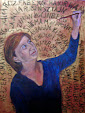
mid-90s.  Against the backdrop of nursing home chatter and frequent beeps from residents, she told us of her life and her experience teaching young children. Behind her is an image of her as a young woman reading a book that had special significance in her history. During our first interview she sang her favorite Yiddish song for us, also one of mine. Oyfn Pripetchik (At the Fireplace) is a song about a teacher, a rabbi, who is teaching young children the Yiddish alphabet. You can find the song at this link.  Teaching children the alphabet seemed especially applicable given our interviewee’s history.  She attends a regular Yiddish class and spoke of how much she likes the power and fire of the language, offering her latest words to stump her teacher.  In the painting I wanted to include Yiddish, especially some words from the song that related to children learning the Aleph Bes (alphabet). I’m not sure if I’ve finished this yet as I am still experimenting with how I want to represent these stories, but this is what I have thus far.

I am also continuing with my Radom Hole in Time series.  One of the things that I loved in the 1937 film of Radom was the way people walked almost into the camera creating a sense of immediacy in the viewer.  I wanted to do an image that would capture that sense.  The image on the right is the result of that effort.

Thursday, October 8, 2009

Painting at Last!

It has been a little over a month since my return from Lithuania and a lot has happened since my return. A week after I came home, my long-term partner and I married. At the beginning of the week, I had no idea that would be occurring. I spent three days planning and took advantage of the lovely September weather we were having in Minnesota to enjoy a beautiful outdoor wedding. Shortly after that we took off on another overseas flight to spend a week in Paris for our honeymoon. With the experience of Lithuania fresh in my mind, I looked at Paris through new eyes and will share some of those observations in this blog.

In between I was able to begin some of my paintings from my trip. I was sketching ideas on the plane to Paris. My blog gives me considerable material from which to glean visual imagery. One of the images that stuck in my memory was that of the trees overlooking Ponar, the killing site of Vilnius in which most of the Jews were murdered. They bore silent testimony to the horrors that occurred there. While I usually paint people, I felt compelled to try to capture the imagery of the trees overlooking the burial pits. Below I wanted something that suggested the bodies buried in the pits and decided to go with metaphor and use the letters of the Yiddish alphabet to represent bodies.(see closeup) Lying on their sides they provide a figural suggestion and unfortunately an accurate representation in that the future of Yiddish was largely buried in the pits with its speakers. Bands of upright letters spell out “Gedenken” which means “Remember” in Yiddish. As I neared the bottom of the pit I increased the size of these bands until the letters become clearly apparent. The vantage point of the viewer is from the pits looking upward, perhaps the last view of its many victims. The painting is 24" x 72".

Since my return I’ve read the book “The Ponar Diary 1941-1943 by Kazimierz Sakowicz. This book was written by a Polish journalist who lived in Ponar during the time of the murders. He observed them daily from his attic and wrote about what he witnessed, burying each page in a bottle. I was especially struck by his dispassionate tone in which he would talk about the beautiful day in the same breath as the murders. I wanted the painting to reflect that juxtaposition as well. I’m not sure if I’ve completed this painting or if I will paint out the lower section and rework it, but here’s the image thus far. Its name of course is Gedenken/Remember.

Another painting which I’ve been working on is based on the stories told in the blog entry “Storytelling”. As you may recall we visited a restaurant in Vilnius under which there is a tunnel that ran from the old synagogue behind the restaurant to outside of what was once the ghetto gates. The proprietor of the restaurant showed us the gate to the tunnel. As we stood under the starry night sky we could almost imagine the synagogue that once stood there. She also shared with us a story about an elderly man who came to the restaurant one day. He stood in front of the restaurant for a long time and then came in and asked if he could sit in a particular room, one where one wall is filled with a rack of wine bottles. He looked distressed as he sat there and she asked if she could get him some coffee. He turned to her and said, “This used to be my bedroom”. He had lived in that building when it was part of the ghetto with his mother and sisters. When he stood up to leave he said, “I won’t be back again”. Yet another story she shared with us was about when they were renovating the space late at night. They often felt and saw a presence which she felt was benign, as if it were children. She had learned that the coal chute was often a hiding place for children during the ghetto when hiding successfully meant another day of life. As we left we had told her that if she felt the presence again she should say, “Shalom Aleichem” which means “Peace be with you”.

All of those stories are reflected in my painting titled “Shalom Aleichem”. In this painting an old man is the central figure. I based the painting on an elder Lithuanian man who was attending the Vilnius Yiddish Institute. Behind him are circles within circles signifying the wine rack which gradually melts into a starry night sky. Above him is the gate to the tunnel with the tunnel leading from its lower left corner in the direction of the ghetto gates. A chute with the suggestion of a child flows into it, perhaps a recollection of the old man, perhaps a ghost-like presence.

The third painting I’ve been working on is a language painting based on one of the few buildings left in Vilnius with Yiddish writing. Below the storefront is a window on which visitors have written in Yiddish in the dust. The Yiddish was translated as “You were not killed, the nation of Israel lives”. The painting contains part of the script over the door as well as the handwritten Yiddish for “the nation of Israel lives”. In the corner is a pile of stones such as those left on tombstones to show one has visited the grave. There are images embossed into the painting that are drawn from the synagogue memorial in Riga. Unfortunately they don't show up well in a photograph.

I don't know that I would consider any of these paintings finished yet. That is always a hard call as I often am tempted to change them even when they are hanging in a show. If you are interested in seeing what I am currently working on or past work, you are always welcome to stop by studio 409 in the California Building, 2205 California St. NE, Minneapolis, MN. We are usually open from 12-5 on the second Saturday of each month along with other studios in the building.